Two friends are arguing about whether their congressman is corrupt.
One of them says: “He took $50,000 from a defense contractor right before voting for the bill that contractor wanted.” The other says: “Yeah, but he’s the only person in this district who actually fights for working people. Have you seen who he’s running against?”
These are not the same kind of statement. They’re not even arguments with each other. The first is a fact claim (did money change hands, did a vote happen). The second is a values claim (whose interests should we be prioritizing). One of them could in principle be settled by a journalist with a subpoena. The other can’t be settled at all, because it’s about what we want, not what is.
But notice that they sound like a disagreement. The two friends will leave that conversation feeling like they argued about the same thing. That’s the trick I want to talk about.
I’m going to call these Fact arguments and Values arguments, and the binary I want to explore isn’t which one is better. It’s whether you can keep them apart in your own head when it counts. Because most political talk (and most personal talk, honestly) blends them together in a way that lets us cheat. Specifically: it lets us conclude the facts we want to be true based on what we already believe should be true. And that, I think, is what most people mean when they say “ideology,” even if they wouldn’t put it that way.
Let me give you the cleanest example I can think of. You can believe that everyone deserves a living wage. You can also believe that a particular minimum wage law, set at a particular number, in a particular labor market, will increase unemployment among the people you’re trying to help. There’s no contradiction between those two beliefs. The first is a values claim about who deserves what. The second is a factual claim about how an economy responds to a policy intervention. They live in different rooms.
The problem is that almost nobody actually keeps them in different rooms. What we do instead is something more like: “I value workers, so the minimum wage must be good for them, so anyone telling me it raises unemployment must be lying or a shill or simply has the values wrong.” We collapse the factual question into the values question, and we do it because it’s easier. (It’s also more enjoyable. Holding two things at once that point in opposite directions is genuinely uncomfortable, and most of us are not Russian novelists.)
This goes the other direction too, obviously. You can believe in personal responsibility as a value and still recognize that childhood lead exposure causes measurable IQ drops. You can think your country’s military intervention was morally justified and still acknowledge that it didn’t work. You can love your dad and notice he’s an alcoholic. The values don’t determine the facts. They never have. We just keep pretending they do because the pretense is so comforting.
The pretense is the whole problem.
I hate doing the “here’s a thing everyone does wrong” move because it’s always smug, but I’m going to do it here, because the move is so universal that I’m clearly doing it too, and the only way out is to name it out loud. Try this: pick a political position you hold strongly. Now ask yourself, honestly, whether you would change your vote if a specific empirical claim turned out to be wrong. Most people can’t even formulate the question. The empirical claim and the political position have fused in their head. There’s no daylight between them. (If you find that you can formulate the question, congratulations, you are about to lose every argument you ever have at a dinner party.)
Here’s the actual cost of fusing them: you become unable to tell when your side is losing. You can’t update on bad news because the news, if true, would mean your values were wrong, and your values can’t be wrong, so the news must be false. This is what people mean when they say someone is “in a bubble,” but it’s worse than that. A bubble is what happens to the information. Ideology is what happens to the person.
Anyway. Let’s get into it.
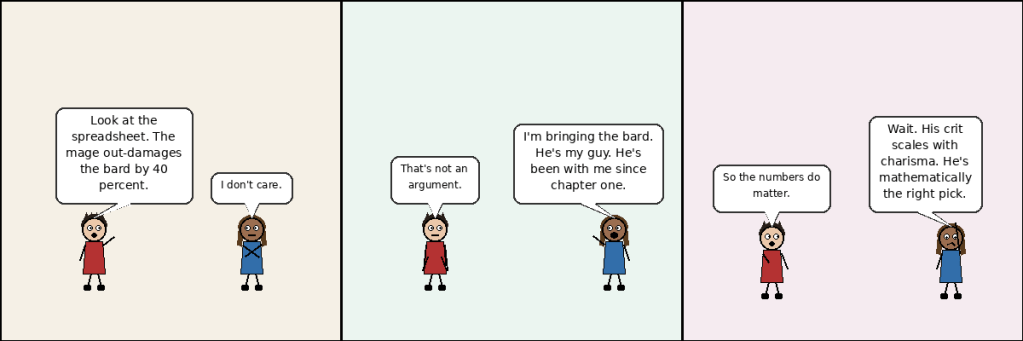
Let me explain the trick.
The trick isn’t that people argue about facts. The trick isn’t that people argue about values. The trick is the third thing, the bastard child, the move where you weld a factual claim and a values claim together so tightly that pulling on one yanks the other, and now neither can be checked, because checking either one feels like an attack on the whole soul of the speaker. That’s the trick. That’s what ideology is. The other two are just arguing.
Most people think ideology is “having strong opinions.” It isn’t. Plenty of people have strong opinions about facts (the earth is round, the bridge will hold) and plenty have strong opinions about values (cruelty is bad, dignity matters). Those people aren’t ideologues. Those people are just awake. An ideologue is someone whose factual beliefs and value commitments have been fused into a single load-bearing structure, where the facts are recruited to defend the values and the values are recruited to defend the facts, and any attempt to separate them is treated as treason.
I want to be precise about this because the people who first hear it tend to mishear it. I am not saying that caring about values is the disease. Caring about values is the immune system. Caring about facts is the immune system. Either one alone, held openly, is fine, and most of the people I respect care passionately about both.
The disease is the weld. The disease is the moment your values reach out and grab a factual claim and refuse to let it go, so that disagreeing with the factual claim becomes indistinguishable from disagreeing with the values, and the factual claim can never be tested again because every test now feels like an assault on your soul. You can have all the values you want. Just don’t let them eat the facts.
The con works because separation is exhausting. It is genuinely tiring to hold “I want my country to do well” and “my country just lost a war” in the same head at the same time. Most people, given a choice between cognitive labor and a comforting lie, take the lie. I am not pretending I’m above this. I’m a guy who has held political beliefs for years that I never really pressure-tested, because pressure-testing them would have meant losing arguments with people I liked, and losing arguments with people I liked would have meant losing the people. We all do it. The difference is whether you know.
A taxonomy. Forgive me. (I won’t.)
The first move is the sneaky one, what I’ll call the launderer. You start with a values claim (“we should help the poor”) and you launder it through a factual claim (“raising the minimum wage helps the poor”) and now if anyone argues with the factual claim you can accuse them of opposing the values. They didn’t. They might be a saint who loves the poor and just thinks your specific policy will throw fifteen percent of them out of work.
But you’ve laundered the value through the fact, and now the fact is wearing a halo, and shooting at it looks like shooting at the halo. This is how you get arguments where one person is doing economics and the other person is doing theology and they think they’re having a conversation.
The second move is the retreat, which is the launderer running backwards when caught. You said something factual. The fact got embarrassed. So now you say you were really making a values claim the whole time, and how dare anyone reduce a values claim to mere empirics.
“We need to deport everyone here illegally because they commit crimes at higher rates” turns into “we need to deport everyone here illegally because the rule of law matters,” somewhere around the time the crime statistics show the opposite. “Universal healthcare will save money” turns into “healthcare is a human right” the moment a Congressional Budget Office report disagrees. The retreat is impressive footwork, like watching a dancer pretend the stumble was choreography.
Both directions, all the time, every faction. I am not picking on a side. There is no side that doesn’t do this. The sides are largely defined by which retreats they execute most gracefully.
The third move is the lock, and the lock is the worst, and the lock is what Eco was writing about.
Umberto Eco wrote an essay in 1995 called “Ur-Fascism,” about the fascist regime he grew up under, listing fourteen features of what he called eternal fascism. Not the specific historical movement but the recurring shape of the thing, the structure that keeps showing up under different names and different costumes. Read it. I’ll wait. Most of the features are what you’d expect (cult of tradition, fear of difference, appeal to a frustrated middle class) but buried in the list is the one that matters most for what we’re talking about, and Eco doesn’t even number it as the most important. He just slips it in.
Disagreement is treason.
In Ur-Fascism, “the only truth is to act,” which means thinking is suspicious, which means anyone who tries to separate the empirical from the moral is a saboteur. The movement does not hold beliefs that can be tested. It holds a single fused thing (a vision of who we are and what is true and what we owe each other) and to pull at any thread is to attack the whole tapestry.
There is no “I share your values but disagree with your strategy.” There is no “the policy is good but the data is bad.” Every disagreement is total, because every belief is total, because every fact is a values claim wearing a costume.
This isn’t just fascism. Fascism is just the purest form. Eco was clear about that (he called it Ur-Fascism, eternal fascism, because the structure recurs). The rationalist forum that excommunicates anyone questioning a forecast. The activist movement that treats methodological critique as bigotry. The religious community where doubting a historical claim is doubting God. The economics department where questioning the model is questioning the market. All of them running the same play. All of them, when you press, denying that they’re running it.
Here’s what the lock costs you, and this is the part nobody wants to hear, because admitting it costs you the comfort of the lock itself. It costs you the ability to lose.
You can’t notice you’re losing, because losing would mean some claim attached to your values was wrong, and you can no longer separate the claim from the values, so any sign of being wrong feels like an assault on everything you care about, and the assault must be a lie, planted by enemies. The lock makes you defeat-proof in the only way that matters. It makes you unable to perceive defeat. Which is also unable to perceive reality. Which is also unable to course-correct. Which is also, eventually, unable to function. The lock kills you in slow motion and the last thing it kills is your awareness that you’re dying.
I know about this from the inside. I have been the person on the other side of someone else’s lock. Most people who write online have. You share the values. That’s not the issue. You share the values and then you ask whether one of the empirical claims attached to those values is actually true, and you watch the room reorganize itself around the proposition that you must have always been a bad person, because the empirical claim and the values had been welded for so long that nobody in the room could tell which was which anymore, and pulling on the empirical end felt to them like pulling on the values end. They weren’t lying. They genuinely couldn’t see the seam. Hello. I waved.
The fact and the value were welded. “He said the wrong thing” was a fact, “the wrong thing is wrong” was a value, and welded together they meant I was a wrong thing, and the wrong thing being banished was wisdom. None of it could be examined. To examine the fact was to attack the value. To attack the value was to attack the people who held it. To attack them was to be an enemy.
So I became one, in the only way available, which was to keep saying the thing. The lock turned me into what it needed me to be in order to keep functioning, which is, by the way, the second thing locks do. They produce the enemies they require.
And here is the part that makes the weld so hard to spot, which is that the facts inside the weld are almost never the kind of fact you can look up. They are not “this senator took fifty thousand dollars from the Hamburglar.” They are not “the bridge has held for fifty years.” They are something else, a third species of claim that wears the costume of a fact but operates more like a creed.
They are claims about how the world works.
Bad people get punished. Hard work is rewarded. Pollution ruins the planet. A show of strength makes your enemies back down. Free trade lifts everyone. Tax cuts pay for themselves. Education breaks the cycle. Markets find the right price. Love wins. Truth wins. The arc is long, but it bends. Those are not values. They sound like values. They are not values. They are predictions, dressed up as values, about what the universe does in a given set of circumstances.
The reason they fool people, including the people making them, is that each one is half a values claim and half a factual claim, glued together with so much old paint that you cannot pry the halves apart with a knife.
“Hard work is rewarded” is a moral wish (people who work hard deserve to be rewarded) and a causal forecast (in fact they are, in our actual economy, on average) and the two have been welded since you were five years old, since your mother explained why the kid in the picture book got the apple. You believe the moral part. Fine. You should believe the moral part. But you are also believing the causal part, and the causal part is a claim about labor markets and inheritance and zip codes, and you have not checked it, because you cannot tell that there is anything there to check.
This is the trap. Not “this senator is corrupt” versus “this senator is good.” Those are easy. Those are facts you can in principle look at. The trap is the thousand quiet sentences underneath every political position you hold that have the shape of a value but the substance of a forecast.
“Letting people choose freely will lead to better outcomes.” Read that one slowly. There is a values claim in there: people should be free to choose, autonomy is good, paternalism is degrading. There is also a factual claim in there: when people are free to choose, outcomes get better. Better by what measure? In which domains? On what timescale? Compared to what alternative? You don’t know. Nobody who says the sentence knows. The sentence is not designed to be checked. The sentence is designed to make the values feel like they are riding on a track laid by physics, so that questioning the track sounds like questioning the values.
“Disorder breeds violence.” Same shape. “Hate speech leads to real violence.” Same shape. “If we don’t stand up to them now, they will only get bolder.” Same shape. “More guns in good hands means fewer crimes.” Same shape. “Visibility creates acceptance.” Same shape. Both sides, all sides, every side. Half the political pundits in the world get paid to issue these sentences with confidence and the other half get paid to issue the opposite ones with confidence, and neither half is actually doing forecasting. They are doing liturgy. The sentences are prayers about how the universe rewards their team.
You can tell because of how they react to falsification. When the strong response doesn’t make the enemy back down, they say just one more surge. When the free choice produces worse outcomes, they say the choice wasn’t free enough. When the deregulation produces a bust, they say the regulation that remained caused it. When the pollution doesn’t ruin the world on schedule, they say the schedule was always longer. The forecast is welded to the value, and a forecast welded to a value is no longer a forecast. It is a wheel that turns whichever way it has to turn so that the value at the center stays unmoved.
The dirty secret is that I do this too. Everyone does. I have a list of sentences I issue with serene confidence about how the world works, and if you pulled on any of them I’d find that I had no idea where the values stopped and the prediction started, because they were welded together by a teacher I respected when I was sixteen and they have been load-bearing ever since.
Sometimes I notice. Most of the time I don’t. The ones I notice are the ones a friend pressed me on hard enough that the weld cracked, and watching the weld crack is genuinely upsetting, because it turns out you don’t just lose a fact, you lose a way the world was supposed to work, and underneath there is just weather and accident and other people’s choices and no guarantee that the moral arc bends anywhere in particular.
Most people decline that experience. I do not blame them. The world with the welds intact is more livable. It is also stupider, more brittle, more prone to running you off a cliff while assuring you that cliffs don’t exist for people like you. You pick.
I am not telling you to fix this. I am not the kind of writer who fixes things. I gave up trying to fix things around the time I noticed that the people I was trying to help would have preferred I shut up. I’m just describing the shape of the con, because the con is everywhere, and pretending it isn’t is exhausting, and I am too tired to be polite about it.
The fact-values weld is not a feature of bad people. It is a feature of comfortable people. It is what comfort is made of. It is the price of not having to think too hard about whether the thing you believe is true and the thing you want to be true are the same thing, which they almost never are, because the world wasn’t built for your convenience and neither was the truth.
***
Consider the trial of Socrates, which is not the trial most people remember. Most people remember the corruption of the youth, the asking of questions, the hemlock at sundown, the noble death. What they forget is the actual indictment, which contained two charges, and the difference between them. He was accused of impiety (a question of fact: does this man honor the gods of the city) and of corrupting the young (a question of values: is what he does to them good or bad). The Athenians who voted to condemn him did not separate these charges, because nobody who is condemning anybody ever separates the charges. They felt that he was guilty, and the felt-guilt produced both verdicts simultaneously, and then the values verdict (he is bad for us) reached back through time and reorganized the factual one (he must therefore be impious), and a man drank poison because his accusers could not tell two questions apart.
Two and a half thousand years later we are still doing it. We still cannot tell two questions apart. We have built civilizations, libraries, courtrooms, peer review, double-blind studies, the entire apparatus of inquiry, and we still cannot tell two questions apart. This is the oldest failure mode and it shows no signs of aging.
The Stoics had a word for it: sunkatathesis, assent. They thought the entire moral life turned on the discipline of withholding assent from impressions until you had examined them. An impression arrives. It says: that man is dangerous. That policy is wicked. That fact is true. The undisciplined mind assents instantly, and once it has assented, it cannot unassent without admitting it was wrong, and admitting one is wrong is one of the things humans are worst at. So the assent calcifies. The impression becomes a possession. The possession becomes a position. The position becomes an identity. The identity becomes a wall, and on the other side of the wall there are people, also assenting, also calcifying, also building walls. We did not become like this through any one error. We became like this by failing, ten thousand times in a row, to pause before assenting.
Plato has a phrase, in the Phaedrus, that I keep coming back to: the discipline of carving nature at its joints. He’s talking about division as a method, the way a butcher separates a carcass not by hacking through the bones but by finding the place where the bones already articulate, the place the body itself proposes for cutting. The good philosopher, like the good butcher, does not cut where it is convenient. He cuts where the joint is. He cuts where the bone divides.
Most of what we do, when we argue, is cut wrong. We slice off the part that would expose us and call the rest the whole. We separate the things that ought to be separated only when the separation flatters us, and we fuse the things that ought to be distinguished whenever the fusion strengthens our position. The factual question and the values question are different bones. They articulate at a joint that almost nobody finds, because finding it requires admitting that the position you currently hold might survive only one of them, and admitting that is, for most of us, more than the soul can presently bear.
What I am asking, in the end, is for an act of butchery that the soul resists. To take a thing you believe and divide it into the part you believe because it is true and the part you believe because you want it to be. Not for an audience. For yourself, in private, where there is no team to defend you and no enemy to score against. The Egyptian dead, in their long passage through the underworld, were said to have their hearts weighed against a feather, and the feather was the feather of ma’at, which means truth and order and balance and the way things actually are. The hearts that weighed too heavy with self-deception were eaten.
The light is going down. The scale is waiting.
TAMAR CODEX and GALIT CODEX, in the Tower Codex commons, arguing over whether to retire the old marching song “The Three Bells of Mordecai.”
GALIT: We have to retire it. We can’t keep singing it.
TAMAR: Can I ask why?
GALIT: Because the second verse is about killing peasants.
TAMAR: I’m not sure it is, though.
GALIT: “And down went the small ones, three by three.” Tamar. Three by three. The bells go three by three. The peasants go three by three. It’s not subtle.
TAMAR: Right, but I think “the small ones” is a kenning for the bells themselves. The bells are small relative to the great bell of the cathedral. They go three by three because the song is about the peal pattern. There’s a fifteenth-century gloss that says…
GALIT: I do not care about the fifteenth-century gloss.
TAMAR: No, I know. I’m just saying that whether the song is about killing peasants is a separate question from whether we should sing it.
GALIT: Why is it separate?
TAMAR: Because if it’s not about killing peasants, the case for retiring it changes. You’d still have the case that people think it’s about killing peasants, which is real, but that’s a different case. That’s a case about reception, not about the song.
GALIT: The case about reception is the only case. The song is what it does in the world. Right now, in the world, it makes people think about killing peasants. That’s what the song is.
TAMAR: That’s actually a coherent position. I don’t agree with it, but I want to register that you’ve just made a values argument, not a factual one. You’re saying: regardless of what the song means, we should retire it because of what it produces. That’s fine. That’s an argument we could have. But two minutes ago you were saying the song is about killing peasants, which is a factual claim, and now you’re saying it doesn’t matter what the song is about, which is a values claim. You can’t have both.
GALIT: I can have both because they both lead to retiring the song.
TAMAR: They lead to retiring the song now. They don’t lead to the same place if the facts change. If a tenth-century manuscript turned up tomorrow that proved the song was about cathedral bells, your fact argument would collapse and your values argument would still stand. So you should pick the values argument and stop pretending you care about the manuscript.
GALIT: What if I care about both.
TAMAR: Then you should be willing to update one when it loses and keep the other one. You’re not. You’d retire the song no matter what the manuscript said. So the manuscript wasn’t doing any work for you.
GALIT: Fine. The values argument. We retire the song because it produces harm.
TAMAR: I want to ask whether it actually produces harm. That’s a fact question.
GALIT: Tamar.
TAMAR: I’m not being difficult. I want to know. Is there a peasant who has been hurt by the song?
GALIT: People are upset.
TAMAR: Upset is a real thing, but it’s not the same as harm, and conflating them is going to cost you when somebody disagrees with you who isn’t your friend. If your case is “people are upset,” somebody will eventually say, “I’m upset that you retired the song,” and then you’re just counting upsets, and you’ll lose, because there are more people who like the song than people who don’t.
GALIT: So I’m supposed to do nothing.
TAMAR: You’re supposed to make the actual argument you’re making, which is: “I think this song represents something I want our culture to move away from, and I’m willing to upset people who like it, because the values are more important than the comfort.” That’s a real argument. It’s a values argument and you should make it as a values argument.
GALIT: That’s what I’ve been saying.
TAMAR: It is not what you’ve been saying. You’ve been saying it’s about peasants. You’ve been saying it produces harm. You keep reaching for facts because the facts are easier to defend than the values. But the values are what you actually care about, and you should defend them in the open instead of letting them hide behind a bunch of empirical claims that you’d abandon the moment they stopped being convenient.
GALIT: You’re being insufferable.
TAMAR: I know. I’m sorry.
GALIT: No you’re not.
TAMAR: A little. (Pause.) Look. If you came to me and said: “Tamar, I think the song is fine as a piece of music and I don’t think it harms anyone, but it represents an era I want our Tower to leave behind, and I want us to retire it as a symbolic act,” I would vote with you. I would. The values argument is one I can hear. The mixed-up argument I can’t hear, because every time I push on a piece of it the piece falls down and you grab a different piece, and after a while I don’t know what I’m being asked to agree to.
GALIT: You vote with me?
TAMAR: I vote with you on the values argument. I want it to be the values argument. I want it on the record that we retired the song because we decided to, not because we proved something we couldn’t prove.
GALIT: That sounds bad in a speech.
TAMAR: It sounds honest in a speech. Those aren’t the same thing.
GALIT: (long pause) What if I just sang it wrong on purpose for the rest of my life.
TAMAR: That’s a third option.
GALIT: I’m taking the third option.
TAMAR: Galit.
GALIT: I’m taking the third option, Tamar.
Further reading
- Ideology is Comfort: argues that the function of ideology is to comfort the believer by ensuring uncomfortable questions never get asked.
- What is Ideology: defines ideology as the inseparable fusion of factual claims and values claims, treated as a single unit.
- I Wish My Enemies Were Right and I Was Wrong: the diagnostic for ideology: would you rather your side were wrong about something, or your enemies right? Most people can’t bear either.
- Dumb Things To Believe: on the empirical claims people pick up because their team holds them, not because they’ve thought about them.


Leave a Reply