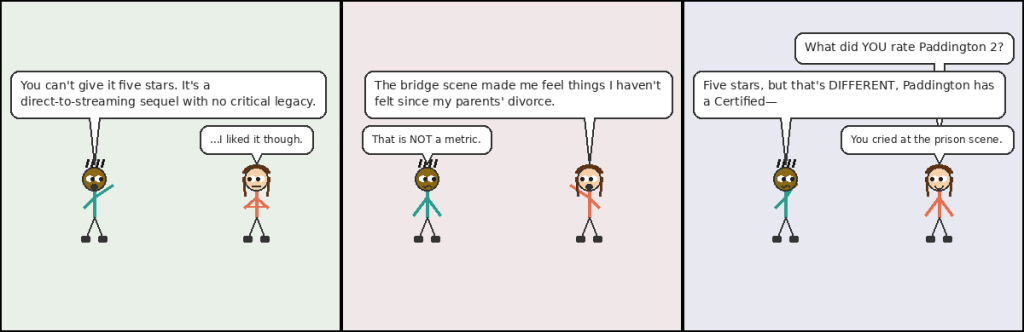
There are, if you really get down to it, only two ways to think about whether something is any good.
The first way is the way you were trained to think about it, whether or not you were ever actually trained. You absorbed it. You breathed it in through the cultural atmosphere like secondhand smoke. It goes something like this: a work of art exists within a network of other works, and of people who have opinions about those works, and of institutions that bestow or withdraw legitimacy from those opinions, and all of this together constitutes a kind of floating parliament of taste in which your individual vote counts for basically nothing. The painting means what it means because of the other paintings. The novel succeeds or fails on grounds that were established by other novels, and by the critics of those novels, and by the graduate students who wrote dissertations on the critics of those novels, and by the algorithms that surface certain dissertations and bury others.
Everything signifies. A particular chord progression signifies “indie rock” or “dad rock” or “coffee shop” depending on when it was deployed and by whom and how many people on the internet agreed about it afterwards. In this framework, which I will call the Parliament because I need to call it something, art is essentially a language. It has a grammar. There are correct and incorrect usages. You can be fluent, or you can mangle it, and the people who are fluent will know you’ve mangled it and will wince, very slightly, in a way that communicates to everyone else who is fluent that wincing was the appropriate response.
This is not a stupid way of thinking. It accounts for quite a lot. It explains why Duchamp’s urinal is art and the urinal in the pub down the road isn’t, which is a question that has bedevilled thirteen-year-olds and contrarian newspaper columnists for roughly a century. (The answer is: context, referent, institutional framing, the gallery wall as a speech act. You knew this already.) It explains why a forgery can be chemically identical to the original and still worth nothing.
It explains why Bob Dylan getting the Nobel Prize made some people furious and other people smug, and why the fury and the smugness were both, in their way, appropriate responses to what was essentially a border dispute between two adjacent parishes of the Parliament. It’s the way almost everyone who writes about art professionally thinks about art, even when they pretend otherwise, because the alternative is to say things like “I just thought it was neat,” and you can’t file seven hundred words of “I just thought it was neat” and expect to keep your column.
The Parliament has rules. It has case law. It has precedent. When you walk into a gallery and see a canvas that’s been painted a single shade of white, the Parliament is what tells you whether to be bored or to feel the luminous hush of the void pressing against the back of your skull. Probably it tells you to be bored, actually, because by now there have been too many white canvases and the move has been absorbed into the general lexicon, but the point is that your boredom is itself a function of the network. You’re bored because the gesture is legible. You’ve read it before. This is what people mean when they say something is “derivative,” which is the most Parliamentary word in the English language: it means you can trace the derivation, you can see the wires, the thing that once signified “rupture” now signifies “design.”
Fine. All of this is fine.
But there’s another way.
The second way is harder to describe because it is, almost by definition, the thing that resists description. It is the experience of encountering a work of art — or, more dangerously, a work of entertainment, or a work of what other people have confidently identified as garbage — and feeling something happen inside you that has nothing to do with the network. Something that doesn’t care about derivation, that can’t be traced to an institutional origin, that isn’t a position you’re adopting within a field of positions. You just felt it. It went through you.
The film that everyone says is commercial slop, the mass-produced franchise entry with the $200 million budget and the AI-assisted colour grading and the plot that was obviously reverse-engineered from audience testing data — you sat in the dark and something in it got you right in the sternum and you can’t explain why, or rather you can explain it but only in terms that sound like you’ve had some kind of episode. I will call this one the Encounter, because it is fundamentally about two things meeting each other without mediation.
The Encounter is suspicious. The Parliament is right to be suspicious of it. People who talk exclusively in the language of the Encounter tend to be either very young, very stoned, or trying to sell you something. The Encounter is how the entertainment industry wants you to relate to its products, because the Encounter doesn’t care about quality; it cares about intensity. The Encounter is what happens when a thirty-eight-year-old man cries at a Marvel film and then posts about it online, and everyone has to pretend this is a normal and acceptable thing that happened instead of a species-level warning sign.
The Encounter is easily manipulated. Music swells, the camera pushes in, the lighting goes amber, and your dopaminergic system does what it evolved to do in the Pleistocene, which is respond to stimuli, and you feel moved, and you mistake being moved for being in the presence of something meaningful. The entire history of propaganda is the history of engineering Encounters.
So the Parliament has very good reasons for distrusting the Encounter. The whole apparatus of criticism, the whole enormous whirring machinery of taste and distinction and takes and countertakes, exists in large part to protect you from the Encounter, which is to say: to protect you from your own credulity, your own animal susceptibility to being told a story in a dark room.
The Parliament says: do not trust what you feel. Or rather: what you feel is itself a product of structures, and those structures can be analysed, and once they’ve been analysed they lose their power over you. This is essentially the Enlightenment applied to aesthetics. Free yourself from the tyranny of your own responses.
I think this is right, mostly. I think it’s true that most of what passes for genuine aesthetic experience is in fact a kind of elaborate neurological grift. I think it’s true that if you sat down and really honestly anatomised the last time you cried at a film, you’d probably find that what made you cry was not the film but the fact that the film reminded you of a time when you were capable of being made to cry by things that actually mattered, and so really you were crying at your own diminished capacity for feeling, which is a very boring thing to cry about.
And yet.
And yet I have this memory, and I don’t entirely know what to do with it, of sitting in a cinema in — I think it was 2014? 2015? — watching something that I won’t name, because naming it would immediately activate the Parliament, and the Parliament would render its verdict, and the verdict would be “no,” and my memory would be buried under the verdict like a cat under a landslide. It was a film that nobody I knew had any respect for. The reviews were polite at best. The discourse, insofar as there was any discourse, had already moved on to something else.
And there was a scene — I’m not going to describe the scene either, because the scene doesn’t work in description, it only works in the dark, at that particular speed, with that particular score, in that particular state of unknowing — and I understood something, or felt that I understood something, which is not the same thing but might in certain circumstances be better. I felt that the film was trying to say something that could only be said by a thing that nobody took seriously. That its commercial indifference to its own seriousness was precisely the condition that allowed it to be serious in a way that respectable art could not. As if seriousness were a kind of contraband, and the only way to smuggle it past the border was inside something that looked, from the outside, like product.
I am aware that this sounds like cope. This is exactly what the Parliament would say: you’re aestheticising your own bad taste. You liked a dumb film and now you’re performing twelve layers of irony and sincerity to avoid admitting that you liked a dumb film. And they’d be right to say it! They’d be right! There is an entire subculture of people who have turned “actually, the thing you think is bad is good” into a personality, and most of those people are annoying. I know this because I’m sometimes one of them.
But there is a difference — I think there is a difference — between the person who defends a bad film because defending bad films makes them feel interesting, and the person who sits alone in the dark and recognises something. The recognition is the key. It’s not that the film is “secretly good” by the Parliament’s own standards. It’s not that you’ve detected hidden depths that the critics missed. It’s that the film did something to you that the Parliament’s standards are not equipped to measure. It landed in a part of you that has no representation in the floating parliament of taste. And you can’t prove it. You can’t write a convincing essay about it, because the essay would have to be written in the Parliament’s language, and the thing you’re trying to describe is precisely what that language was designed to exclude.
This is where it gets difficult.
Because the honest thing to say is that both of these are real, and they are genuinely in conflict, and the conflict cannot be resolved. The Parliament is right that the Encounter is unreliable. The Encounter is right that the Parliament is airless. The Parliament produces brilliant criticism and dead art. The Encounter produces living art and terrible criticism.
When the two agree — when a film is both institutionally legible and immediately overwhelming — we call it a masterpiece, and then we build a little shrine around it and kill it with reverence. When they disagree, which is most of the time, we get the strange, low-level hum of aesthetic bad faith that characterises almost all contemporary culture: people who know what they’re supposed to like, people who like what they’re not supposed to like, people performing opinions they don’t hold, people holding opinions they can’t perform.
And I’m not going to resolve it. I refuse. Both sides have asked me to adjudicate, and I am recusing myself from the case on the grounds that the case is a trap.
The moment you pick a side, you become the thing the other side warned you about. Pick the Parliament, and you become a person who has replaced the capacity for experience with the capacity for commentary — someone who can tell you exactly why a film is good without ever having been touched by it, a kind of aesthetic corpse, very articulate, very well-read, very dead. Pick the Encounter, and you become a rube, a mark, a sentimentalist who calls things “powerful” and can’t tell the difference between being moved and being manipulated — which, again, is a difference that might not exist, which is the whole problem.
I had the two of them set up in my mind like boxers in their corners, or like the prosecution and the defence, or like two people at a dinner party who are clearly about to have an argument that ruins the evening for everyone. I had the whole thing mapped out. The Parliament says this, the Encounter says that, they’re both right, they’re both wrong, nobody wins, go home.
But something happened.
I was trying to think of an example. A concrete example, a work of art that could serve as the test case, the disputed territory where the two frameworks clash. And I thought of several. I thought of the usual suspects. But the more I thought about it, the less the frameworks mattered, because what I was actually remembering was not a position on a work of art but the work of art itself, and the memory of it was doing the thing it had always done, which was to bypass everything I had set up to receive it. It came in through the side door. It ignored the seating plan. And suddenly I wasn’t thinking about how we judge things. I was thinking about the things themselves.
There’s something underneath both the Parliament and the Encounter. Something that is not a way of judging, but the reason judgment exists at all, the original problem to which both of these are imperfect and probably doomed solutions.
It’s the problem of the fact that things exist, and that some of them are beautiful, and that beauty is not a category or a feeling but a kind of event that happens between you and the world, and that when it happens you’re not a critic and you’re not a consumer and you’re not a person with opinions, you’re just a creature in the path of something.
I don’t mean beauty in the gift-shop sense. I mean it in the old sense, the terrifying sense, the sense in which beauty is closer to violence than to pleasure. The Greeks had a word for it — they always do, the smug bastards — which was thambos, astonishment, the sacred stupor that hits you when you see something that shouldn’t exist but does. It’s the thing that makes you stand still. Not the thing that makes you reach for your phone, or for a vocabulary. The thing that makes you stand still and be, for a second, nothing but a pair of eyes. Or not even that. A surface for the world to write on.
The Parliament and the Encounter are both, ultimately, ways of managing this. Ways of not being destroyed by it. The Parliament manages it by turning it into language, into social relations, into a system of references that can be navigated and mastered. The Encounter manages it by privatising it, making it a personal experience, something that happens inside you and belongs to you. Both of them are trying to take something that is fundamentally uncontrollable and make it safe.
And I understand why. I understand the impulse. The alternative is to stand in front of the thing and let it do whatever it’s going to do to you, which might be nothing and might be everything. The alternative is to admit that your entire apparatus of taste — the films you’ve ranked, the albums you’ve rated, the mental map of culture you’ve spent your whole life constructing like a coral reef, one tiny accretion at a time — is a defense mechanism. Against what? Against the possibility that something might actually reach you.
I’ve spent — how many words now? Several thousand — setting up a neat dichotomy and then watching it dissolve, which is the sort of thing I do, and which I’m told is annoying, and which I will continue to do regardless, because the dissolution is the point. It was always the point. The two courts exist, and they are real, and they are in genuine conflict, and neither of them is adequate to the thing they’re fighting over, which is the brute stupid gorgeous fact that a particular arrangement of sounds or shapes or words or moving images can reach into the animal centre of a human being and rearrange something. Not teach. Not persuade. Not represent. Rearrange.
We have been trying to explain this for about forty thousand years, which is roughly how long people have been making art if you count the cave paintings at El Castillo, which I do, because the hand that pressed itself against the rock wall and blew pigment around its own fingers was doing something that no framework can contain. It was not making a statement. It was not participating in a discourse. It was not signalling tribal affiliation or storing information for future generations, although it may also have been doing all of those things. What it was doing, at its core, at its unspeakable and unreachable core, was saying: I was here, and I saw something, and I wanted the wall to know.
And the wall didn’t judge it.
I keep coming back to this. The wall didn’t judge it. The wall accepted the hand, the pigment, the breath, the dark. It didn’t ask whether it was derivative or original, whether it was critically acclaimed or commercially viable, whether the artist was being sincere or performing sincerity. The wall was not a Parliament and it was not an Encounter. It was a wall. It received the mark. And the mark has lasted forty thousand years, which is longer than any review, and longer than any feeling, and longer than any of us will last, and I think maybe that’s the only thing about art that actually matters: not how we judge it but the fact that it was made at all, in the dark, by someone whose name we will never know, for reasons we will never fully understand, on a wall that was not expecting it and did not ask for it and has kept it anyway, all this time, without being asked.
 Alt Binaries
Leave a comment