[Author's note: I decided to move to a three post a week schedule (MWF) for the first two weeks. After the first six posts, I will return to MTh.]
“The strong do what they can, and the weak suffer what they must.”
(Thucydides, who was having a bad day)
The word “agentic” has escaped the tech industry and is now loose in the wild. You see it in LinkedIn bios and self-help threads and the kind of podcast where a guy in a baseball cap tells you that your failures are a mindset problem. “You can just do things,” the agentic whisper goes. Your job is boring? Start a side project. Want to live in a castle? Land is cheap in Portugal. There is surprisingly little you actually need permission for.
There’s something genuinely thrilling about this. It’s also the exact same pitch used by every multilevel marketing scheme in history.
Because here’s the opposite framing, which is equally true: your entire life was substantially determined before you were born. Your parents’ zip code predicted your SAT score. The economy you graduated into shaped your career more than your resume did. Your brain chemistry is not something you chose at a character creation screen. You were, in many measurable ways, dealt a hand and then told to smile about it.
We have a nice word for when something isn’t your fault. Innocence.
(I hear in VC interviews they ask founders if they are “agentic or mimetic.” As if there could be anything more mimetic than answering agentic because it’s the answer you know they want to hear.)
Agency versus Innocence. Two words that are both, on their face, desirable. Nobody wants to be described as lacking agency. Nobody wants to be guilty. And yet the two perspectives are almost completely at odds, and most people lean hard toward one without ever noticing they’ve chosen.
The Agentic person looks at a failed business and asks what the founder did wrong. The Innocent person looks at the same failure and asks what structural forces made it inevitable. Both of them are usually correct. Neither of them finds the other’s answer satisfying even a little bit.
This binary shows up everywhere once you start looking. Nietzsche called them herrenmoral and slavenmoral (he was a terrible marketer). Psychologists split them into internal and external locus of control. The Exploring Egregores blog mapped them onto the Lovecraftian twin gods Yeb and Nug (yes and no, optimism and fatalism, the pyramid scheme and the subreddit). I find “Agency” and “Innocence” more useful because neither word sounds like an insult. Though give it time.
The existing terms are all pre-loaded. “Master morality” makes you think of Nazis, even though the person most likely to be destroyed by their own agency is themselves, not some oppressed underclass. “Victim” makes you think of weakness, even though solidarity among the wronged has toppled more regimes than any lone wolf ever has. The connotations steer you toward picking a side before you’ve even understood what the sides are.
The failure modes are symmetric and predictable. Too much Agency and you’re the founder burning through your spouse’s credit cards on a doomed app because you believed hard enough. You’re the fitness influencer who tells a clinically depressed person to just get up earlier. You’re the gambler on a streak. Too much Innocence and you’re the person with a graduate degree and a podcast about why it’s pointless to try, who hasn’t applied for a job in eight months because the economy is “structural.” You’re the gaming subreddit that escalated from mild critique to full existential outrage because a sequel was on mobile phones. Both of these people exist. You probably know one of each. (You might be one of each, depending on the topic.)
And that parenthetical is the whole point. People are not all one or the other. On most days you’re some mixture, and the mixture shifts depending on whether you’re talking about your career, your relationships, or your Elden Ring playthrough. The question is not “which one are you.” The question is which lens is useful right now.
There’s a reason I’m putting these up as tools and not identities. You are not an Agentic Person or an Innocent Person. You are a person who sometimes needs to grab the wheel and sometimes needs to forgive yourself for the crash. Agency is fire magic: it gets things done and it burns the caster. Innocence is ice magic: it protects you and it freezes you in place.
Innocent people are more often right. Agentic people are more often happy.
Make of that what you will.
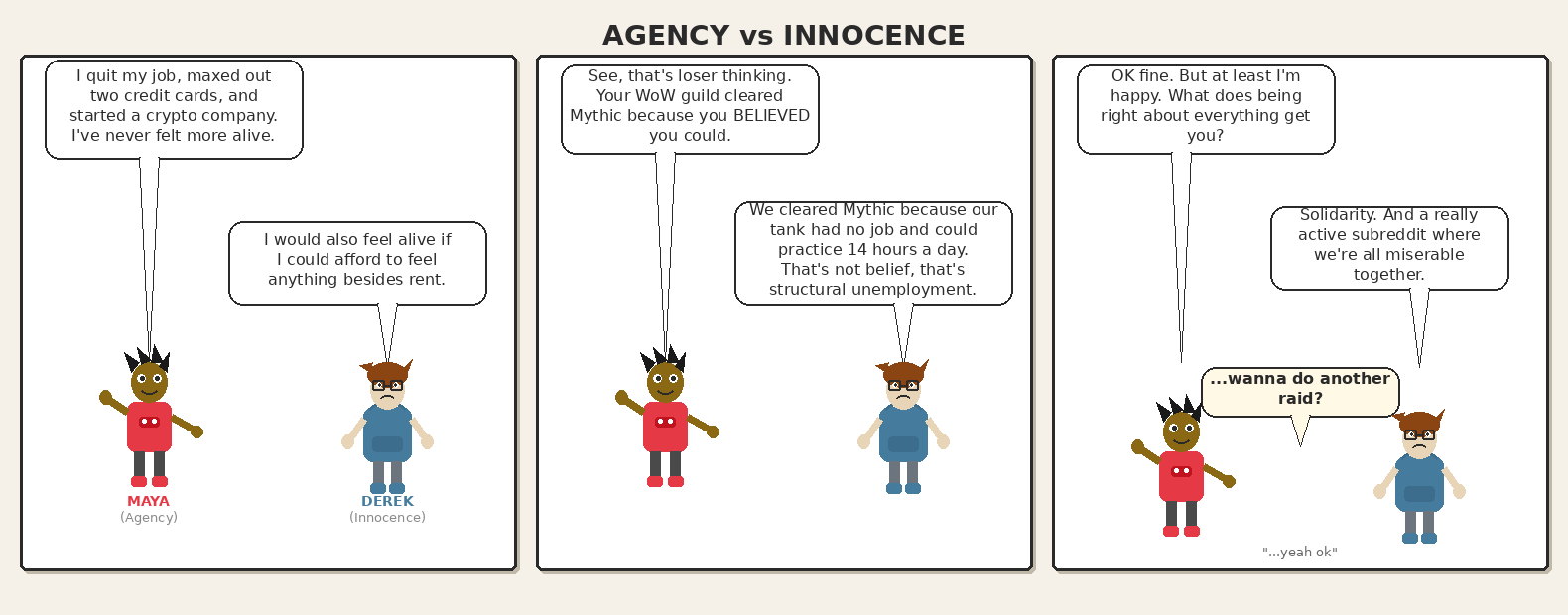
Imagine two people sitting next to each other at a bus stop. They went to the same high school, graduated the same year, similar grades. One of them now runs a small business that does reasonably well. The other works a job they don’t love and is behind on student loan payments.
If you ask the business owner to explain the difference, you will hear a story about choices. They took a risk. They worked weekends. They saw an opportunity and they seized it. If you ask the person with the student loans, you will hear a different story entirely: about a parent who got sick, a recession that hit at the wrong time, an industry that automated their first career out from under them. These are not just two explanations. They are two completely different theories of how the world works.
The Agency theory says: people are the primary authors of their own outcomes. Your decisions, effort, courage, and discipline are the main variables. The world presents obstacles, sure, but obstacles are what you see when you take your eyes off the goal. Pull yourself together. Make a plan. Execute.
The Innocence theory says: people are largely shaped by forces beyond their control. Economics, biology, family, geography, timing, luck. Individual effort matters, but it operates within constraints so powerful that pretending otherwise is not just wrong, it’s cruel. The lottery of birth is the single biggest predictor of where you end up. Everything after that is marginal.
Both of these are empirically supportable. That’s what makes the binary interesting rather than just another internet argument. The research on “locus of control” broadly finds that people who believe they control their outcomes (internal locus) tend to achieve more, earn more, and report higher life satisfaction. But the research on social mobility, economic stratification, and behavioral genetics finds that your parents’ income, your country of birth, and your neurochemistry predict your life outcomes with an accuracy that should make any “just believe in yourself” rhetoric feel a little obscene.
So we have two true things that point in opposite directions. Welcome to a real binary.
One way to think about Agency is as a performative belief. It may not be perfectly accurate as a description of reality, but believing it makes it more true. The person who thinks “I can affect my circumstances” will, on average, try more things, persist longer, and stumble into more opportunities. The belief generates the evidence for itself. This is what the growth mindset research is (roughly, controversially) about. It’s also what every motivational speaker is selling you. The placebo effect, but for your whole life.
And it works! Up to a point.
The point at which it stops working is fascinating, because it’s the point where Agency curdles into something genuinely destructive. Consider the trajectory: you start a business because you believe in yourself. It struggles. Agency says: push harder. It still struggles. Agency says: you’re not believing hard enough. You take on more debt. Agency says: winners don’t quit. You mortgage the house. Your spouse is begging you to stop. Agency says: they just don’t understand the vision.
This is not a hypothetical. This is the documented pattern of MLM recruitment, of startup culture burnout, of gambling addiction, of certain strands of evangelical prosperity gospel where illness is reframed as insufficient faith. The Agency framework has no native concept of “sometimes you lose because the game was unwinnable.” Every loss is reinterpreted as a failure of will. And if you’re the one who failed, well, you must not have wanted it enough.
The cruelty is quiet. It presents as encouragement.
The podcast “The Dream” documents this in excruciating detail with multilevel marketing schemes. The pitch is always Agency: you are special, you can do this, you deserve financial independence. The failure is always reframed as more Agency: you didn’t work hard enough, you didn’t recruit enough people, you let negativity into your life. At no point does the system ever admit that the structure was designed so that most participants would lose money. To admit that would be to allow Innocence into the room, and Innocence is the one thing a pyramid scheme cannot survive.
So Agency has built-in defenses against its own correction. It calls doubt “loser thinking.” It treats structural analysis as defeatism. If you point out that most small businesses fail, you’re a hater. If you note that generational wealth predicts outcomes better than effort, you’re making excuses. The immune system of the Agency worldview is: anyone who disagrees with me is simply less courageous than I am.
Now flip it.
Innocence, taken seriously, is one of the great moral engines of human civilization. It is the insight behind every social safety net, every civil rights movement, every moment a society decided that punishing people for circumstances beyond their control was barbaric. If your poverty is caused by redlining, you don’t fix it by telling people to hustle harder. If your depression is caused by a serotonin imbalance, the correct response is not a motivational poster. Innocence says: the system produces these outcomes, so fix the system.
This is, very often, correct.
And it leads to real things. It leads to solidarity: “we’ve all been screwed by the same forces, so let’s band together.” It leads to mercy: “don’t torture yourself over things that were never in your control.” It leads to structural reform: “if the bridge keeps collapsing, stop blaming the drivers and inspect the bridge.” These are genuinely good outcomes that the Agency worldview struggles to produce, because Agency is allergic to the concept that outcomes might not track effort.
The relief Innocence provides is underrated. When you’ve been grinding yourself to dust over a situation that was never actually within your power to fix, someone telling you “this is not your fault” can be the most transformative sentence you’ve ever heard. Therapists know this. Good managers know this. Anyone who has watched a friend collapse under self-blame for a layoff that was purely a spreadsheet decision knows this. Innocence can be medicine. The question, as with all medicine, is dosage.
But Innocence has its own degenerative form, and it is just as predictable. If nothing is ever your fault, then nothing is ever your responsibility, and if nothing is ever your responsibility, then nothing is ever in your power. The most pathological version of Innocence is a person who has outsourced all agency to structural forces and now waits, passively, for the structure to change. The revolution will come. The economy will improve. Someone will fix this. In the meantime, there’s a community of people online who share this analysis, and they are very, very, very angry, and none of them are doing anything except being angry together.
The Exploring Egregores blog calls this the “web of fragility”: communities where shared grievances resonate and amplify until even trivial disappointments feel like existential injustices. Anyone who has watched a gaming subreddit go from “this is a fun game” to “the developers are deliberately ruining our lives” over the course of eighteen months has seen Innocence in its advanced form. Each individual complaint might be legitimate. The collective spiral definitely isn’t.
And Innocence, like Agency, has its own immune system. It calls initiative “pulling yourself up by your bootstraps” (a phrase originally coined to describe something impossible, which tells you where Innocence lands on the subject). It treats individual success stories as survivorship bias. If you got out of a bad situation through effort, Innocence says you were lucky, or privileged in some way you haven’t noticed, or an exception that proves the rule. The immune system of the Innocence worldview is: anyone who disagrees with me is simply less aware of reality than I am.
If you’re noticing that both immune systems make the same move (my critics are epistemically inferior), that’s the pattern. They’re mirror images.
And both of them, at their worst, produce the same thing: communities of people who have stopped listening to anyone outside the group. The agentic community spirals into hustle culture where admitting exhaustion is treated as weakness, where every conversation is a performance of capability, where the most successful person in the room has the most authority regardless of whether their advice generalizes. The innocent community spirals into what I’ll reluctantly call a complaint loop: the observations get darker, the perceived enemies get more powerful, the sense of helplessness intensifies, and anyone who suggests that maybe you personally could do something about any of this is met with a wall of structural arguments that, while individually valid, have collectively become a cage.
Terry Pratchett wrote the best fictional version of the Innocence trap in his Sam Vimes “Boots” theory, which has been quoted so many times online that it’s essentially a political meme. Vimes observes that a rich man who buys fifty-dollar boots that last ten years spends less than a poor man buying ten-dollar boots every year that fall apart. This is a completely accurate observation about how poverty is self-reinforcing. It is also, if you let it become your entire worldview, a recipe for never buying any boots at all because the system is unfair.
The Vimes boots thing is brilliant because it knows when to stop. It makes a structural observation and then Vimes goes back to work. He doesn’t join a subreddit about boot inequality. He doesn’t build an identity around being a person who knows about boots. The insight serves the work rather than replacing it.
There’s a thought experiment I find useful. Imagine someone tells you their marriage is falling apart. If your instinct is “what are you doing about it?” you’re reaching for Agency. If your instinct is “that sounds incredibly hard, I’m sorry” you’re reaching for Innocence. Notice that both of these are appropriate responses. Notice also that deploying the wrong one at the wrong time is a good way to lose a friend.
Now scale that up. Your friend lost their job. Agency says: “what’s your plan?” Innocence says: “the job market is brutal right now, don’t blame yourself.” Your country is struggling economically. Agency says: “we need bolder leadership with a stronger vision.” Innocence says: “global capital has hollowed out our manufacturing base and no single leader can fix that.” A student is failing in school. Agency says: “they need to study harder and take responsibility.” Innocence says: “they need support services because their home situation is a disaster.” In every case, the right answer depends on things you’d need to actually investigate, not on which framework you brought with you to the question.
The legal system, oddly, understands this binary better than most pop psychology. Criminal law applies Agency: you chose to commit this crime, you are responsible, here are the consequences. But it carves out exceptions that are essentially Innocence claims: duress, insanity, diminished capacity, self-defense. The entire apparatus of justice is a machine for sorting actions into “you chose this” and “you couldn’t help it,” and the boundary between those two categories is where most of the interesting legal arguments happen. The insanity defense is not a loophole. It is a formal acknowledgment that Agency has limits.
Tort law does something even subtler. The concept of “contributory negligence” is a device for splitting an outcome between Agency and Innocence: yes, the truck driver hit you, but you were jaywalking. Partial fault. The law literally apportions agency, assigns it a numerical value, converts it to money. Every personal injury case is a small philosophical seminar on how much of your misfortune was your own doing, conducted by people in suits who pretend the question has a definitive answer because someone needs to write a check.
Gender is another place this binary shows up with uncomfortable clarity. There is a well-documented tendency in many cultures to treat men as hyper-agentic (responsible for everything, including things that happen to them) and women as hypo-agentic (acted upon, in need of protection, less blameworthy). A man who loses his job is a failure. A woman who loses her job encountered a difficult economy. A man who commits a crime chose evil. A woman who commits a crime was driven to it. These patterns are not universal and they are changing, but they remain remarkably persistent in how we tell stories, assign blame, and allocate sympathy.
Notice that both positions are bad for the person they’re applied to, in different ways. Hyper-agency means you never deserve help. Hypo-agency means you never get credit. Being the eternal subject of the sentence is exhausting. Being the eternal object is infantilizing.
Parenting sits right at the intersection. Every parent lives the Agency/Innocence tension daily, because the entire project of raising a child is a slow, agonizing transfer of agency from you to them. When do you let them make their own mistakes (treating them as agents) versus protecting them from consequences they can’t yet understand (treating them as innocents)? Helicopter parents have gone all-in on the Innocence of childhood. Free-range parents have gone all-in on the Agency of childhood. Neither group is wrong about the dangers they’re responding to. The helicopter parents correctly observe that the world will hurt their kids. The free-range parents correctly observe that overprotection will cripple them. The correct parenting balance is, to nobody’s surprise, impossible to determine in advance and context-dependent to an infuriating degree.
There’s a video game that captures this beautifully, though it was probably not trying to. In Disco Elysium, the player character is a detective who has destroyed his life through drink and bad decisions. The game lets you play him as maximally agentic (“I am a superstar cop and I will solve this case through sheer force of will”) or maximally innocent (“I am a broken man shaped by political and personal forces I never controlled”). Both playthroughs are valid. Both are kind of pathetic. The game’s genius is that it never tells you which reading is correct, because it knows the answer is: both, simultaneously, depending on the moment. The hangover is your fault. The political system that produced your despair is not. You still have to get up and investigate.
The same double vision shows up in a stranger place: the Dark Souls genre. Every player of those games has had the experience of dying to a boss fifty times and oscillating between “I need to get better” (Agency) and “this is unfair game design” (Innocence). The community has a famous phrase for the first stance: “git gud.” And they have an equally famous counter: some bosses just have busted hitboxes. What’s interesting is that the players who succeed tend to hold both beliefs simultaneously. They accept that the boss might be poorly designed AND that they can still beat it through practice. The structural complaint and the personal effort coexist, each one feeding the other rather than canceling it out.
This might actually be the most psychologically healthy position available. Not “it’s all up to me” and not “nothing I do matters” but “the constraints are real, and within those constraints I will act.” It doesn’t have the satisfying cleanness of either pure stance. It doesn’t make for a good motivational poster or a good protest sign. But it has the notable advantage of being true.
Political rhetoric has an interesting tell here. Most political movements combine Agency and Innocence, but they apply them asymmetrically. “We are strong and can do anything” (Agency for the in-group) combined with “we are being persecuted by powerful enemies” (Innocence for the in-group) combined with “our enemies are pathetic losers” (Agency applied to the out-group to make them blameworthy) combined with “but also terrifyingly dangerous” (Innocence applied to the out-group to justify extreme response). Umberto Eco’s description of ur-fascism identified this exact double-move: the enemy is simultaneously too strong and too weak. It is Agency and Innocence weaponized in tandem.
But this asymmetric application isn’t unique to fascism. It’s the default mode of nearly all partisan thinking. My side’s failures are structural (Innocence). My side’s successes are earned (Agency). Your side’s failures are deserved (Agency). Your side’s successes are systemic privilege (Innocence). If you want a one-sentence test for intellectual honesty, try this: can you apply the same framework to yourself that you apply to your opponents?
Almost nobody can. I can’t, most days.
The deeper thing worth understanding is that Agency and Innocence aren’t really empirical claims at all. They’re stances. They’re orientations toward the world that you adopt because they’re useful for a particular purpose, the way you might pick up a hammer or a saw depending on whether you need to join two boards or cut one in half. You don’t walk around asking “am I fundamentally a hammer person or a saw person?” You look at the task and grab what works.
Agency is the right tool when you need to motivate action, take responsibility, or change something within your power. Innocence is the right tool when you need to extend compassion, recognize systemic failure, or stop blaming yourself for something that genuinely wasn’t your fault. The person who can wield both without flinching, who can say “this is my responsibility” on Monday and “this was never in my control” on Tuesday, and be right both times, is the person who actually understands the world.
Which is uncomfortable, because it means living without a unified theory of whose fault everything is.
Most people would rather pick one.
Five more places this binary shows up that are worth noticing:
- Addiction recovery. The twelve-step model simultaneously tells you that you have a disease (Innocence: your alcoholism is not a moral failing) and that you must take radical personal responsibility for your recovery (Agency: nobody can do this for you). The entire framework is an attempt to hold both tools at once, and the tension between them is where the actual therapeutic work happens.
- Speedrunning. The speedrunning community is obsessed with the idea that any game can be beaten faster through skill and practice (pure Agency), while simultaneously cataloguing every frame-perfect trick and random number generator seed as an acknowledgment that the game’s code constrains what is physically possible (pure Innocence). The world record is always “what a human can achieve given what the machine allows.”
- Therapy modalities. Cognitive behavioral therapy is essentially an Agency technology: your thoughts create your feelings, so change your thoughts. Psychodynamic therapy is essentially an Innocence technology: your childhood shaped your unconscious, so understand the forces that made you. Both demonstrably work. Neither camp loves admitting the other’s results.
- Sports commentary. Listen to how pundits narrate a team’s losing streak. If the team is a prestige franchise, the narrative is Agency: the coach made bad decisions, the star didn’t show up, they lack heart. If the team is a perennial underdog, the narrative is Innocence: they don’t have the salary cap space, the refs were unfair, the schedule was brutal. Same sport, same loss, different metaphysics.
- The Sims. The Sims might be the purest Agency-vs-Innocence simulator ever created. You control nearly every variable in your Sim’s life (total Agency), but the game keeps generating random fires and burglaries and bad mood spirals (Innocence). Every Sims player eventually discovers that even with godlike power over a single life, outcomes still feel partly out of control. Which is perhaps the most honest simulation of the human condition any video game has produced.
There is an older framing for this, older than Nietzsche, older than psychology, older even than Thucydides and his bitter Athenian generals. It comes from a place where these questions were not debated in seminar rooms or subreddits but enacted in the architecture of belief, stamped into the liturgical calendar and the shape of temples, woven so deep into the structure of thought that pulling one thread loose meant unraveling the cosmos itself.
The ancient Stoics held that the sage is free even in chains: that the only domain of true action is the interior, the will, the deliberate motion of the rational soul toward virtue, and that all the rest (the body broken on the wheel, the city burning, the child dead of plague) belongs to a category they called adiaphora, things indifferent, things that happen to you rather than things you do, and therefore irrelevant to the only question that mattered, which was whether your will remained your own. This is Agency taken to its most radical and most beautiful endpoint: even your death is something you can choose to meet well, and so nothing in the world can truly defeat you. Epictetus was a slave. He said: you can chain my leg, but Zeus himself cannot overpower my will. And he meant it, and something in the sentence makes the throat catch even now, two thousand years on, because he is right and it is glorious and it is also, let us be honest, the philosophy of a man who had no other card to play.
Against this the Preacher wrote, the race is not to the swift, nor the battle to the strong, neither yet bread to the wise, nor yet riches to men of understanding, nor yet favour to men of skill, but time and chance happeneth to them all. Ecclesiastes, the most Innocent book ever written, the great exhausted sigh of the Hebrew Bible, a document so thoroughly committed to the proposition that nothing you do matters that it borders on comedy. Vanity of vanities. The rivers run into the sea and the sea is not full. The thing that hath been is the thing which shall be. And there is no new thing under the sun. You could carve these words into the entrance of every Reddit forum devoted to complaining about capitalism and they would fit perfectly, which tells you something about the permanence of the Innocence instinct and also about the fact that Reddit users could do with reading more Ecclesiastes and less of each other.
But neither the Stoic nor the Preacher gets the last word, because neither can. They are the systole and diastole of a single heartbeat that has been pulsing since the first hominid stood upright and looked at the horizon and felt, simultaneously, that they could walk there and that the distance was impossible. We are creatures who experience ourselves as agents (“I chose this, I made this, I am responsible”) and who know, with the part of the brain that dreams and flinches and cannot be argued with, that we are also flotsam, kicked from eddy to eddy by currents we did not create and cannot name, inheritors of a body we did not design, participants in an economy we did not build, speakers of a language that thinks us as much as we think it. The Stoic answer to this is heroism. The Ecclesiastes answer to this is wisdom. Both of them are correct in the way that a photograph of a fire is correct: it captures the shape but not the heat.
What it feels like, from the inside, to be a person, is to be both of these things at once, not in alternation but simultaneously, the way a wave is simultaneously a motion of the sea and a thing the wind did to it, and the attempt to resolve this into one clean story (I am the captain of my fate, or, I am the product of my circumstances) is not wisdom but exhaustion, the mind collapsing into whichever frame hurts less. The Nug and the Yeb. The fire and the frost. The twin blasphemies, inseparable, each one the parent of a god. We carry both. We use both. We are never, not for a single moment, only one.
To know this is not to find peace. It is to find the question itself.
Further reading referenced in this post:
Nug and Yeb | Exploring Egregores (a blog that maps Lovecraftian gods to memetic psychological forces. The Nug and Yeb post frames optimism vs. pessimism as twin egregores (self-replicating ideas): Yeb is the addictive power of “believe in yourself” and Nug is the addictive comfort of “it’s not your fault.”
The Knee Question
VICTORIA: You’re limping.
DRAKO: I’m not limping. I’m walking with intention.
VICTORIA: You are limping. Your left leg is doing something your right leg disagrees with. I can see it from here.
DRAKO: It’s stiff. It gets stiff. I warm up and it’s fine.
VICTORIA: It’s been six weeks.
DRAKO: And I’ve been rehabbing it for six weeks. Diligently. Ice, compression, the little rubber band exercises. I have done everything the physical therapist said to do and now I am going back to league night because I told the team I’d be back for playoffs.
VICTORIA: The physical therapist said eight to twelve weeks.
DRAKO: The physical therapist said eight to twelve weeks as a range. I’m ahead of schedule. Some people heal faster. I’m one of those people.
VICTORIA: Based on what evidence?
DRAKO: Based on the fact that I have decided to be.
SENECA: (looking up from her tea) That’s not how connective tissue works.
DRAKO: Seneca, I appreciate the concern. Both of you. But I know my body. I’ve played through worse. Junior year I sprained my ankle in the second quarter and finished the game.
VICTORIA: And then couldn’t walk for a month.
DRAKO: And then it healed and I was fine.
VICTORIA: You still tape that ankle.
DRAKO: (pause) Preventatively.
VICTORIA: You tape it every single time you play because it never fully healed because you played on it when you shouldn’t have. That’s not a success story. That’s a cautionary tale you’ve rebranded as toughness.
DRAKO: It’s a story about not quitting.
VICTORIA: It’s a story about a twenty-year-old who didn’t have health insurance making a decision that a thirty-two-year-old is still paying for! Your body is keeping a tab, Drako. It always keeps a tab.
SENECA: (quietly) It does keep a tab.
DRAKO: My team needs me. We’ve been working toward this all season. I’m not going to sit on a couch and watch them lose because I’m being careful.
VICTORIA: You say “careful” like it’s a character flaw.
DRAKO: In excess? It is. You can be so careful you never do anything. You can wrap yourself in so much caution that you suffocate. I have seen people treat every minor setback like a catastrophe and use it as an excuse to stop — stop playing, stop training, stop living. I refuse. My knee is at eighty percent. Eighty percent of me is better than a hundred percent of most people.
VICTORIA: God, you actually believe that.
DRAKO: I know it.
VICTORIA: And what happens when eighty percent of your knee becomes sixty percent? Fifty? What happens when you plant wrong on a fast break and that partial tear becomes a full tear and now you’re looking at surgery, and six months, and the kind of recovery that doesn’t care how disciplined you are?
DRAKO: That’s a hypothetical.
VICTORIA: It’s a probability. The PT said returning too early significantly increases the risk of reinjury. That’s not my opinion. That’s the medical consensus about how your specific tissue is behaving right now in your specific leg.
DRAKO: Medical consensus is a range. I am at the aggressive end of the range. That is still inside the range.
VICTORIA: You are past the range! Eight to twelve! It has been six!
DRAKO: I feel ready.
VICTORIA: Feelings are not a diagnostic tool!
SENECA: (setting down her tea) Can I ask something?
DRAKO: If it’s about connective tissue again —
SENECA: It’s not. Drako, why this game? There will be other seasons. Other playoffs. Why does it have to be Tuesday?
DRAKO: (longer pause than expected) Because if I don’t go back now I’m afraid I won’t go back.
SENECA: Ah.
VICTORIA: What?
DRAKO: Every week I sit out, the couch gets more comfortable. The excuses get easier. First it’s “the knee isn’t ready.” Then it’s “well, the season’s almost over anyway.” Then it’s “I’ll join again next year.” And then next year I’m thirty-three and the knee is a little worse and there’s a new excuse and I’m the guy who used to play. I have watched that happen to every single person I know over thirty. They stop. They find a reason. The reason is always responsible. And then they’re done. I will not be done.
SENECA: That’s honest.
VICTORIA: That’s — okay. That’s actually honest. And I hear it. But Drako, the thing you’re afraid of — becoming someone who stops — you can’t prevent it by destroying the knee you’d need to keep playing. You’re sacrificing the long game for the short game because the short game is the one you can control right now. That’s not discipline. That’s panic dressed up as toughness.
DRAKO: It is not panic.
VICTORIA: It’s a little bit panic.
DRAKO: (through his teeth) It is urgency.
VICTORIA: The urgency is the panic! The “if not now, never” feeling — that’s your agency running hot. That’s the founder maxing out credit cards because if he stops he’ll realize the business isn’t working. You’re doing to your knee what MLM guys do to their savings accounts.
DRAKO: Did you just compare my basketball league to a pyramid scheme?
VICTORIA: I compared your decision-making pattern to a pyramid scheme! The structure is the same! “Ignore all warnings, push harder, the people telling you to stop just don’t understand the vision —”
DRAKO: The vision of playing basketball?
SENECA: I think what it’s trying to say —
DRAKO: I know what it’s trying to say. It’s saying I’m being reckless and stupid and I should sit at home and accept my limitations like a good little patient.
VICTORIA: I am saying that your limitations are real, whether or not you accept them, and that your knee does not care about your willpower! Your knee is not inspired by your determination! It is a hinge made of meat and it has a healing timeline and you do not get to negotiate with it by being brave!
SENECA: (firmly) Both of you. Stop.
(They stop.)
SENECA: Drako, you’re afraid that resting means quitting. Victoria, you’re afraid that pushing means breaking. You’re both afraid for him, actually. You’re just afraid of different things.
(Neither of them says anything for a moment.)
SENECA: What if you went to practice on Tuesday but didn’t play the game?
DRAKO: What’s the point of that?
SENECA: You stay in the room. You stay on the team. You warm up, you run the light drills the PT cleared you for, you sit on the bench during the game, you stay in the rhythm. You don’t lose the habit. And your knee gets two more weeks.
DRAKO: I’m not a bench player.
SENECA: You’re an injured player. That’s not the same thing as a quitter. Those are different words for a reason.
VICTORIA: (quieter) I would feel a lot better if you did that.
DRAKO: Since when do you care about basketball?
VICTORIA: I don’t care about basketball. I care about you being able to walk at forty-five.
DRAKO: (beat) That’s —
VICTORIA: Don’t make it weird.
DRAKO: I’m not making it weird. You made it weird by caring about my knees.
SENECA: Caring about someone’s knees is not weird. Knees are important. You only get two.
DRAKO: (exhales) Two more weeks?
SENECA: Two more weeks. Go to practice. Do the drills. Sit the game. If the PT clears you at eight weeks, you’ll be back for the second round of playoffs, which is the one that actually matters.
DRAKO: (grudgingly) The second round is the one that matters.
VICTORIA: Was that so hard?
DRAKO: Agonizing. I think I’d rather have torn the other knee.
SENECA: Can we get soup? I would very much like soup.
VICTORIA: You always want soup.
SENECA: Soup is the Innocence food. It asks nothing of you. You just receive it.
DRAKO: That is the most passive relationship anyone has ever had with a meal.
SENECA: And yet I am the one proposing we go get it. Which is Agency.
VICTORIA: (to Drako) She does this every time. She makes the thing that sounds like doing nothing into the thing where she’s the one who actually did something.
DRAKO: It’s infuriating.
SENECA: It’s soup. Come on. You can limp there.
DRAKO: I am not limping.
SENECA: Walk with intention, then. Soupward.
(They go. The knee is still at six weeks. The playoffs are still coming. Drako will sit on the bench on Tuesday and it will be the hardest thing he’s done all season. But his knee will get its two weeks, and the soup will be warm, and Victoria will pretend not to watch him walk and be quietly relieved when it looks a little better than yesterday.)
On Friday, we’ll have the last of the Big Three. Something about Darth Vader…


 Alt Binaries
Leave a reply to bambamramfan Cancel reply