Every few years, some tech founder gives an interview where they describe their ideal workday. It always involves waking up at 4 AM, doing a cold plunge, and then having seven back-to-back meetings with brilliant collaborators, culminating in a late-night brainstorm on a whiteboard that solves everything. And every few years, some novelist gives an interview where they describe their ideal workday. It always involves a cabin, no phone, a dog that doesn’t need much, and six hours of staring at a wall before writing a single sentence that will outlive them.
These are not the same kind of person.
I want to talk about two modes of creating and relating to other people that are so fundamental most of us don’t notice we’re choosing one. I’m borrowing the names from the Exploring Egregores blog, which maps philosophical tendencies onto Lovecraftian gods (stay with me). The first mode is Cthugha, the Living Flame: a Great Old One made of fire who lives inside a star and is served by vampires that drain minds to fuel a collective intelligence. The second is Ithaqua, the Wind Walker: a giant humanoid who wanders the polar wastes alone, kidnapping the occasional worthy soul and leaving everyone else to freeze.
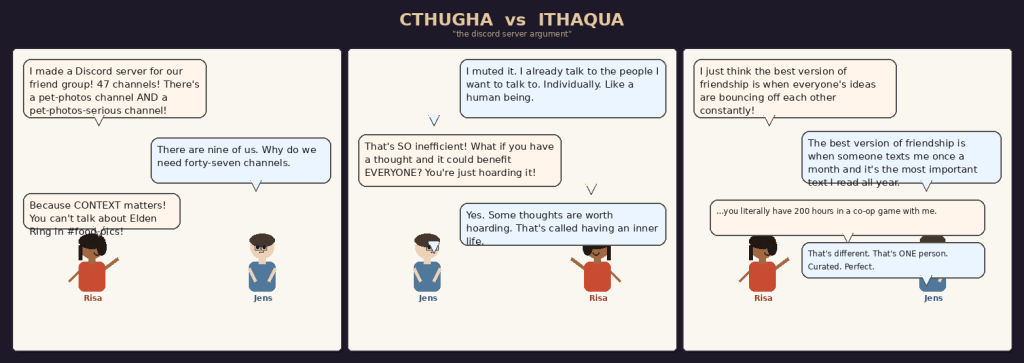
Cthugha is the impulse to connect. To share every thought, join every group chat, build the network, dissolve the barrier between your mind and someone else’s. The Singularity is a Cthugha project. So is Wikipedia. So is that friend who adds you to a 47-channel Discord server for a nine-person friend group.
Ithaqua is the impulse to withdraw. To protect the fragile, weird, personal thing you’re building by keeping it away from the heat of other people’s opinions. To value depth over breadth. To have one best friend instead of a hundred acquaintances, and to consider that a more-than-adequate social life.
Most arguments about introversion and extroversion are actually about this, but the personality-test framing misses what’s really at stake. This isn’t about whether parties drain you. It’s about whether you think the best version of a human mind is one that’s connected to everything or one that’s fully its own thing. Whether you believe the tragedy of mortal life is that we can’t share enough, or that we can’t keep enough to ourselves.
Cthugha people are terrified of lost knowledge. Every story that dies with its teller, every thought that evaporates because you didn’t tweet it, is a small apocalypse. Ithaqua people are terrified of dilution. Every time you workshopped your poem in a group, every time you let a committee redesign your vision, some essential fragile thing melted. (There’s a reason every mythology puts fire and ice at opposite ends of the cosmos. The Norse placed Muspelheim and Niflheim at the two poles of creation, and the world began where they touched.)
And the wild part (the part that makes this a real binary and not just “social butterflies vs. hermits”) is that both fears are completely correct.
You can’t resolve this by meeting in the middle. The middle is just a lukewarm group chat where nobody shares their real thoughts and nobody has time to develop their own.
These are two different tools for two different problems. Sometimes you need the fire. Sometimes you need the ice. The question is whether you know which one you’re reaching for, or whether you’re just doing whatever your personality defaults to and calling it a philosophy.
The internet used to be Cthugha’s paradise. The web circa 2008 was built on a single assumption: more connection is better. Open blogs, open forums, Twitter as a genuine town square, Facebook showing you everything chronologically like a communal bulletin board. Remove friction. Let ideas propagate. And it worked, for a while. Wikipedia. Open-source software. The rationalist blogosphere, where people argued about ideas in public and changed their minds in public and the discourse felt like it was ratcheting upward because every conversation was visible to everyone.
And then, sometime around 2016, people started leaving. Not the internet entirely. They went to Discord servers, private Slacks, group chats, paywalled Substacks. The conversations that used to happen on open forums started happening behind invite links. This was Ithaqua’s counterattack.
Part of the story is defensive: the public internet became a panopticon, and people with half-formed ideas retreated behind walls of ice. But that’s only half of it, and maybe the less interesting half. The other reason people moved to Discord is that it’s just better for certain kinds of thinking. Consider a Discord server dedicated to finding secrets in World of Warcraft. Nobody in that server is afraid of public attention. They moved there because a hundred people who all care intensely about the same niche produce denser discourse and faster iteration than any public forum could. Everyone in the room is already up to speed. You can skip the preamble. The conversation is tighter, the feedback loop is shorter, and the collective output is higher.
Walls aren’t just for keeping danger out. They’re for keeping signal density in.
As the public platforms scaled, they stopped rewarding ideas and started rewarding engagement, which turns out to be a very different thing. The post that generates the most engagement is not the most insightful; it’s the most provocative, or the most screenshot-able, or the one that triggers the strongest emotional response from the largest number of people. The Cthugha fire, which was supposed to illuminate, started to just burn. So people migrated. Some for defensive reasons: “I need a room with twelve people I trust, where I can be wrong out loud.” Others for offensive ones: “I can do more in a focused channel of fifty obsessives than on a public forum of ten thousand generalists.” Ithaqua as retreat versus Ithaqua as concentration.
Cthugha believes ideas become real through contact with other people. The more people, the more real. An idea you never shared is basically an idea that doesn’t exist yet. Ithaqua believes ideas become degraded through contact with too many people too soon. What the Ithaqua-oriented person wants isn’t zero audience. It’s a chosen audience. A curated twelve instead of an algorithmic forty thousand.
You can see the tension in miniature in any shared Google Doc. For compiling notes or co-authoring a report, multiple minds on the same text is clearly better than one person alone. But have you ever tried to write in a shared Google Doc? Not compile. Not edit. Write.
The moment someone else’s cursor appears in your paragraph, you start writing for them. The sentence gets shorter, safer, more committee-approved.
The document becomes more correct and less interesting. Twitter in 2022 was more correct than Twitter in 2012. It was also dramatically less interesting.
But there’s an observation I keep coming back to, one that I think justifies writing this whole piece: the tools that enable mass collaboration keep being built by people working in isolation. And the tools designed for isolation keep being used to build communities.
In 2005, the BitKeeper license for managing the Linux kernel was revoked. Linus Torvalds (irascible, opinionated, worked alone in Finland for years) didn’t adopt any existing alternative. He disappeared for two weeks and emerged with Git, an entirely new version control system, because nothing else met his standards.
Git became the foundation of GitHub: millions of developers sharing code, reviewing each other’s work, building on each other’s contributions. A Cthugha paradise. But Git’s design philosophy is itself Ithaqua architecture. Unlike earlier version control systems, it’s distributed. Every developer has a complete local copy. You can work offline, in your own branch, for as long as you want, and only merge back when you’re ready. The tool that powers the world’s largest collaboration platform was specifically designed so individuals could work in isolation.
The network was built by a hermit. And the hermit’s work was only possible because of the massive community that gave him something worth building tools for.
Discord follows the same blueprint. It’s a platform (Cthugha infrastructure) whose fundamental unit is the private server (Ithaqua architecture). Connect, but on your own terms. Choose who gets in. Control the context. Not less connection, but connection with walls. Tolkien spent twelve years showing The Lord of the Rings only to the Inklings. That was a Discord server before Discord existed, and it produced Middle-earth. If he’d been soliciting feedback on a public forum from chapter one, we’d have gotten a shorter, more conventional book.
The pattern keeps repeating: the best collaborative infrastructure comes from solitary vision, and the best solitary work is shaped by some carefully bounded community. Neither pole can sustain itself. Git needs GitHub. GitHub needs Git.
Which brings us to identity, where the binary cuts deepest.
Cthugha doesn’t just think identity emerges from relationships. It thinks identity is separable. You are not one unified self; you are many facets, and each facet can be shared independently with the community that cares about it. You’re a leftist, so you’re in a political Discord. You’re a horse girl, so you’re in an equestrian forum. You’re dealing with ADHD, so you’re in a support group. You’re a veteran, so you’re in a veteran community. Each of these groups gets the slice of you that’s relevant. None of them needs the whole picture. And that’s not a loss. That’s efficiency. You can be more authentically yourself in each of those spaces because you’re only bringing the relevant part. The horse people don’t need your political opinions cluttering up the conversation about saddle fit.
Taken to its extreme, your identity is a network address, or really a set of network addresses, one for each community that hosts a piece of you. Together they add up to something richer than any single context could contain.
To an Ithaqua-oriented person, this is horrifying, because identity is not separable. There is a core you, a private self, that your relationships express but don’t create. The horse thing and the politics and the ADHD and the military service aren’t separate modules you can distribute across different servers. They’re all one person, and the connections between them (the way your service shaped your politics, the way your ADHD affects your riding, the way all of it feeds into who you are at 3 AM when nobody’s watching) are the most important part. Parceling yourself out to specialized communities doesn’t make you more authentically present in each one. It makes you a fraction in all of them.
The Ithaqua position is: you get all of me or nothing. I don’t have a “work self” and a “hobby self” and a “politics self.” I have a self. It’s complicated and contradictory and it doesn’t fit neatly into any single community’s topic header. If you want to know me, you have to deal with the whole thing.
Hence the alt account, the anonymous handle, the Discord username that isn’t your real name. Not because Ithaqua people are hiding, exactly, but because selective revelation is different from being parceled out. They’ll share deeply with one or two people who get the whole picture. But they won’t distribute fragments of themselves across fifteen groups, because to them that’s not sharing. That’s dismemberment.
Here’s where it stops being abstract. Think about what happens when someone dies.
If Cthugha is right about identity, then the network preserves most of them. Their posts are still there. Their contributions to the codebase, the community, the group chat archives. The way they shaped other people’s thinking, the jokes that got absorbed into the group’s vocabulary, the recommendations that changed someone’s taste forever. The loss is real but distributed. The person is gone, but their effects persist in the network like heat after a fire.
If Ithaqua is right, then the thing that died is precisely the part that was never shared. The private experience of being that specific person. The unsent drafts. The connections between facets that no single community ever saw. The 3 AM thoughts. Everything the network preserved was already a copy, a projection, a facet distributed to its appropriate audience. The original is gone, and it was the only thing that mattered.
Both of these are coherent. Both of them describe something real about what it feels like to lose someone. And the disagreement between them isn’t resolvable, because it rests on a question that no one has ever answered: is a person the sum of their effects on others, or is a person the thing that exists when no one is watching? Cthugha says the fire. Ithaqua says the ice. And you’ve probably noticed, if you’ve lost someone, that you oscillate between the two. Some days the archive is a comfort. Some days it’s an insult.
(I default to Cthugha. I have nine group chats and I regret nothing and also everything. But I notice that the writing I’m proudest of was all done with the door closed.)
In romantic relationships, Cthugha love looks like merging. Finishing each other’s sentences. Having no secrets. Shared email accounts (terrifying to Ithaqua). Ithaqua love looks like parallel play. Two people who have their own rich inner lives and choose to share pieces of them with each other, carefully, over time. The couple that’s been together thirty years and still has separate hobbies and a lot of mutual respect for the parts of each other they’ll never fully understand.
In work, Cthugha productivity is brainstorming sessions, agile sprints, open Slack channels for everything. Ithaqua productivity is deep work. Closed doors. Headphones. There is a phase of any project where you need other people and a phase where other people will ruin everything, and the two phases look identical from the outside.
These two orientations have very different failure modes, and the current internet showcases both daily. Cthugha, pushed to its extreme, produces groupthink: the community so committed to consensus that dissent becomes unthinkable. Twitter’s main-character phenomenon, where the entire platform focuses on destroying one person per day, is Cthugha’s fire with no hearth to contain it. Ithaqua, pushed to its extreme, produces the crank: the brilliant person who has been alone so long they’ve lost calibration with reality, or the private Discord that becomes so insular it develops its own conspiracy theories and nobody inside can tell they sound unhinged. Every Unabomber is an Ithaqua failure mode. So is every community that started as a thoughtful refuge and ended as a cult.
Some places this binary shows up beyond the internet:
- Language learning. Immersion programs (move to the country, surround yourself with native speakers, learn by osmosis and embarrassment) are Cthugha. Studying alone with textbooks and flashcards, building a meticulous grammatical foundation before you ever speak to anyone, is Ithaqua. Both work. They produce different kinds of fluency.
- Grief. Cthugha grief wants to talk about it. Wants to be surrounded by people who knew the person, share memories, process collectively. Ithaqua grief wants to be alone with it. Considers public mourning a performance that cheapens the real feeling. Will process it internally, on their own schedule, and emerge when ready.
- Journaling. The person who journals by blogging, posting, tweeting their thoughts into the world for anyone to see and respond to, is Cthugha. The person who journals in a locked Moleskine that they’d rather burn than let anyone read is Ithaqua. Same act. Completely different relationship to the self.
There is something ancient about this opposition, something that predates the terminology by millennia, and it is worth sitting with that ancientness for a moment rather than rushing toward a conclusion that would only flatten it. The fire gods of the old world were always communal gods. Agni in the Vedic tradition was the messenger between humans and the divine, the priest of the sacrifice, the mouth that consumed the offering so that its essence could travel upward to the gods and outward to the community of worshippers. The hearth fire of Hestia in the Greek world was not merely warmth but the literal center of the household, the point around which the family gathered and from which the city-state derived its sacred continuity. Prometheus’s theft of fire was not the acquisition of a private tool but the gifting of technology to all humanity, and his punishment was infinite, because what he had given was a permanent alteration of the collective condition. Fire, in every tradition, belongs to everyone. It cannot be hoarded. A candle that lights another candle does not diminish. This is the deep mythic logic of Cthugha: that the best things in life are non-rivalrous, that sharing is not loss but multiplication, and that the only true death is the death of connection.
And the ice gods were always solitary. The frost giants of Norse mythology were the enemies of community, the forces that pressed inward from the edges of the world where no one lived, where the world-tree’s roots crept into darkness and only the bravest or most foolish would follow. Skadi chose the mountains over Asgard. The Wendigo of Algonquian tradition was the horror of the individual consumed by their own hunger, cut off from the reciprocal obligations of the group, wandering the frozen wastes as a warning about what happens when you stop sharing, when you stop needing anyone, when the self becomes so absolute that it devours everything around it. And yet: the mystics of every tradition went into the desert, the mountain, the cave. Forty days. Three years. A lifetime. The prophets were not committee members. Moses went up the mountain alone. The Buddha sat under the tree alone. The vision that would reshape the entire community had to be received in isolation, because the community’s own noise would have drowned it out. The Wendigo is a monster, but the hermit-sage is holy, and the difference between them is only whether the isolation produced something that the community needed.
Both of these are true. That is the problem.
What is at stake in this binary is finally not a question of strategy or productivity or even temperament but of metaphysics, of the oldest question about what a self is and where it ends, whether the boundary of your skin is a prison wall or a fortress wall or merely a membrane, a permeable thing that lets the right things in and keeps the right things out. The alchemists spoke of solve et coagula, dissolve and recombine, and perhaps this is the closest any tradition has come to holding both truths simultaneously without flinching: that the self must sometimes dissolve into the collective fire to be purified, and must sometimes freeze into solitary crystal to find its proper shape, and that the rhythm between these states is not a problem to be solved but the fundamental pulse of a life that is actually being lived. Plotinus in the Third Ennead describes the soul’s emanation outward from the One and its longing to return: every act of creation is a departure, a cooling, a differentiation into lonely form, and every act of love is a burning-away of that form back into the unity from which it came. He did not say which direction was better, because he understood, as the ice and fire cults understand in their separate and irreconcilable ways, that the direction you are moving matters less than the fact that you are moving.
So we are left, as we always are with binaries that actually mean something, not with a resolution but with a tension. You are probably, at this moment, living too far toward one pole. If you are the type of person who reads longform blog posts about philosophical binaries, you are statistically more likely to be oriented toward Ithaqua, toward the private cultivation of esoteric knowledge, and you might benefit from texting a friend your half-formed idea instead of polishing it in silence for another month. If you are somehow reading this in a group, passing your phone around a table while someone else reads over your shoulder, you might be oriented toward Cthugha, and you might benefit from closing the tab and sitting alone with whatever this made you feel, without immediately processing it through conversation. The fire needs fuel that was grown in darkness. The ice needs a distant warmth to give it shape. And the deepest works of the human spirit, the ones that actually endure, the ones that reshape the collective imagination, have almost always been made by someone who understood both temperatures and knew, in their body and not just their theory, when to open the door and when to bolt it shut.
Reference Reading:
Cthugha, the Living Flame | Exploring Egregores — Maps transhumanism, rationalist community, and hyper-connectedness onto the fire god. The original source for this binary’s framework.
Ithaqua, the Wind Walker | Exploring Egregores — Maps radical independence, lone genius, and “Let It Go” onto the ice god. Directly opposes the Cthugha essay.
 Alt Binaries
Leave a comment