Alt Binaries: Vision vs Strength
Every couple of months someone in my orbit gets really into sourdough, or jiu-jitsu, or cold plunging, and within about forty-eight hours they’ve developed a complete cosmology. The world, they explain to me, has a grain. You just have to go with it. Your body already knows how to heal itself. Your community already knows how to organize itself. Your bread dough already knows when it’s ready. All the interventions, all the optimizations, all the five-year plans and government programs and productivity apps are just getting in the way of what would happen naturally if everyone would stop interfering.
I nod. I eat the bread. (The bread is usually excellent.)
And then about three months later the same person has pivoted to a new obsession, and now they’re furious about some system that’s broken. The school district is failing their kid. The healthcare system is a nightmare. The city won’t fix the pothole that’s been there since 2019. And when I gently remind them that things have a natural grain that we shouldn’t interfere with, they look at me like I’ve just suggested we communicate exclusively through interpretive dance.
This is the binary. Not the content of either position (I have no feelings about sourdough), but the structural move underneath both of them.
One posture says: reality has a shape. It works. Learn the shape, live inside it, get strong. The problems you think you see are mostly evidence that you haven’t adapted yet. If you’re cold, put on a jacket. If you’re weak, get stronger. The system isn’t hostile, you’re just not good enough at it yet.
The other posture says: reality is a meat grinder. It does not care about you. Every good thing you’ve ever experienced was built by someone who refused to accept the default, and the default is always degradation. If you’re cold, someone needs to invent heating. If you’re weak, the game is rigged against you and we need to change the rules.
These aren’t political positions. I mean, they get used as political positions all the time, by everyone, on every side. But the underlying logic is older than politics. It’s older than agriculture. It’s probably older than language.
The best articulation of this binary I’ve found comes from a writer named balioc, who calls them the Cult of Strength and the Cult of Vision. His framing is precise enough to be worth borrowing wholesale: the Cult of Strength is centered on the idea that it is desirable to be part of an antifragile system. The Cult of Vision is centered on the idea that the world in which we live does not inherently support our flourishing. Everything I’m about to say is downstream of his observation, though I’ll be taking it places he might not endorse.
Both of these are obviously true in different contexts. (You knew that. I’m just contractually obligated to say it.) You probably already know which one you default to, and you’re already composing your rebuttal to the other. Sit with that for a second. It’s useful information about yourself.
The people who are best at anything tend to be able to operate in both modes, switching between them the way a musician switches between rehearsed technique and improvisation. The rest of us mostly just argue about which one is real.
Let me walk you through it.
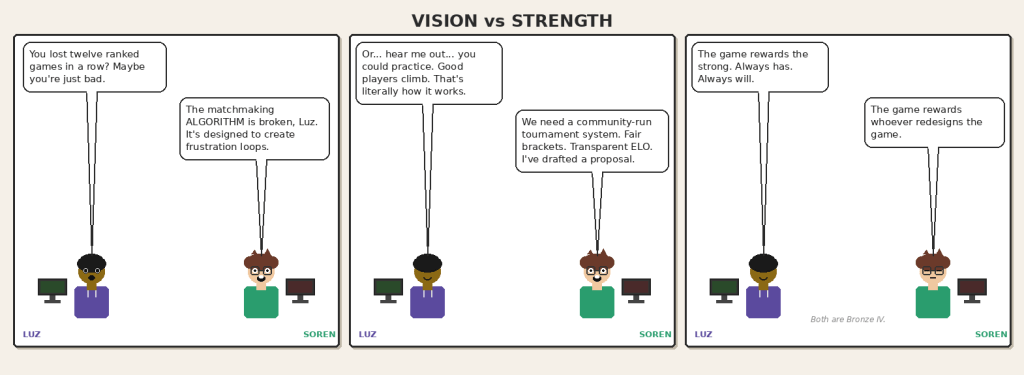
Imagine you’re running a restaurant. Opening night went fine, maybe even well. But over the next few months, little things start slipping. A cook gets sloppy with the risotto. The host seats a couple next to the kitchen door. Your Saturday night reservation system has a gap that means empty tables during peak hours.
One approach: this is normal entropy. Restaurants are living organisms. You fix the risotto by talking to the cook. You move the couple. You patch the reservation gap when it comes up. The restaurant knows what it needs to be; your job is to maintain it, not redesign it. Your grandmother ran a restaurant for thirty years and never once used scheduling software. The business works if you let it work and stay attentive to the reality on the ground.
The other approach: these aren’t random failures, they’re symptoms. The kitchen layout causes the sloppy risotto because the station is too far from the pass and the cook compensates by rushing. The host seats people badly because there’s no systematic floor plan that accounts for noise zones. The reservation gap exists because you inherited the system from the previous owner and never rebuilt it for your volume. The restaurant will keep producing new little failures until you sit down and redesign the underlying systems. Attentiveness to the ground is good, but it’s band-aids on a structural wound.
Neither of these people is wrong. But they’re operating from such fundamentally different assumptions about how reality works that they would have trouble even agreeing on what a successful restaurant looks like.
That gap is what the Cult of Strength and the Cult of Vision are about.
Let me be more precise about each.
The Cult of Strength, at its core, holds that the universe has a grain. There are ways of being that work, and ways of being that don’t, and the difference isn’t arbitrary. It’s discoverable. You discover it the way you discover anything: by doing the thing, failing, adjusting, and doing it again. A healthy community is one that has found the groove. A healthy person is one who has adapted to reality rather than demanding reality adapt to them.
This is not (though Vision people often accuse it of being) simple-minded conservatism. The Strength disposition doesn’t say “everything is already perfect.” It says something more like: “the patterns that survive are patterns that work, and you should be very careful before you decide you know better than a pattern that’s been working for a thousand years.” A Strength person can absolutely acknowledge that bad things exist. They just think the solution is usually to get better at navigating existing reality rather than to tear it down and build something new.
If you’ve ever gotten good at a physical skill (playing an instrument, rock climbing, cooking, welding) you know the feeling of your body learning the right movement. Not from a textbook. Not from a theory. From the grain of the material itself. The wood tells you where to cut. The dough tells you when it’s done. The rock tells you where your hand goes next. And the more you listen, the better you get, and the better you get, the more the world feels like it’s fundamentally on your side. Like there’s a right way to be, and you’re getting closer to it.
That’s the emotional core of Strength. Alignment with reality as a source of genuine security.
The Cult of Vision begins from a darker place.
Vision says: okay, the wood does have a grain. But the grain of the wood is not for you. The wood doesn’t care if you build a house or a coffin. The rock doesn’t care if you use it for shelter or it falls on your head. Nature is not hostile, exactly. It’s indifferent. And indifference, at scale, becomes hostility, because anything that spends energy being good (generous, kind, fair, creative) is at a disadvantage against anything that spends that same energy being ruthlessly effective. Without intervention, systems drift toward exploitation. The strong eat the weak. The dishonest outcompete the honest. Goodness is a walled garden, and someone has to build the wall.
This, too, is not (though Strength people often accuse it of being) naive utopianism. Most serious Vision thinkers are, if anything, more pessimistic about human nature than Strength thinkers. They just draw a different conclusion from that pessimism. Where Strength says “people are flawed, so the systems that survive their flaws are the good systems,” Vision says “people are flawed, so we need to build systems that actively counteract those flaws, because the default is always decay.”
If you’ve ever looked at some institution (a school, a hospital, a government, a family) and thought “this doesn’t have to be this bad, someone just needs to think about it for five minutes,” you were in Vision mode. The conviction that things can be better by design, that suffering is often just the absence of someone having bothered to engineer a solution.
One way to see the difference clearly: think about how each side handles a kid who’s struggling in school.
Strength says: school is supposed to be hard. That’s the point. Struggle builds capability. A kid who never faces difficulty never learns to face difficulty, and then they’re helpless when real difficulty arrives (and it will arrive). The answer is not to make school easier; the answer is to help the kid get tougher. Maybe get a tutor. Maybe the parents need to enforce a homework routine. But the structure of the challenge is correct. Lowering the bar means producing weaker people.
Vision says: the school was designed in the 1890s for a completely different population with completely different needs. The fact that a kid is struggling isn’t evidence that the kid needs to get stronger; it might be evidence that the system was never built for that kid in the first place. Maybe the curriculum is wrong. Maybe the teaching method assumes a learning style this kid doesn’t have. Maybe the forty-five-minute class period is arbitrary and counterproductive. The answer is to redesign the system based on what we now know about how learning actually works.
Notice how both of these contain real wisdom and real danger. The Strength version can become a justification for cruelty (any amount of suffering can be reframed as “building character”). The Vision version can become a justification for helplessness (any failure can be blamed on “the system” rather than on the person). And each side sees the other’s danger far more clearly than its own.
But here’s the thing I find most interesting about this binary, which is not how it shows up in individual decisions but what happens when an entire culture organizes itself around one pole. Because individual Strength-thinkers and individual Vision-thinkers are usually reasonable people with reasonable positions. When a whole civilization picks a side, though, you get something much stranger. You get a collective personality. A mood. A type of architecture, a type of storytelling, a type of anxiety.
Strength cultures are recognizable by a particular quality that’s hard to name but easy to feel. Call it settledness. There’s a confidence to daily life that comes from everyone agreeing (mostly unconsciously) that the world has a shape and we more or less know what it is. Your obligations are legible. Your role is comprehensible. The guy at the hardware store knows what he’s doing; the woman who runs the school has been doing it for twenty years; the local government is mediocre but functional. Nobody is trying to reinvent society from scratch because society, for all its flaws, basically works.
Postwar suburban America was a Strength culture so thoroughgoing that it forgot it was one. The whole premise of that civilization was that the right way to live had been discovered: nuclear family, single-family home, car, steady job, church on Sundays or not, kids in public school. The content might be secular and modern, but the structure was pure Strength: there is a grain, we have found it, now we just need to maintain it. The anxiety that haunted that world was the anxiety of deviation. What if my kid doesn’t fit in? What if my marriage doesn’t look like the other marriages? What if I want something that the groove doesn’t have room for? The punishment for deviation wasn’t usually dramatic. It was just loneliness. The system didn’t attack you; it forgot about you.
Rome in its republican and early imperial periods was a Strength culture of the sort that knew it was one. The mos maiorum (the way of the ancestors) wasn’t just a tradition; it was a load-bearing philosophical claim. The reason Rome works, a Roman senator would tell you, is that we do things the way they have always been done, because the way they have always been done works. Innovation was not forbidden. It was just treated with suspicion, the way you’d treat someone who wanted to replace a wall in your house: maybe the wall is load-bearing. Maybe you should find out before you start swinging.
Traditional Japanese culture. Rural Ireland before the 1990s. Most forms of orthodox religious life across most of human history. The common thread is not a particular set of beliefs but a particular relationship to believing: the conviction that the important questions have been answered, and the project now is to live inside those answers skillfully.
Strength cultures produce certain characteristic goods. Deep craft traditions. Stable communities where people know each other across generations. A kind of calm that comes from not having to figure everything out from scratch every morning. And they produce characteristic pathologies. Rigidity. A tendency to crush anyone who doesn’t fit the template. A dangerous blindness to their own decay, because the story they tell themselves (“everything is working”) makes it very hard to notice when it isn’t.
Vision cultures have an entirely different texture.
Second Temple Judaism is maybe the purest example in the historical record, and it’s worth sitting with for a moment. Here is a people who have been conquered, exiled, scattered, and returned to a homeland that is now a client state of a foreign empire. The old kingdom is gone. The old temple was destroyed and rebuilt as something lesser. The world, manifestly, is not working. And the cultural response is not to accept the new reality (Strength) but to develop an extraordinarily sophisticated set of ideas about what reality should be and how to get there. Prophecy. Apocalypticism. Messianism. Elaborate legal codes designed to sanctify daily life, to build a kind of portable holy society that could survive inside a broken world. The Pharisees weren’t rule-obsessed pedants (though their critics described them that way, then and now). They were Vision architects: if the world won’t give us a just society, we’ll construct one out of law and practice and sheer collective discipline.
That’s the characteristic energy of a Vision culture. Not optimism, exactly. More like a furious refusal to accept the given. The world is wrong and we know what right looks like, so we are going to build it, brick by brick, law by law, institution by institution, and every setback only proves how necessary the project is.
You see the same energy in the early Soviet Union (before it calcified into its own kind of grim Strength culture). In the Bauhaus and its ambition to redesign everything from furniture to cities to the human relationship with space. In the Progressive Era in America, when a whole generation of reformers looked at industrial capitalism and said: this is intolerable, and we are going to engineer something better. Public health departments, food safety laws, settlement houses, zoning codes. Not organic adaptations. Deliberate constructions. Walled gardens against the entropy of unregulated life.
Vision cultures produce their own characteristic goods. Creativity. Moral seriousness. A willingness to look at suffering that a Strength culture would rather explain away. The conviction that things can be better is, in many circumstances, the single most important thing a culture can possess. And they produce characteristic pathologies. Exhaustion, because the project never ends. A tendency toward purism and internal policing, because if the world must be built right, then anyone building it wrong is a threat. And a specific kind of brittleness: Strength cultures decay slowly, like wood rotting from the inside. Vision cultures tend to shatter, because they’re held together by an idea, and when the idea fails, there’s nothing underneath.
The really unnerving thing is to watch one turn into the other.
Christianity started as a Vision project (the Kingdom of God is coming, the current world is fallen, we are building something new) and became the defining Strength culture of medieval Europe (this is just how things are, God ordained it, the patterns are set). American democracy started as a radical Vision (we are going to design a government from first principles based on Enlightenment philosophy) and became the deepest Strength culture of the twentieth century (this is just how things are done, the Constitution is sacred, the patterns are set). Every successful Vision hardens into Strength over time. And every Strength culture, if you dig deep enough into its history, was once someone’s wild idea about how the world should be reorganized.
Which means that the guy defending tradition and the woman proposing revolution are often, without knowing it, performing the same act at different points in its lifecycle. The Cult of Strength is usually defending some previous generation’s Cult of Vision. And the Cult of Vision is usually building the next generation’s Cult of Strength. They need each other the way an inhale needs an exhale. Which does not stop them from being furious at each other, because it never has and it never will.
- Linux was born as a Vision project (one Finnish grad student decided to build an entire operating system from scratch because the existing ones weren’t good enough) and became the ultimate Strength institution (it now runs most of the internet precisely because decades of messy, organic, unplanned development made it robust in ways no designer would have predicted). It’s the lifecycle of the two cults compressed into a single piece of software.
- Every few months, Wizards of the Coast faces the question of whether to ban dominant cards from competitive Magic: The Gathering. The Strength position: the metagame is self-correcting. If a deck is too powerful, players will adapt, develop counters, find weaknesses. Let the format find its own equilibrium. The Vision position: competitive ecosystems, left unchecked, degenerate toward whatever is most ruthlessly effective, which is often miserable to play against. Fun does not evolve naturally in competitive environments. It has to be designed for. This is balioc’s entire thesis playing out over sixty-card decks, and the argument has been running for thirty years with no sign of resolution.
- Yellowstone’s wolf reintroduction was a Vision project (we are going to deliberately re-engineer this ecosystem by introducing a predator) that succeeded precisely because it restored a Strength dynamic (predator-prey relationships that self-regulate once the pieces are in place). The Vision was to get out of the way. Which is either a contradiction or the whole point.
There is a garden in Kyoto, Ryōan-ji, fifteen stones on white gravel, and the arrangement is such that from any vantage point you can only see fourteen of them; the fifteenth is always hidden, and the monks who built it in the late fifteenth century understood something about the relationship between design and nature that most of us arrive at only after decades of argument, which is that the most powerful human constructions are the ones that build incompleteness into their structure, that leave a gap for reality to assert itself, so that the visitor standing on the wooden platform looking at what appears to be an accident of placement is in fact experiencing one of the most meticulously engineered encounters with wildness ever conceived, every stone placed by hand to simulate the feeling that no hand placed them at all.
That is the problem, or the glory.
The Stoics, who were Strength thinkers in their bones (Marcus Aurelius writing in his tent that the universe is change and your life is what your thoughts make it), nevertheless spent enormous effort constructing a philosophical system to teach people how to accept nature, which is an obviously paradoxical enterprise: if acceptance were natural, you would not need a school for it. Epictetus needed a lecture hall to explain that you don’t need lecture halls. The grain of reality required a blueprint to make it legible.
And the great Vision projects, the ones that actually lasted, were the ones that knew when to stop. Rome’s engineers built aqueducts that carried water from the mountains to the city through gravity alone, no pumps, no mechanism, just the patient exploitation of the earth’s own slope, and what made Roman infrastructure endure for millennia was precisely that it worked with the grain of the physical world even while imposing on it a shape the physical world would never have chosen on its own. The Pont du Gard still stands because its builders understood that vision without respect for stone is just arrogance waiting to collapse.
There is a word in Japanese, wabi-sabi, that names something more precise than “the beauty of imperfection” (the usual translation, which is like translating saudade as “sadness”). What wabi-sabi actually points at is the aesthetic that emerges when a made thing has been used, when the design encounters the reality of hands and weather and time, so that a tea bowl is most beautiful not when it leaves the kiln (that is the moment of purest Vision) nor when it shatters (that is entropy) but at the point where the glaze has cracked just so, where the rim has been worn by a hundred lips, where the object carries the record of its negotiation between what someone intended and what the world allowed. Neither the potter’s design nor the clay’s nature is dominant. The bowl is their argument made permanent.
You could say the same about a constitution. Or a marriage. Or a city.
The Cult of Strength says: listen to the soil.
The Cult of Vision says: imagine the garden.
The soil is real. The garden is real. The fifteenth stone is always hidden. Every tradition was once someone’s radical invention. Every invention, if it’s any good, becomes someone’s tradition. And you will find yourself, at various hours of any given Tuesday, praying at both altars, because that is what Tuesdays require. What matters is whether you can feel the hinge where listening becomes designing and designing becomes listening again, and hold it, briefly, the way you hold a breath before diving, aware that what comes next is not your choice but that the dive itself was.
In which the office coffee machine has broken and two reasonable adults handle it with characteristic grace
DRAKO: The machine is broken. We drink the instant.
GALIT: We are not drinking the instant, Drako. The instant coffee in that cabinet is from before the renovation. I’m fairly sure it predates the building code.
DRAKO: It’s coffee. It contains caffeine. It performs the function. If you need a hand-pulled espresso to get through a Tuesday morning, the problem isn’t the coffee.
GALIT: No, the problem is that we’ve been limping along with a twelve-year-old drip machine that breaks every six weeks and everyone just keeps fixing it instead of acknowledging that the entire break room is a structural disaster. There’s no water filter. The outlet it’s plugged into trips the breaker if you also run the microwave. The counter is fourteen inches deep, which is enough for exactly nothing.
DRAKO: The counter has been fourteen inches deep for seven years and we’ve managed.
GALIT: We’ve suffered.
DRAKO: Suffering is a strong word for minor inconvenience around a beverage.
GALIT: It’s not about the beverage. It’s about the fact that no one in this office has ever sat down and said “what do we actually need this space to do, and how do we build it to do that?” We just inherited this break room from whatever contractor slapped it together in 2017 and we’ve been performing triage ever since. I want to gut it. New layout, proper electrical, a coffee setup that doesn’t require a degree in percussive maintenance.
DRAKO: So your solution to a broken coffee machine is a full renovation.
GALIT: My solution to a systemically dysfunctional space is a redesign. The coffee machine is a symptom.
DRAKO: The coffee machine is a coffee machine. It has a heating element and a carafe. The heating element failed. You replace the element. This is what maintenance looks like. Not everything is a symptom of structural rot.
KERRY: I want to point out that neither of you has made any coffee yet.
GALIT: Kerry, do you want to weigh in, or are you just going to stand there with your mug and look amused?
KERRY: I brought coffee from home. I’ve been bringing coffee from home for three years. But please, continue. This is like watching C-SPAN but for appliances.
DRAKO: At least someone here has adapted.
KERRY: I wouldn’t call it adapting. I’d call it recognizing that this exact argument happens every time the machine breaks, and I’d rather drink lukewarm French press in my car than be present for the part where Galit starts drawing floor plans on the whiteboard.
GALIT: I have one floor plan and it’s very practical.
KERRY: It has a dedicated water filtration zone, Galit. It’s a break room. People eat yogurt in there.
GALIT: People deserve better than eating yogurt next to a machine that smells like burnt plastic every morning.
DRAKO: People deserve to not be coddled. You learn more from a bad cup of coffee than a good one. It teaches you that comfort is not the point. The point is function. The point is getting the thing done and moving on to the work that actually matters.
GALIT: And you think the work that actually matters isn’t affected by the fact that everyone starts their day mildly annoyed?
DRAKO: I think that if mild annoyance derails your workday, the annoyance is not the problem.
KERRY: He’s doing the thing where he turns every practical question into a character test. You know that, right? “Should we fix the elevator?” “If the stairs defeat you, you were already defeated.”
DRAKO: The stairs are better for you.
KERRY: We’re on the ninth floor, Drako.
GALIT: This is what I’m talking about. The building has an elevator that works intermittently, a break room that’s a fire hazard, and a heating system that thinks it’s April in every month that isn’t April. And every time someone suggests improving any of it, Drako acts like the suggestion itself is evidence of moral weakness.
DRAKO: I act like the suggestion is usually more expensive, more disruptive, and less effective than simply maintaining what exists. You want to gut a break room over a heating element. At some point the scale of the response needs to match the scale of the problem.
GALIT: At some point the accumulation of small problems becomes a big problem, and the refusal to see that is not strength. It’s stubbornness wearing a philosophy costume.
KERRY: She’s right about the costume thing.
DRAKO: And you, Kerry? What do you believe?
KERRY: I believe I brought coffee from home and I’m going back to my desk. You two figure out whether we’re replacing a heating element or remodeling the building. I’ll be over here, caffeinated and uninvolved. Which, for the record, is the only position that has actually produced any coffee today.
GALIT: That’s not a philosophy, Kerry. That’s just avoidance.
KERRY: And yet. [sips coffee] It works.
DRAKO: …
GALIT: …
DRAKO: She’s not wrong.
GALIT: She’s not wrong that she has coffee. She’s wrong that having coffee is the same as solving the problem.
KERRY: [from the hallway] You know what’s funny? You both think I’m avoiding the question. But the question you’re arguing about is “what do we do about the coffee machine.” And I have coffee. You don’t. So which of us is actually avoiding the question, and which of us just answered it in a way that doesn’t feel satisfying enough to count?
GALIT: That’s…
DRAKO: Annoying.
GALIT: Extremely annoying.
DRAKO: Do you want some of the instant?
GALIT: God. Yes. Fine.
Referenced reading:
balioc, “Cult of Strength and Cult of Vision” — The original Tumblr post laying out this binary: antifragile systems vs. walled gardens against entropy.
 Alt Binaries
Leave a comment