I want to talk about something nobody frames correctly, which is the relationship between caring and competence (and more specifically, the uncomfortable fact that they’re often inversely correlated in practice, even if they shouldn’t be in theory).
The binary is Cat vs Dog.
Not the animals. The operating systems.
Cat-mode is: selfish, but aware. You know what you want, you know what’s going on around you, and you act accordingly. You don’t volunteer for things you won’t follow through on. You don’t pretend to care about someone’s problem if you’re going to half-listen while checking your phone. When you help, it’s because you actually have something useful to contribute, and you’ve done the math on whether your help is worth the cost. You are, let’s be honest, kind of a jerk about it. But the trains run on time.
Dog-mode is: good intentions, poor awareness. You care. You care so much. You see someone struggling and you sprint over with your whole heart in your mouth, and you knock over a lamp on the way there, and you lick their face when they needed space, and you sit on the thing they were trying to fix. You meant well. You meant incredibly well. But the wreckage speaks for itself.
This is not a binary about whether it’s better to be selfish or generous. That question is boring and the answer is obvious. This is a binary about what happens when you control for outcomes and only look at the mechanism. Because the Cat and the Dog can arrive at the same result (helping someone, hurting someone, changing nothing) via completely different internal processes, and those processes shape everything about how other people experience them.
Imagine you have two coworkers. One of them never volunteers for anything, does her own job extremely well, and when you ask her for help she either says “no” or gives you a precise, correct answer in under two minutes. The other one volunteers for everything, is constantly checking in on people, and spends forty-five minutes “helping” you with a problem she doesn’t understand before you realize you’ve been teaching her your job while she provides emotional support you didn’t ask for.
Who is the better colleague?
Obviously the answer is “it depends on what you needed.” If you needed competent, boundaried expertise, the Cat is your hero. If you needed someone to sit with you in the break room after a bad meeting and just be there, the Dog is invaluable. The problem arises when the Dog thinks she’s providing expertise and the Cat thinks she’s providing comfort. Because the Dog’s expertise is usually wrong, and the Cat’s comfort is usually absent.
I keep seeing this binary everywhere once I started looking for it. The friend who says “I don’t know enough about that to give you advice” versus the friend who says “oh my God, I have so many thoughts” and then proceeds to confidently guide you in the wrong direction. The country that stays out of a regional conflict versus the one that intervenes with the best of intentions and destabilizes a continent. The parent who enforces a bedtime versus the one who lets the kid stay up because the kid seems so happy right now and confrontation is hard.
I’m going to be honest about my own positioning here, because the style guide says I should be: I am a Dog who desperately wishes he were a Cat. I am the person who volunteers for things and then does them badly. I see a friend in distress and I rush in, armed with nothing but vibes and a willingness to make the situation about me. I have been on the receiving end of Cat-mode help exactly twice in my life and both times it felt like being slapped and then realizing the slap was correct. “I don’t think you actually want my opinion, I think you want me to agree with you, and I’m not going to do that.” Devastating. Perfect. Life-changing. Left a mark.
The Cat doesn’t apologize for the mark. That’s the whole thing.
(Also, I realize that I just described cats and dogs. The metaphor is not subtle. But the labels are stickier than “self-interested clarity” and “altruistic blindness,” which sounds like an academic paper that eight people would read and six of them would be the author’s graduate students.)
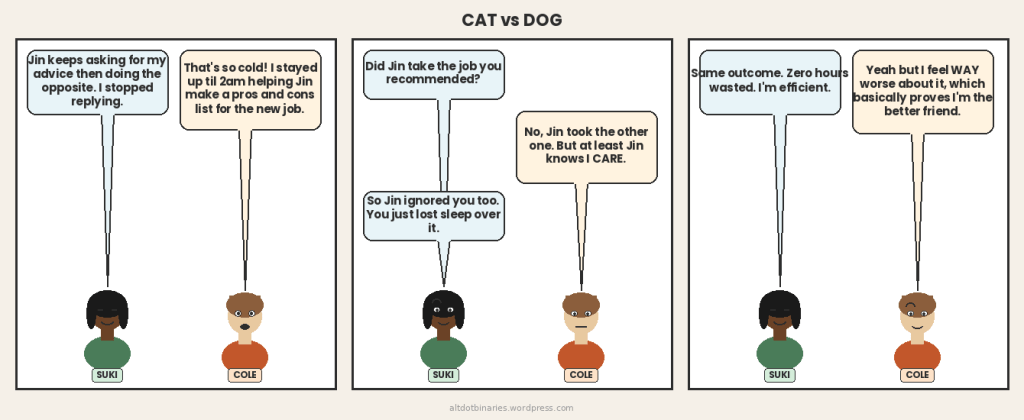
Let’s start with something you already know but haven’t organized into a framework yet.
Think about the last time someone tried to help you and made things worse. Not maliciously. Not through neglect. Through sheer, luminous, unbearable effort. They meant so well that they overrode your preferences, your expertise, and your explicit instructions, because their desire to help was so strong that it crowded out the part of their brain responsible for asking “is this actually helping?”
Now think about the last time someone refused to help you and it turned out to be the right call. Maybe they said “that sounds like something you need to figure out on your own.” Maybe they just didn’t show up, and in their absence you discovered you were capable of handling it. Maybe they looked at the situation, did some private calculation, and decided their involvement would make it worse.
Most moral systems treat the first person as better than the second. And in terms of character, they might be right. But in terms of outcomes? It’s genuinely not clear.
This is the Cat vs Dog binary. It is about the tension between two qualities that we naively assume go together (caring about others and being good at caring about others) but which in practice often pull in opposite directions. The Cat has clarity. The Dog has heart. And the question that makes this binary interesting is: which failure mode is more dangerous?
One way to think about it is through a concept I’ll call the Helpfulness Trap. The Helpfulness Trap is what happens when the act of helping someone becomes its own reward, detached from whether the help actually helped. You see this everywhere once you have a name for it. The coworker who insists on “collaborating” on your project when what they’re really doing is adding their name to work they don’t understand. The nonprofit that measures success by dollars raised rather than problems solved. The friend who forwards you seven articles about your medical condition, none of which are relevant, because the forwarding is the point.
The Helpfulness Trap is Dog-mode at its worst. It replaces the question “did this work?” with the question “did I try?” And it’s pernicious because it feels virtuous. The Dog is not lying when she says she cares. She really does care. Her caring is just not connected to a feedback loop that would tell her whether the caring is producing results.
The Cat, meanwhile, has an extremely efficient feedback loop. The Cat asks: “What do I get out of this? What does the other person actually need? Can I provide it? Is it worth the cost?” These are selfish questions. They are also, in a weird way, more respectful questions than the Dog’s approach, because they treat the other person as someone with actual needs rather than as an occasion for demonstrating virtue.
Imagine two people responding to a friend who just got dumped.
The Dog shows up at their door with ice cream and a playlist and a sleeping bag and plans to stay the whole weekend. She cancels her own commitments. She is there. She talks for three hours about the friend’s feelings, then her own feelings, then feelings in general. She cries more than the friend does. At the end of the weekend, the friend is exhausted and the Dog feels wonderful about what a good friend she is.
The Cat sends a text: “That sucks. Want to get dinner Thursday?” Thursday arrives. They eat. The Cat asks two specific questions and listens to the answers. She does not cry. She does not share a comparable experience. She says “you’ll be fine, you always are” and picks up the check. The friend goes home feeling weirdly better and slightly annoyed that the Cat isn’t more upset on their behalf.
Neither of these is the “right” response. That’s the whole point. Some people, mid-breakup, desperately need the Dog. They need to be held and validated and surrounded by messy, overwhelming care. Other people need the Cat’s clean, bounded, unsentimental acknowledgment. And the tricky part is that the Dog always shows up as the Dog and the Cat always shows up as the Cat, regardless of what the situation calls for.
There’s an old debate in software engineering that maps onto this beautifully, and it’s obscure enough that I think it qualifies as the kind of deep cut this post needs. In 1989, a programmer named Richard Gabriel wrote a short essay called “Worse Is Better.” It compared two philosophies of software design. The first (which he associated with MIT and Lisp) prioritized correctness and completeness: the system should do the right thing, always, even if that makes it complicated. The second (which he associated with Unix and C) prioritized simplicity: the system should be simple to build, even if that means it’s occasionally wrong.
The MIT approach is Dog-mode. It cares about getting everything right. It wants to handle every edge case, serve every user, anticipate every need. And as a result, it’s bloated, slow, hard to deploy, and frequently never ships at all, because perfection is the enemy of existence.
The Unix approach is Cat-mode. It does one thing, it does it simply, and it doesn’t apologize for the things it doesn’t do. It ships. It works. It’s not complete, but it’s there. And because it’s there, people start building on top of it, and over time the ecosystem grows to handle the things the original tool ignored.
Gabriel’s essay made a lot of people angry because the conclusion seemed to be that worse software wins. But that’s not quite what he was saying. He was saying that a system optimized for caring about everything loses to a system optimized for awareness of its own constraints. The Dog-system tries to be all things to all people and collapses under its own ambition. The Cat-system knows exactly what it is and isn’t, ships on time, and lets the world adapt.
The same pattern shows up in parenting, and this is where it gets genuinely uncomfortable.
There’s a style of parenting that is very Dog: emotionally available, constantly communicating, deeply invested in the child’s inner life, always asking how they feel. This is, by most contemporary standards, “good parenting.” And frequently it is good. But it has a failure mode, which is the parent who is so attuned to the child’s emotional state that they can’t set a boundary. The kid says “I don’t want to” and the Dog-parent enters a forty-minute negotiation, because the child’s feelings are sacred and must be processed. The result, often enough, is a kid who has an incredibly rich emotional vocabulary and absolutely no ability to do things they don’t feel like doing.
The Cat-parent says “bedtime is 8:30” and walks out of the room. The kid cries. The Cat-parent does not return. This feels, in the moment, like a failure of love. But the kid learns that some things are non-negotiable, that their feelings are real but not always actionable, and that the parent is a stable structure rather than an emotional negotiating partner. The Cat-parent’s apparent coldness is, in a specific and limited way, a form of respect for the child’s capacity to handle discomfort.
(I should note that both of these are caricatures, and real parenting is obviously more complicated. But the tendencies are real, and most parents have a default mode that looks more like one than the other.)
In politics, the Cat vs Dog distinction explains a lot about why people who agree on goals often disagree violently on methods. Consider foreign aid. The Dog-approach to foreign aid is: these people are suffering, we have resources, we should give them resources. The Cat-approach is: these people are suffering, we have resources, but simply giving them resources will create dependency, distort local markets, empower corrupt intermediaries, and ultimately make things worse, so we should do the harder thing and figure out what specific intervention will actually produce the outcome we want.
The Dog-approach feels morally superior. It has the urgency of compassion behind it. How can you not help when people are starving? And the Cat-approach sounds callous. “Let me do a cost-benefit analysis while children die.” But the history of international development is, to a significant extent, the history of Dog-mode interventions that produced Cat-mode outcomes (or worse), and Cat-mode analyses that were ignored because they weren’t emotionally satisfying.
A thought experiment. You’re walking down the street and you see a child who has climbed a tree and is now scared to come down. The Dog sprints over, holds out their arms, says “jump, I’ll catch you!” with total confidence, despite having never caught a falling child and having no real sense of the physics involved. The Cat stops, looks at the tree, looks at the kid, and says “you got up there, which means you can get down. Start with your left foot on that lower branch.” The Dog’s intervention is more dramatic, more loving, and far more likely to result in two people on the ground with injuries. The Cat’s intervention is colder, less satisfying, and more likely to result in a kid who can climb trees.
But it would be a mistake to conclude from these examples that Cat-mode is just better. It isn’t. The Cat has its own catastrophic failure mode, which is that awareness without caring produces optimization without purpose.
The purely Cat-mode person knows exactly what everyone needs and provides none of it, because nothing is worth the cost. They see a friend struggling and they do the math and the math says “not my problem.” They understand the dynamics of every relationship they’re in and they use that understanding to extract maximum value at minimum effort. They are, in the limit case, a sociopath: perfectly aware, perfectly selfish, perfectly useless to anyone who isn’t currently useful to them.
Cat-mode without any Dog in it is Bartleby the Scrivener. “I would prefer not to.” Complete awareness, complete refusal. Nothing gets knocked over, nothing gets broken, and also nothing gets done, because the Cat has optimized its way out of participating in anything that might cost something.
Dog-mode without any Cat in it is that friend who reorganizes your kitchen while you’re at work because she thought it would be a nice surprise, and now you can’t find the coffee filters and three of your mugs are broken but she’s beaming because she worked so hard and she’s so proud and you can’t even be mad because she genuinely, sincerely, with her whole heart, thought this would make your life better.
The reason both of these are disasters is that Cat and Dog aren’t really about selfishness and generosity. They’re about the relationship between intention and information. The Dog has the right intention and the wrong information. The Cat has the right information and the wrong intention. And the challenge of being a functional adult is somehow keeping both channels open at the same time, which is harder than it sounds, because the two channels interfere with each other.
Caring about someone makes you worse at seeing them clearly. This is almost a law of human cognition. The more emotionally invested you are in a situation, the more your perception warps around your emotional needs. You see what you want to see, or what you’re afraid of seeing, rather than what’s there. The Dog’s great caring is precisely what degrades the Dog’s awareness, because the Dog is processing the situation through the lens of “how can I help” rather than the lens of “what is actually happening.”
Conversely, seeing clearly makes you worse at caring. The Cat’s awareness creates distance. Once you understand a system well enough to model it, you’ve already taken a step back from being inside it. The Cat sees the friend’s breakup as a predictable pattern (they always date the same type, this was always going to end this way, they’ll be fine in three months) and that clarity, while accurate, makes it harder to sit with the rawness of the friend’s pain right now.
This is why, incidentally, therapists have such strict training around boundaries. A therapist is someone professionally required to be both Cat and Dog simultaneously: caring deeply and seeing clearly. The training exists because the natural state of caring-plus-seeing is for one to destroy the other. Without training, you either burn out (Dog wins, Cat dies) or you become detached (Cat wins, Dog dies). The whole therapeutic apparatus is an artificial structure designed to hold both orientations in productive tension.
In practice, most people are not pure Cats or pure Dogs. Most people are Dogs about the things they care about and Cats about the things they don’t. You are probably a Dog about your children and a Cat about your neighbor’s lawn. A Dog about your best friend’s marriage and a Cat about your coworker’s diet. This selective deployment is itself a kind of wisdom. The question is whether you’re doing it consciously (choosing when to care and when to calculate) or whether it’s just happening to you (caring about whatever triggers your emotions and calculating about everything else).
Here are five more examples of this binary showing up in places you might not expect:
- Group projects in school. The Dog does everyone’s work, resents it, produces middling results because she’s spread too thin, and gets the same grade as the kid who did nothing. The Cat does exactly her section, well, on time, and if the rest of the group fails, she has documentation proving her part was complete. The Dog is a better teammate. The Cat gets a better grade.
- Restaurant tipping in America. The Dog tips generously because the server seems tired and probably has kids and the system is so unfair. The Cat tips exactly 20% because that’s the norm, or tips nothing and donates the equivalent to a lobbying group pushing for a living wage. The Dog’s compassion subsidizes a broken system. The Cat’s calculation might eventually fix it (or might just be a convenient excuse for being cheap).
- Open-source software maintenance. The Dog-maintainer accepts every pull request, responds to every issue, tries to make every contributor feel welcome, and burns out in eighteen months. The Cat-maintainer has strict contribution guidelines, closes issues that don’t meet the template, and ignores feature requests that don’t align with the project’s scope. The Dog-project has more contributors and more bugs. The Cat-project has fewer contributors and works.
- Emergency room triage. The entire system is Cat-mode by design: you assess severity, you allocate resources based on need, you ignore the screaming person with a broken finger while you save the quiet person having a heart attack. Dog-mode triage would treat whoever seems most distressed first, which would kill people. Medicine learned this lesson centuries ago. Most other institutions haven’t.
- The way people give directions. The Dog says “oh it’s really easy, you just go down the road and turn left at the big tree, you can’t miss it.” The Cat says “take the second right after the gas station, go 0.4 miles, the building is on the left, number 1247, there’s no sign.” The Dog’s directions feel warmer and are completely useless. The Cat’s directions feel robotic and get you there.
What you might notice about these examples is that they’re all, in some sense, about the same thing: the gap between performing care and delivering results. The Dog performs care fluently, naturally, beautifully. She makes you feel seen. She makes you feel less alone. And then the project is late, or the directions are wrong, or the intervention backfires. The Cat delivers results, efficiently, correctly, coldly. She makes you feel like a line item. And then the thing actually works.
There is something deeply uncomfortable about this, because our entire moral vocabulary is built around intentions. We forgive the person who tried and failed. We suspect the person who succeeded without trying. The Dog gets credit for effort; the Cat gets suspicion for ease. And so the Dog gets promoted to management (where her Dog-mode tendencies cause maximum damage at maximum scale) and the Cat gets passed over (because she “doesn’t seem like a team player”).
But here I want to resist the easy conclusion, which would be “so we should all be more like Cats.” That’s wrong too, and in a specific, structural way.
A world of pure Cats is a world that runs smoothly and means nothing. Every interaction is a transaction. Every relationship has a balance sheet. Nobody sacrifices, nobody overextends, nobody does the beautiful, stupid, glorious thing of caring more than is rational, and the result is an efficient machine that nobody loves, because it was never designed to be loved, only to function.
The Dog brings something into the world that the Cat cannot generate: the willingness to be wrong on behalf of someone else. The Dog shows up with the wrong ice cream flavor and the willingness to stay all weekend, and yes, it’s a mess, but it’s a mess that says you matter to me more than my comfort, more than my competence, more than my dignity. That message is, for some people in some moments, the only thing that keeps them alive. The Cat’s correct, bounded, efficient text message does not save anyone’s life at 3 AM. The Dog’s chaotic, overwhelming, inappropriate sleepover might.
Consider the old stories, the ones that survived because they were carved into temple walls or whispered at crossroads or scratched into the marginal space of monastic manuscripts where the monks were supposed to be copying psalms and instead recorded the things that actually mattered to them, the small negotiations of hunger and love and territory that make up a life regardless of the century.
In Mesopotamian cosmology there are two forces at the foundation of reality: Tiamat, the salt water, the chaos-mother, vast and indiscriminate and teeming with unformed life, and Marduk, the young god who slays her and builds the ordered world from her corpse. Marduk is Cat. He sees, he calculates, he acts with precision. He carves the sky from Tiamat’s ribs. He is the intelligence that separates and names. And Tiamat is Dog: she is the generative flood, the undifferentiated caring that produces everything and organizes nothing, the primordial milk that feeds equally the beautiful and the monstrous because she cannot tell them apart and does not want to. Marduk needs Tiamat’s body to build with. Tiamat, left alone, produces only chaos. The world exists in the space between them, which is to say the world exists because something that saw clearly killed something that loved blindly and felt terrible about it afterward, or didn’t, depending on which tablet you read.
There is a version of this in the Oresteia, which is really a three-play argument about whether justice should be Dog or Cat. The Furies are Dog-mode justice: passionate, relentless, incapable of proportion. A crime was committed, therefore punishment must follow, with a heat that matches the heat of the original wound. Athena’s court is Cat-mode justice: dispassionate, procedural, capable of weighing competing claims and arriving at a verdict that satisfies no one completely but allows the city to continue functioning. Aeschylus does not pretend this is a happy resolution. The Furies are given a home beneath Athens, not destroyed. They are honored, fed, appeased. Because a city that operates only on Cat-mode calculation has no immune system against the things that calculation cannot address: the grief that will not be rationalized, the wound that will not heal on schedule, the debt that no ledger can contain. The Furies live underground. They are always there. A city that forgets them learns what it means to have no Dog.
And this is what the binary is, in the end, or rather what it refuses to be in the end, because the Cat in me wants to provide you with a clean conclusion and the Dog in me wants to assure you that both options are beautiful and valid and that whatever you are is enough, and I am not going to do either of those things. The binary is a description of a tension that does not resolve. It is the tension between seeing and caring, between accuracy and warmth, between the kind of love that knows your name and the kind of love that shows up at your door at midnight with the wrong food and the right intention and refuses to leave. You do not choose between them. You negotiate with them, daily, hourly, in every interaction where you must decide whether to be honest or kind, whether to help or to be useful, whether to give someone what they want or what they need. The Cat in you says: these are different things. The Dog in you says: it doesn’t matter, they’re hurting, go. And the person you are when you’re at your best is the one who can hear both of those voices and let the situation (not your temperament, not your ego, not the voice that happens to be louder that day) determine which one speaks.
The Stoics had a word for it, or several words, because the Stoics had words for everything: oikeiosis, the process by which a creature expands its circle of concern from the self outward, from the body to the family to the city to the cosmos. The Cat is the creature at the center, precise and boundaried and alive. The Dog is the expansion, the reach, the willingness to feel what is not yours to feel. The Stoics thought you needed both motions to be human, the contraction and the extension, the awareness of self and the dissolution of self into care for others. They did not think it was easy. They did not think it was natural. They built an entire philosophical system to train people to do it, and twenty-three centuries later most of us are still terrible at it, which at minimum suggests the problem is real.
The Party
In which Eitan ne Jyanssen Codex and Hadria Breaker argue about who behaved worse at Aleksander’s gathering the previous night.
HADRIA: I had a wonderful time last night.
EITAN: I know you did.
HADRIA: What’s that supposed to mean?
EITAN: It means you had a wonderful time. That’s an observation, not an accusation. Though since we’re here: did you notice Oneila leave early?
HADRIA: Oneila was there?
EITAN: She was sitting in the corner by the window, having a quiet conversation with Laszlo. First time they’ve spoken in weeks. It looked delicate. Important, even. And then you arrived at their end of the room like a weather event and shouted something about how Laszlo’s new research reminded you of a drinking song.
HADRIA: It does remind me of a drinking song! The meter is almost identical. I was being supportive of his work!
EITAN: You were being loud in the vicinity of his work. Those are different things. Oneila flinched, closed up, and left within ten minutes. Laszlo watched her go. He looked like someone had shut a door in his face.
HADRIA: …I didn’t see any of that.
EITAN: No. You didn’t.
HADRIA: Well, if it was so obvious, why didn’t you say something? You were right there. You could have pulled me aside.
EITAN: I was across the room.
HADRIA: Then come across the room! Use your legs!
EITAN: And do what? Insert myself into a social situation to manage your volume? I’m not your handler, Hadria.
HADRIA: No, you were too busy being polite in your corner. I saw you, you know. Standing by the drinks table with that little half-smile, saying the exact right thing to whoever came by, never going to anyone yourself. Aleksander throws a party and you treat it like a post you’re observing from.
EITAN: I had several good conversations.
HADRIA: You had several efficient conversations. Kamella told me she tried to talk to you about her nightmares and you gave her a two-sentence response and changed the subject.
EITAN: She mentioned the nightmares in passing. I acknowledged them. I didn’t think she wanted a deep examination of her subconscious at a gathering with wine and music.
HADRIA: She did, Eitan. That’s why she brought it up. She was reaching out. And you gave her the conversational equivalent of a nod and a closed door.
EITAN: I gave her the conversational equivalent of “I heard you and I’m not going to make a scene about it in public.” That’s called tact.
HADRIA: That’s called being a wall with manners.
EITAN: Better a wall with manners than a landslide with enthusiasm. Do you know what else happened while you were having your wonderful time? You told Tamar his proposal for the irrigation schedule was “brilliant, really brilliant, wow.” Tamar was glowing. I’ve seen the proposal. It has three errors in it. He’s going to present it to the Council next week with total confidence, and they’re going to find the errors, and he’s going to wonder why his friend told him it was brilliant when it wasn’t.
HADRIA: I thought it was brilliant! I’m not a mathematician!
EITAN: Then why are you giving a professional assessment?
HADRIA: It wasn’t an assessment, it was encouragement! He’s been working so hard, and he seemed nervous, and I wanted him to feel good about it!
EITAN: And in three days he’s going to feel significantly worse about it, because he went in unprepared. Your encouragement is a loan against future embarrassment. You made him feel good now at the cost of making him feel terrible later. But you won’t be there for the later part, so it won’t feel like your fault.
HADRIA: That’s not fair.
EITAN: I know it isn’t.
HADRIA: Okay, so what did you do for Tamar? Did you tell him about the errors?
EITAN: No.
HADRIA: Why not?!
EITAN: Because it was a party and she was having a good time and I decided it could wait until tomorrow when I could explain properly.
HADRIA: So you also didn’t help her! You just didn’t help her quietly! At least I made her smile!
EITAN: You made him smile about something that’s wrong. I made no one smile about anything. We can debate which is worse, but the outcomes are: Oneila is hurt, Laszlo is shut down, and Tamar is walking into a Council meeting with false confidence. None of that traces back to me.
HADRIA: No, what traces back to you is that Aleksander asked me afterward if you’d had a good time. Because he couldn’t tell. He organized this whole thing, Eitan. He was so excited. And you stood in the corner and were pleasant for three hours, and the person who loves people more than anyone in Haven couldn’t tell if you were enjoying his company or enduring it.
EITAN: I was enjoying it.
HADRIA: He doesn’t know that.
EITAN: …Ah.
HADRIA: Yeah. “Ah.” So I knocked over a few things. I was too loud and I didn’t read the room and I accidentally stepped on something fragile between Laszlo and Oneila that I didn’t even know was there. That’s all true. But every single person at that party knew I was happy to be there. Every person knew I cared about them. I got it wrong, but I was in it. You got it right and you were nowhere.
EITAN: That’s… not inaccurate.
HADRIA: Look at you, being generous. “Not inaccurate.” I’m framing that.
EITAN: The problem is that you’re describing two different kinds of failure and I can’t determine which one is worse.
HADRIA: Eitan, we don’t have to figure out which one is worse. We just have to go to the next party and you have to be a little more Hadria and I have to be a little more Eitan.
EITAN: The thought of you attempting to be reserved is genuinely frightening.
HADRIA: The thought of you attempting to be warm is genuinely hilarious.
EITAN: I’ll tell Aleksander I had a good time.
HADRIA: And I’ll apologize to Oneila. Without shouting.
EITAN: …At a normal volume?
HADRIA: I said without shouting. Don’t push it.
 Alt Binaries
Leave a comment