This binary is politically loaded in a way that most of my other posts aren’t, so let me trip the mines on purpose. Left-coded movements and right-coded movements both use strength rhetoric and victim rhetoric, but people have a nasty habit of only noticing the version used by the other side. When your side says “we shall overcome,” that’s a brave declaration of hope. When their side says something structurally identical, that’s a threatening war cry. When your side says “we’re being silenced,” that’s a righteous plea for justice. When their side says it, that’s pathetic whining designed to manipulate the referee.
I’m going to try to be ruthlessly evenhanded about this. If I use an example from one political direction I will pair it with one from the other. You will almost certainly feel that I’m being too generous to the other side anyway. That’s the nature of the beast.
(Also: this is not the same as my post on agency vs innocence. Agency and innocence are about how we assign moral responsibility. Strength and victim rhetoric are about persuasion strategies. You can use victim rhetoric while being an extremely agentic person. You can use strength rhetoric while having zero actual power. They’re tools, not identities.)
What makes this binary genuinely dangerous is the escalation dynamic. These two rhetorics don’t just coexist. They feed each other. If you’re already feeling vulnerable, and the other side starts loudly proclaiming their strength and inevitability, that is the most terrifying thing in the world. Every chest-thumping victory speech sounds like a threat. And if you’re already in strength mode (rallying your people, projecting confidence), and the other side starts performing helplessness and victimhood, that feels like a con. They’re gaming the system. They’re playing the refs.
So the strength side pumps harder, which terrifies the victim side more, which makes them plead louder, which makes the strength side angrier about manipulation, and the cycle tightens.
There is a scene in the Iliad where Achilles sits in his tent and refuses to fight, and the entire Greek war effort collapses around his absence, and what is happening in that tent is not strategy but something closer to liturgy: the strongest warrior alive performing his own woundedness, broadcasting his dishonor so loudly that the cosmos itself has to respond, his mother Thetis carrying his grief up to the throne of Zeus like an offering, like a prayer, because in the logic of the poem the strong man’s suffering is the most powerful force in the universe, more powerful even than his spear, and the gods rearrange the entire war to answer it. Achilles’ victim rhetoric is his strength rhetoric. The categories collapse into each other at sufficient intensity, the way matter and energy are the same thing at sufficient temperature, and what you get is something that looks less like a political tool and more like the fundamental grammar of how human beings have always talked to power.
That collapse is where this essay is headed. But first, at lower temperatures, let me walk you through how the two rhetorics work when they haven’t yet fused.
Imagine you’re in a meeting at work. Two departments are fighting over the same budget allocation. Department A’s pitch goes something like: “We’ve been the top-performing division three quarters running. Our team is the strongest it’s ever been, and with this funding we’re going to absolutely dominate the market. Get on board.” Department B’s pitch sounds different: “We’ve been systematically under-resourced for years. Our people are burning out. If leadership doesn’t intervene now, we’ll lose half our team to competitors by Q3.”
Both pitches can be completely true. They’re not descriptions of reality so much as rhetorical lenses you choose to present reality through. And notice the audiences they’re aimed at: strength rhetoric points inward (at your own team, your own supporters, neutral observers who respect confidence) and says join the winning side. Victim rhetoric points at authorities (managers, institutions, the media, neutral observers who respond to empathy) and says this is unjust and you should care.
This explains something that otherwise seems paradoxical: why does the same movement use completely different rhetoric in different contexts?
Think about labor unions. At a rally, a union leader stands before her members and says “we built this company, we run this company, and we have the power to shut this company down.” That’s strength rhetoric. It’s meant to fire up the rank and file, to make them feel their collective power, to give them the courage to walk the picket line. Now the same union leader goes on television and talks about the single mother working two shifts who can’t afford insulin for her kid. That’s victim rhetoric. It’s aimed at a different audience (the general public, regulators, sympathetic politicians) and it’s trying to accomplish something different (generate external pressure on the employer through compassion).
Is the union leader being dishonest? Not really. She’s bilingual. Both descriptions are true. The workers genuinely have power and they’re genuinely suffering. The question is just which truth you lead with, and to whom.
You see this exact same structure on the other side of the political aisle. A conservative politician at a rally tells supporters: “We are the silent majority. This is our country and we’re taking it back. We will not be replaced.” Strength rhetoric, aimed inward, designed to mobilize. That same politician goes on a podcast and talks about small business owners being crushed by regulation, about parents who feel powerless against a school board pushing curricula they hate. Victim rhetoric, aimed at persuadable listeners, designed to generate sympathy.
Now, the fact that everyone does this doesn’t mean it’s neutral or consequence-free. Each rhetoric has failure modes, and they’re different failure modes.
Strength rhetoric’s failure mode is that it alienates and frightens people outside the group. The more triumphalist your language gets, the more people who aren’t already on your side hear it as a threat. “We will overcome” is hopeful if you’re in the movement. If you’re not, and you’re not sure whether “overcome” includes you being overcome, it sounds ominous. The internal experience of strength rhetoric is pride. The external experience is often intimidation.
Victim rhetoric’s failure mode is the opposite. It exhausts sympathy and invites accusations of manipulation. The more you emphasize your suffering, the more people start to wonder whether the tears are strategic. And sometimes they are. Victim rhetoric can be used manipulatively, which is exactly what makes it so corrosive when overused, because it poisons the well for everyone who is actually suffering.
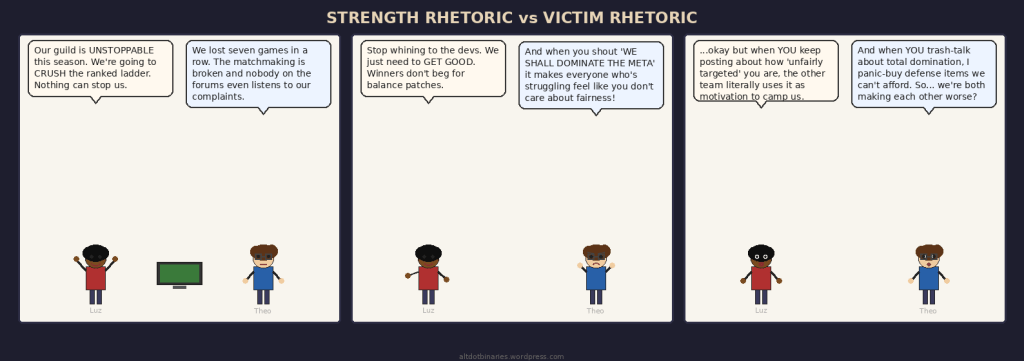
Suppose Group A is using strength rhetoric. They’re projecting power, talking about their momentum, maybe getting a little triumphalist. Group B responds with victim rhetoric (either sincerely or strategically): “Look at how aggressive they are. We’re in danger. We need protection.” Group A sees this and interprets it as manipulation: “They’re not really scared. They’re playing the victim to get authorities on their side.” So Group A doubles down on strength rhetoric to prove they won’t be shamed into silence. Group B sees the doubling-down and now they are actually scared, which produces even more victim rhetoric, which Group A perceives as even more cynical manipulation.
Call this the Rhetoric Spiral. Each side’s chosen tool is exactly calibrated to make the other side’s tool feel more necessary and more justified. Strength produces fear, which produces victimhood claims, which produces contempt, which produces more aggressive strength displays. The strength side thinks the victim side is trying to get an unfair advantage by calling the teacher. The victim side thinks the strength side is a bully who only respects force. Neither of these perceptions is entirely wrong, which is what makes the spiral so hard to break.
Now let me give you a weirder example, because the political ones are obvious enough that everyone has already formed their opinions.
In professional wrestling (stay with me), the entire art form is built on the tension between strength rhetoric and victim rhetoric. A “heel” (villain) does promos where they brag about how dominant they are, how they’ve beaten everyone, how no one can stop them. That’s strength rhetoric. The “face” (hero) does promos about how they’ve been screwed by the system, how the odds are stacked against them, how they’re fighting for something bigger than a title belt. That’s victim rhetoric. The face’s victimhood makes the heel’s strength feel oppressive. The heel’s strength makes the face’s victimhood feel sympathetic. They’re two instruments playing a duet. And the most compelling moments happen when a character switches registers: Stone Cold Steve Austin’s entire career arc is a masterclass in being simultaneously the toughest guy in the room and the blue-collar worker getting screwed by his corporate boss.
Religious movements do this too, and they always have. Early Christianity is perhaps the most successful example of victim rhetoric in human history (a persecuted minority appealing to universal compassion), which over centuries transitioned into one of the most successful examples of strength rhetoric (Christendom, the Crusades, “Onward Christian Soldiers”). Contemporary evangelical Christianity in America uses both simultaneously: “we are the moral backbone of this nation” (strength) and “we are a persecuted minority in a hostile secular culture” (victim). Contemporary progressive activism does the same: “we are the future, demographics are on our side” (strength) and “marginalized communities are under constant threat” (victim).
So if both rhetorics are legitimate tools that everyone uses, what determines which one a person or movement reaches for in a given moment?
Partly, position. Groups that feel genuinely ascendant lean harder on strength rhetoric because it matches their lived experience. Groups that feel genuinely threatened lean harder on victim rhetoric for the same reason. But crucially, most groups feel ascendant in some dimensions and threatened in others (culturally winning but economically losing, or politically powerful but socially despised), which is why most groups really do use both and really do believe both.
But the deeper determinant is theory of change. If you believe progress comes from showing your own strength and acting with boldness, you’ll gravitate toward strength rhetoric because it fits your model of how things get better. If you believe progress comes from awakening the conscience of bystanders and authorities, you’ll gravitate toward victim rhetoric because that’s the engine of your model. Martin Luther King Jr.’s strategy was explicitly designed around victim rhetoric aimed at the nation’s conscience (the televised brutality of Birmingham, the imagery of peaceful protesters attacked by dogs and fire hoses). But Malcolm X’s strategy was explicitly designed around strength rhetoric aimed at the Black community’s self-respect and capacity for self-defense. Both strategies had real effects, and the relationship between them was itself a rhetoric spiral: King could present himself as the moderate alternative to Malcolm X’s strength posture, which made his victim rhetoric more effective, while Malcolm X could argue that the system’s violence against King’s peaceful protesters proved that victim rhetoric alone would never be enough.
There’s no clean answer about which tool is “right.” They’re a saw and a hammer. The person who can consciously choose which to use, rather than being permanently stuck in one mode, is the person who’s most likely to actually get what they want.
Three more places this binary shows up that are worth noticing:
- Job interviews. You’re supposed to walk in projecting competence and confidence (“I led a team of twelve and delivered the project under budget”), which is strength rhetoric aimed at making the interviewer want to hire a winner. But you also need to convey that you want this job, that you’re not so successful you’ll just leave in six months, that you have growth areas you’re hungry to work on, which is a subtle form of victim rhetoric: I need something from you. Lean too hard on strength and the hiring manager starts worrying you won’t take direction, that you’ll be the employee who argues with every decision and thinks you know better than your boss. Lean too hard on need and you seem desperate. The entire ritual is a calibration exercise between these two registers, and most people have no idea they’re doing it.
- Medical patients vs. medical advocates. A patient who goes into a doctor’s appointment projecting confidence and knowledge (“I’ve done my research, I know what I need, here’s my treatment plan”) gets a very different interaction than one who presents as suffering and in need of help (“I don’t understand what’s happening to me, please help”). Chronic illness communities have extensive discussions about which rhetorical stance actually gets better care from doctors, and the answer depends entirely on the individual doctor, the institutional context, and the specific condition.
- Fan communities defending their franchise. When a beloved TV show or game franchise releases something controversial, the fanbase splits and both sides use both rhetorics. Defenders: “This show is brave and important and it’s going to be remembered as a classic” (strength) / “The toxic fans are ruining the community for people who just want to enjoy things” (victim). Critics: “We are the real fans, we know what this franchise is supposed to be, and we won’t accept less” (strength) / “They’re destroying something we loved and calling us bigots for being sad about it” (victim).
Consider what it means that every revolutionary movement in history has sung songs that are simultaneously battle hymns and laments. “We Shall Overcome” is a perfect example, a sentence that contains within itself both the admission of current suffering (we have not yet overcome) and the promise of inevitable victory (we shall), and you cannot pull those two threads apart without destroying the fabric, because the power of the song is precisely that it holds both truths in the same breath, the wound and the weapon, the cry and the war cry. The Marseillaise does this. The Internationale does this. “Amazing Grace” does this (a wretch, saved; lost, found). Every anthem worth remembering does this, because a rhetoric that is purely strong has no pathos and a rhetoric that is purely wounded has no telos, and the human animal needs both in order to get up in the morning and face a world that is, let us be honest, arranged to crush most of the people in it most of the time.
So perhaps the binary is less a choice between two tools and more a description of a single tool with two edges, a double-headed axe that cuts in the direction of pride and in the direction of mercy simultaneously, and the question is never “which rhetoric should I use” but “what am I willing to let the other edge cut,” because every time you stand before an audience and say we are powerful you are also saying someone out there is weak, and every time you say we are suffering you are also saying someone out there is strong enough to save us, and the gap between those two speeches is where the entire human drama of politics, love, war, and prayer takes place, has always taken place, will always take place, in the tent of Achilles, in the throne room of Pharaoh, in the break room where you are deciding how to word that email to your boss.
The Sign
Galit and Nadia are standing outside the elevator doors on the fourth floor of their building. A handwritten “OUT OF ORDER” sign is taped to the doors with packing tape. It has been there for three weeks.
Galit: We’re done waiting. I’ve drafted a letter to the building management company and it doesn’t ask for anything. It informs them. Forty-two tenants have signed, we’ve contacted the housing inspector, and if the elevator isn’t operational by Friday we begin withholding rent into escrow. I want the letter hand-delivered. I want them to see forty-two names.
Nadia: That’s very dramatic. It’s also going to get us evicted.
Galit: They can’t evict forty-two units.
Nadia: They absolutely can evict the three or four loudest ones and let the rest quietly resume paying. But forget that for a second. I’ve been documenting Mrs. Okonkwo on the sixth floor. Seventy-three years old, bad knee. She hasn’t left her apartment in nine days because she can’t do the stairs. I have her on video saying so. I also have the Reyes family: their son uses a wheelchair. He’s been getting carried down six flights by his father every morning. I took photos.
Galit: And you’re going to, what, show these to the management company? Appeal to their conscience?
Nadia: I’m going to send them to the local news.
Galit: …okay, that’s slightly less naive than I assumed.
Nadia: The management company doesn’t care about forty-two angry tenants. They have lawyers. What they care about is a segment on the six o’clock news with a seventy-three-year-old woman saying “I’m trapped in my own home.” Because then the city cares. Then the inspector shows up without us even calling.
Galit: I hate this. I hate that this works. You’re telling me that the way to get our elevator fixed is to perform helplessness convincingly enough that someone with actual power decides to do their job out of embarrassment?
Nadia: I’m telling you it’s a tool.
Galit: It’s a tool that only works if someone up the chain has enough shame to respond. And what happens when they don’t? What happens when the news segment airs and the management company releases a statement about “ongoing maintenance” and “commitment to tenant wellbeing” and nothing changes? Then what? You’ve used your best shot and it landed on nothing. At least my approach puts economic pressure on them. Rent escrow actually touches their bottom line.
Nadia: And your approach works great until they find out that half your forty-two signatories only signed because you told them it was a petition, not a rent strike, and they panic the moment they get a legal notice.
Galit: That’s not…
Nadia: Galit. I’ve seen this before. You go in strong, some people lose their nerve, the coalition fractures, management picks off the stragglers, and the three of you who were actually willing to follow through get labeled as troublemakers. Then the elevator gets fixed in three months anyway because the part finally arrived, and management tells everyone it had nothing to do with the tenants.
Galit: So your position is that we should never try to exercise collective power because it might not work perfectly?
Nadia: My position is that how you present your case should be calibrated to the audience. The management company isn’t afraid of tenants. They’re afraid of regulators and press. So you give them regulators and press. That’s not helplessness. That’s strategy.
Galit: Strategy that requires you to package real human suffering into a neat little media-friendly narrative and serve it up for consumption. Mrs. Okonkwo isn’t a strategy, Nadia. She’s a person.
Nadia: She’s a person who told me herself that she wants to be on the news if it gets the elevator fixed. Not everything that involves vulnerability is exploitation. Sometimes people are suffering and showing that suffering is the honest thing to do.
Galit: And sometimes it teaches everyone involved that the only way to get anything is to find the most sympathetic victim and put them in front of a camera, and the people who aren’t photogenic enough or sick enough or old enough just get to keep suffering quietly.
A long pause. They both look at the OUT OF ORDER sign.
Nadia: You know what the worst part is? When I watch you do the whole “we are powerful, we demand” thing, it scares me a little. Not because I think you’re wrong, but because it makes management dig in. They start thinking about liability and precedent and whether backing down makes them look weak to every other building they own. Your strength makes them defensive.
Galit: And when I watch you do the whole “look how much we’re suffering” thing, it makes me furious. Not at you. At the system that made it so the only currency that works is pity. When you lead with suffering, it feels like you’re conceding that we don’t have any power of our own. Like we need someone else to fix it for us.
Nadia: Maybe we do.
Galit: Maybe. But I refuse to build a worldview around that assumption.
Nadia: And I refuse to pretend we have more leverage than we do just because it feels braver.
Another pause. From somewhere above them, the sound of Mrs. Okonkwo’s television, faintly, through the stairwell.
Galit: What if we did both?
Nadia: We’re not doing both. Doing both is how you end up looking confused. You either walk in as a coalition with demands or you walk in as victims with a story. You can’t be both at once.
Galit: Every successful movement in history has been both at once.
Nadia: Every successful movement in history has been both at once to different audiences at different times. Not both in the same room in the same breath. That just looks like you don’t know what you want.
Galit: Fine. You take the news. I’ll take the rent escrow. We’ll see which one gets the elevator fixed first.
Nadia: It’s not a competition.
Galit: Everything is a competition. That’s my whole point.
Nadia: And that’s why you need me.
Galit opens her mouth to argue, decides against it, and starts walking down the stairs. Nadia follows. It’s six flights. They’ll both be out of breath by the bottom. Neither of them mentions this.
 Alt Binaries
Leave a comment