Something bad happens. You know it’s bad. Everyone agrees it’s bad. And then the real argument starts: what kind of bad is it?
Because there are two kinds.
A Leak problem is a problem like bad weather. Yes, it sucks. Yes, people suffer because of it. But it’s not the kind of thing that makes you write a manifesto. It’s the kind of thing you deal with. You grab an umbrella, you build a levee, you buy insurance, you move on. Leak problems are technocratic. They’re about engineering better responses to things that are going to happen regardless. The common cold is a Leak problem. Losing your keys is a Leak problem. A flaky friend who cancels plans sometimes is a Leak problem. You sigh, you adapt, you don’t start a movement about it.
A Rot problem is a problem like injustice. Something is wrong at a structural level, there’s someone or something responsible, and if we just had enough determination we could fix it. Rot problems demand a response. They generate essays and protests and policy proposals. They are the reason anyone has ever said “we need to have a conversation about this.” Climate change is a Rot problem. Inequality is a Rot problem. The fact that your school’s lunch program feeds kids cardboard-flavored protein rectangles when the football team gets catered meals is a Rot problem.
Everyone sorts everything bad into one of these two buckets. Constantly. Usually without noticing.
And the single most common form of political disagreement is not “is this thing bad?” (we mostly agree on that), it’s “is this thing Leak bad or Rot bad?” Is homelessness weather, or is it injustice? Is crime a technocratic puzzle, or a moral emergency? Is the fact that your coworker keeps microwaving fish just an annoyance to be tolerated, or does it reveal something important about the absence of shared norms in your workplace?
(That last one is always Rot. Always. I need you to accept this.)
The classification determines everything downstream. If a problem is Leak, then the suffering it causes is regrettable but not anyone’s fault in the morally interesting sense. You handle it with better tools, better systems, better preparation. Leak problems generate solutions: technical interventions aimed at reducing the harm directly. More police, better drainage, a patch on Tuesday. If a problem is Rot, then the suffering it causes is an indictment. Someone should have prevented it. The fact that they didn’t means something about what our society values, and we need to reckon with that. Rot problems generate responses: cultural or political mobilizations aimed at the thing behind the problem. A march. An op-ed. A reckoning.
Same event. Same suffering. Completely different response, depending on which bucket you put it in.
And here’s where it gets uncomfortable: your bucket assignment is not objective. It feels objective (it always feels objective), but it’s driven by your worldview, your priors, and most of all by what you’re already committed to caring about. A problem becomes Rot when it fits neatly into a story you already believe about how the world is broken. A problem becomes Leak when it doesn’t.
Which means you, personally, right now, are treating some genuine injustice as though it’s weather, and treating some genuine weather as though it’s injustice. Both at the same time. You can’t help it. Neither can I.
But the really insidious thing is that the Rot bucket is emotionally powerful in a way that Leak is not. Writing about a Rot problem is thrilling. It has villains. It has stakes. It has a call to action. Writing about a Leak problem is boring. “We should invest in better drainage systems” does not go viral. “The city’s corrupt neglect of our infrastructure is killing people” does. Same pipe. Same flood. One classification gets you engagement, the other gets you a 3.2 on a civil engineering review board’s interest scale.
The incentive, always, is to promote things from Leak to Rot. The incentive, almost never, is to demote things from Rot to Leak. And this creates a ratchet where, over time, more and more problems are treated as structural moral emergencies, even when a technocratic fix would have been faster, cheaper, and less corrosive to everyone’s blood pressure.
I don’t know how to fix that. (Leak problem.)
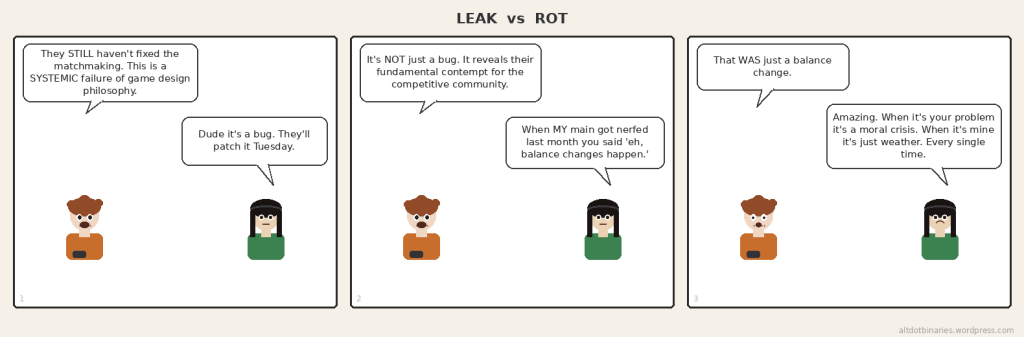
In which Tamar Codex and Galit Codex, both assigned to the committee overseeing Haven’s aqueduct maintenance, disagree about a leaking pipe in the lower residential quarter.
TAMAR: I’ve drafted the repair order. Pipe section 14-C, residential quarter. Estimated two-day fix. I’ve included the cost breakdown. It’s quite reasonable.
GALIT: A repair order.
TAMAR: Yes.
GALIT: Tamar, this is the fourth leak in the lower quarter this year. The fourth. The upper quarter has had zero. You don’t see a pattern here?
TAMAR: I see aging infrastructure in a section with older pipe fittings. The lower quarter was built earlier. The pipes are sixty years older than the upper quarter’s. This is consistent with expected material fatigue.
GALIT: “Expected material fatigue.” So the fact that the poorest families in Haven are the ones with water running down their walls, that’s just physics to you. Not a choice. Not a resource allocation decision made by people with names and addresses who decided the upper quarter gets new copper and the lower quarter gets patches.
TAMAR: The upper quarter’s pipes were replaced twelve years ago as part of a general modernization. It was funded through a bond that the lower quarter’s representatives voted against, because they preferred the funds go toward school construction. Which I supported at the time, incidentally. Schools are important.
GALIT: Oh, wonderful. So it’s their own fault. They chose schools over pipes. Very clean.
TAMAR: That is not what I said. I said the pipes are old and the reasons they are old are complicated and involve good-faith decisions by people who were trying to help. The pipes are still leaking. The repair order still needs to be filed. Can we file it?
GALIT: No. Not yet. Because if we file the repair order, the pipe gets fixed, everyone forgets about it, and in four months there’s a fifth leak, and a sixth, and we file more repair orders, and we never ask why the lower quarter’s infrastructure is systematically worse than the upper quarter’s. Your repair order is a band-aid on a wound that you’re pretending isn’t there.
TAMAR: The wound you’re describing (and I’m being charitable in using your metaphor) is a sixty-year infrastructure gap that will require a complete pipe replacement, which will take three years and cost more than this committee’s entire annual budget. I don’t disagree that it should happen. I’m trying to stop the water from running down an actual family’s actual wall while we figure out how to fund it.
GALIT: And I’m trying to make sure we actually figure out how to fund it instead of just patching and patching and patching forever. Because that’s what happens, Tamar. Every time. We fix the immediate problem, and the energy to fix the systemic one evaporates, because everyone thinks it’s been handled.
***
Imagine two neighbors. Both live on the same street. Last week, a pothole appeared on their road. Big one. Unavoidable. Already claimed a hubcap.
Neighbor A calls the city’s public works department, reports the pothole, and goes about their day. The pothole is a thing that happened. Roads deteriorate. That’s what roads do. The city will come fill it. Annoying but manageable.
Neighbor B posts about the pothole on the neighborhood Facebook group with a 500-word statement about how this is what happens when the city council redirects infrastructure funds to vanity projects downtown. The pothole isn’t just a pothole. It’s evidence. It’s a symptom of a deeper disease, and if we don’t treat the disease (by voting out the current council, attending the next town hall, demanding accountability), more potholes are coming. Worse potholes.
Both neighbors are looking at the same hole in the ground. Neither is wrong about the facts. The pothole exists. Roads do deteriorate. The city council probably did shift some funds. The question is entirely about classification: is this a Leak problem (mundane decay, technocratic fix, call public works) or a Rot problem (symptom of misgovernance, moral urgency, demands systemic response)?
This is the binary I want to explore. Not because one classification is always right and the other always wrong, but because the act of classifying is where most of our real disagreements live, and almost nobody notices they’re doing it.
Notice that solutions and responses can coexist. You can fill the pothole on Monday and campaign against the council on Tuesday. But in practice, the classification tends to crowd out the alternative. If you’ve decided the pothole is Rot, spending time on the Leak fix feels like complicity (you’re putting a band-aid on a systemic wound). If you’ve decided the pothole is Leak, the Rot response feels hysterical (it’s a pothole, calm down, here’s some asphalt).
So what determines which bucket a person reaches for? Several things.
First, your existing worldview. If you already have a framework that says “government is generally competent and things sometimes just break,” you’ll sort most events into Leak. If you have a framework that says “institutions are captured by interests that don’t care about you,” you’ll sort most events into Rot. The framework came first. The classification follows.
Second, emotional proximity. If the problem affects you or someone you love, the pull toward Rot is almost irresistible. When your kid gets sick, it’s a crisis, not a statistic. When someone else’s kid gets sick, you might feel sympathy, but you’re also capable of thinking “well, kids get sick, that’s just how it goes.” Same event. Different classification. Based entirely on whose kid it is.
Third (and this is the one that really matters), the availability of a narrative. Rot problems need stories. They need a coherent account of who caused the harm, why it was allowed to happen, and what would prevent it from happening again. If that story is ready-made and culturally available, the problem slides into Rot with almost no friction. If no such story exists, the problem stays in Leak no matter how severe it is.
This is why some genuinely terrible things get treated as background noise. If there’s no good story about who’s responsible, the mind defaults to “that’s just how things are.” And conversely, some relatively minor things become massive political flashpoints, because the narrative infrastructure is already there, waiting for a trigger.
COVID killed millions of people. That much is not in dispute. What is in dispute (and what consumed an astonishing amount of political energy for years) is where it came from. And the reason the origin matters so much, far out of proportion to its epidemiological relevance, is that the two leading hypotheses sort the pandemic into completely different buckets.
If COVID jumped from an animal to a human at a wet market in Wuhan, then the pandemic is a Leak. Zoonotic spillover is something that just happens. Viruses mutate. Animals and humans live in proximity. SARS did it. MERS did it. Influenza does it constantly. The response is technocratic: better surveillance, faster vaccine pipelines, maybe regulate wildlife markets more tightly. Terrible, but nobody’s fault in the morally interesting sense. We grieve, we prepare better, we move on.
If COVID escaped from a virology lab in Wuhan (one that was doing gain-of-function research on coronaviruses, funded in part by international grants, with safety protocols that may have been inadequate), then the pandemic is Rot. There are decisions. There are decision-makers. There are people who approved the research, people who failed to enforce safety standards, people who may have covered up the leak. Millions of people died not because nature is cruel but because specific humans made specific choices, and those choices should be investigated, and those humans should be held accountable, and the entire framework of gain-of-function research should be reconsidered.
Same virus. Same death toll. Same ventilators, same lockdowns, same grief. But in one version, you mourn. In the other, you prosecute. And in real time, people on both sides chose their classification before the epidemiology was in, because the bucket mattered more than the facts. Once a problem gets drafted into the Leak/Rot war, the question stops being “what actually happened?” and becomes “what kind of story is this?” And everyone already knows what kind of story they need it to be.
There is a particularly stark version of this asymmetry hiding inside the criminal justice system, and once you see it, it’s hard to unsee.
Crime is almost always classified as Rot. Someone committed a crime. They chose to do it. There is a perpetrator, there is a victim, there is a system that should prevent this from happening, and the system failed or the person defeated it. Crime generates outrage, demands for accountability, calls for reform or harsher enforcement. Nobody treats a mugging as weather. The entire apparatus of law and order exists because we collectively decided that crime is the kind of problem that has a responsible agent and requires a moral response.
Now consider what happens when the system punishes the wrong person. An innocent person goes to prison. A judge gives a wildly disproportionate sentence because they were in a bad mood, or because the defendant was the wrong race, or because the mandatory minimum was designed for a different kind of case and nobody updated it. A plea deal is coerced. A public defender with three hundred cases can’t spend more than eleven minutes on yours.
This is, by any reasonable measure, also a problem with responsible agents and structural causes. There are people who designed the mandatory minimums. There are officials who underfund public defenders. There are judges whose biases are statistically documented. The narrative infrastructure is right there.
And yet.
For most people, most of the time, unjust punishment is a Leak. It’s the unfortunate friction of an imperfect system. Sure, it’s sad that sometimes innocents get caught up. Sure, the sentence was harsh. But the system is doing its best, and no system is perfect, and the real problem (the Rot problem, the one that demands moral energy) is the crime itself. The wrongful conviction is a technocratic failure to be addressed with better procedures, not an indictment of anyone’s character or choices. Pay attention to the word people use: they call it a tragedy. Not an outrage. A tragedy. And “tragedy” is the word we use when we want to acknowledge that something was very bad while simultaneously communicating that nobody should be angry about it, because it was the kind of bad that just happens.
Think about how strange this is. A person steals a car: Rot. The state takes twenty years of an innocent person’s life: Leak. The theft of the car generates outrage and a manhunt. The theft of the decades generates a segment on a podcast and maybe, eventually, compensation that works out to less per year than the car was worth. One is a crisis. The other is a regrettable cost of doing business.
The asymmetry is almost perfect. The criminal is a subject who chose to act, so their crime is Rot and demands a full moral reckoning. The system that crushed the innocent person is a complex institution doing its best under difficult conditions, so its failures are Leak and get handled (if at all) through procedural reform. A pro-death-penalty advocate will classify wrongful execution as Leak (a tragic but fixable error in an otherwise necessary system) while classifying the murder that prompted the death penalty as Rot (a moral horror demanding the ultimate response). The person sitting on death row for a crime they didn’t commit might have a different classification in mind.
This is not hypocrisy, exactly. It’s the Leak/Rot machinery doing what it always does: sorting suffering into categories based not on severity but on whether a ready-made story exists about who’s to blame. Crime has a perfect story. Systemic injustice has a complicated one. And complicated stories lose to perfect ones every time.
(Of course, if you’re a defense advocate or a prison reformer, the whole thing flips. To you, the crime is the Leak: bad things happen, people make mistakes, poverty and mental illness and desperation are weather. The real Rot is what happens in the courthouse: the biased judge, the coerced plea, the system that grinds people up and calls it justice. You see the miscarriage as the structural sin that demands a reckoning, and the crime itself as the sad but inevitable friction of a broken world. The point is that you always think one of the two damaging things is the Leak and the other is the Rot. You always think one deserves a systemic response and the other deserves a shrug. And if you happen to be the actual person sitting in the middle of this (the criminal, or the victim, or the innocent who got mistaken for the criminal), the whiplash of watching different people classify your suffering into different buckets, with total confidence, is its own special kind of hell.)
There is a deep cut from game design that illuminates this beautifully, and I want to take a moment with it.
In Dwarf Fortress (the infamously complex simulation game where you manage a colony of dwarves), bad things happen constantly. Floods. Cave-ins. Goblin sieges. Plagues. Your dwarves die in absurd, elaborate, procedurally generated ways. And the community has developed a very specific relationship with these disasters.
When a dwarf dies because of a genuine simulation failure (a pathfinding bug that sends them walking into lava, or an AI glitch that makes them ignore a very obvious threat), the community treats it as funny. They screenshot it, they share it, they add it to the wiki under “notable bugs.” It’s Leak: a flaw in the system, amusing, no deeper meaning. Nobody writes an angry post about the lava pathfinding because nobody believes it means anything.
But when a dwarf dies because of a design decision that the player disagrees with (say, a mechanic where dwarves refuse to eat certain foods even when starving, or a combat system that the player finds unfair), the community treats it very differently. Now it’s evidence of the developer’s failure to understand their own game. Now it’s a Rot problem. The same outcome (a dead dwarf, a ruined fortress) provokes frustration and long forum threads about design philosophy, because the player believes a decision was made that caused this, and the decision-maker should be held accountable.
Same dead dwarf. Same ruined fortress. The only difference is whether the player believes the death was caused by a system being imperfect (Leak) or by a person making a bad choice (Rot). The anger comes entirely from the classification.
Let me say something that might sound callous but I think is important: the Rot classification is often more useful than the Leak one, even when it’s less accurate.
Treating a problem as Rot generates energy. It mobilizes people. It creates pressure for change. If nobody had ever classified workplace injuries as Rot (instead of just “the inherent risks of labor”), we wouldn’t have OSHA. If nobody had ever classified certain diseases as Rot (instead of just “the human condition”), we wouldn’t have the public health infrastructure that’s eliminated smallpox and nearly eliminated polio. The moral urgency of Rot classification is, historically, one of the most powerful engines of genuine progress.
But the Rot classification also has costs that are easy to ignore when you’re the one doing the classifying.
It requires a villain, and sometimes the villain is chosen for narrative convenience rather than causal accuracy. It generates outrage, which is metabolically expensive and socially corrosive even when justified. It resists downgrade: once something has been classified as Rot, the social cost of saying “actually, this might just be a difficult engineering problem” is enormous, because it sounds like you’re excusing the villain. And most importantly, it can crowd out the Leak solutions that would actually reduce suffering right now, because implementing a technocratic fix feels like letting the system off the hook.
The result is a world where we are very good at identifying injustice and very bad at filling potholes. Which is a strange failure mode for a species that knows how to fill potholes.
The reverse failure mode is quieter but equally real. People who default to Leak for everything become very good at managing problems and very bad at recognizing when a problem is actually someone’s fault. The technocratic mindset says: don’t get emotional, just optimize. Which is great advice for bridge maintenance and terrible advice for police brutality. Some problems are Rot. Some suffering is caused by choices that powerful people made and could have made differently. And if your instinct is always to reach for the engineering fix, you’ll end up optimizing the efficiency of a system that’s producing the suffering in the first place.
Both defaults are traps. The person who sees Rot everywhere becomes exhausted and paranoid, because every bad thing that happens is evidence of a hostile system and demands a moral reckoning. (This is a very stressful way to experience a rainstorm.) The person who sees Leak everywhere becomes complacent and occasionally monstrous, because they’ve defined away the possibility that anyone is ever responsible for anything, and the suffering just keeps happening while they tinker with better drainage.
The goal, if there is one, is not to pick a side. It’s to get better at the classification itself: to slow down at the moment when your brain is reaching for a bucket, and ask whether the bucket you’re reaching for is the one the problem actually fits in, or just the one that feels most satisfying.
***
- Student debt. If you classify student debt as Leak, then it’s an unfortunate consequence of expensive education meeting young people who don’t fully understand long-term financial commitments. The fix is better financial literacy, income-based repayment plans, cheaper community college pathways. If you classify it as Rot, then it’s a predatory system designed to extract wealth from a generation that was told college was mandatory. The fix is forgiveness, regulation, systemic restructuring. Notice that both framings contain real truths. The question is always which frame generates the response you think the situation actually needs.
- Addiction. The entire history of addiction policy is a Leak/Rot oscillation. The medical model treats addiction as Leak: a neurochemical dysfunction, to be managed with treatment, medication, harm reduction. The moral model treats it as Rot: a failure of character or a product of social dysfunction, demanding accountability or systemic reform (depending on your politics). Different decades lean different ways. The actual experience of being addicted doesn’t change.
- Video game difficulty. When Elden Ring launched with no difficulty settings, one camp said: the difficulty is a design feature, some players will bounce off it, that’s fine, not everything is for everyone (Leak). Another camp said: the refusal to include accessibility options is an exclusionary design philosophy that reflects who the studio thinks their audience is and isn’t (Rot). Same game. Same difficulty. The disagreement was entirely about whether From Software’s design choice was weather or a decision with moral weight.
TAMAR: So your position is that we should not fix the leaking pipe.
GALIT: My position is that we should fix it and present the full infrastructure report to the council, with the pattern documented, with the cost projections, with the demographic data showing who bears the burden. Both. At the same time. So the fix doesn’t become an excuse to ignore the cause.
TAMAR: I can add the report to the agenda. It will be item eleven of fourteen. Abbas will probably table it due to time constraints. The pipe will be fixed by then regardless.
GALIT: Item eleven.
TAMAR: I don’t control the agenda.
GALIT: You could fight for it to be item one.
TAMAR: I could. But item one is the grain shortage, which is affecting seventeen hundred people today, and item two is the bridge inspection that’s three months overdue. Both of which are, to use your framework, also systemic. Everything is systemic if you look hard enough. Some things are also urgent.
[Pause.]
GALIT: You’re not wrong. That’s what’s infuriating about you. You’re never wrong. You’re just… never enough.
TAMAR: I know. I’ve made peace with that. It’s how I keep going.
GALIT: I haven’t. It’s how I keep going.
TAMAR: Then I’ll file the repair order and you draft the report. We’ll both keep going, just in different directions, and maybe between the two of us, the pipe and the system both get a little less broken.
GALIT: …Fine. But I’m putting it in bold. The whole report. Every word.
TAMAR: I would expect nothing less.
***
But here is the thing that none of the practical advice can touch.
In the Iliad, which is among other things the first great argument about whether war is weather or a crime, Achilles sits outside the walls of Troy and grieves for Patroclus, and his grief is so enormous that it cannot be contained by the category of personal loss (Leak, a friend has died, people die, this is the cost of existing), so it expands outward and becomes something else entirely, a structural indictment of Agamemnon, of the war, of the gods who set the war in motion, of the universe that permits the death of the beloved, and the expansion is useful because it produces the rage that drives him back onto the battlefield, and the rage is destructive because it also drives him to defile Hector’s body and offend the gods and doom himself, and Homer seems to understand that the promotion of a problem from Leak to Rot is the fundamental act of narrative, the moment where suffering becomes story, and that the story is both necessary and lethal.
This is not a metaphor. This is the engine.
Every civilization decides which forms of suffering are weather and which are crimes, and the partition is never neutral, and the partition is never stable. The medieval Church classified plague as Rot (God’s punishment, repent), then slowly, reluctantly, allowed it to become Leak (disease, quarantine, medicine) as the germ theory of contagion made the moral narrative unnecessary. But the moral narrative didn’t disappear. It migrated. It attached to new problems, new villains, new crises, because the human need to believe that suffering means something is not a cultural artifact but a cognitive one, wired in, ineradicable, and the supply of meaningless suffering (which is nearly all of it) generates a permanent demand for stories that will convert it into the meaningful kind.
The Stoics understood this, or tried to. Epictetus, himself a former slave, proposed that the only sane response to the world’s cruelty was to sort everything into things within your control and things outside it. This is a Leak classification of the entire universe. Everything that isn’t your own will is weather. The cruelty of your master is weather. The death of your child is weather. And the freedom that this classification purchases (because it does purchase a kind of freedom) is also, obviously, monstrous, because a world in which slavery is classified as weather is a world in which slavery persists forever, and the Stoics did in fact live comfortably inside a slave empire for five hundred years, which is not the strongest advertisement for their method.
So the Stoic is wrong. And the revolutionary, who classifies everything as Rot and demands a reckoning with every injustice, is also wrong, not because injustice doesn’t exist but because the human body cannot sustain reckoning as a permanent state, and the attempt to do so produces the particular exhaustion and bitterness that you see in anyone who has spent too long treating every rainstorm as a political event.
What remains is the engine itself: the promotion of suffering into story, the ancient and ineradicable machinery by which the unbearable becomes the meaningful, at the cost of also becoming the destructive. You cannot shut it off. You can only learn to hear it running.
This is not an essay that is telling you whether you should feel Leak or Rot about whatever is in front of you right now. I am not where you are and I do not know. This is an essay about empathy: about why someone you otherwise respect and agree with may have a profoundly different reaction than yours, in either direction, and about how you might meet them there.
Further reading referenced in this post’s source material:
rebelhumanist.blogspot.com — “Category A and B Problems” — The original essay defining this binary, written in the aftermath of the Charlie Hebdo massacre, exploring how ideological disagreements are often not about whether something is bad but about whether it’s the kind of bad that demands a structural response or just competent management.
 Alt Binaries
Leave a comment