Alt Binaries — on the two ways we replace people with something more convenient
Everyone knows what objectification is. We have a whole ethics vocabulary for it. Treating someone “like an object” means you only care about what they can do for you. You manipulate or order them around. You don’t consider their inner life. This is bad. Intro ethics, covered, moving on.
What gets less attention is that you can do the exact same thing with admiration.
When you idealize someone, you are also replacing them with a mental construction you find more satisfying. The object-person is a construction built from their usefulness. The ideal-person is a construction built from what they represent to you. In both cases, the actual person is gone and you’re in a relationship with your own projection. The difference is the direction: the objectified person exists to serve your needs, and the idealized person exists to embody your values.
Neither of these is about seeing someone. Both of them are, technically, about not seeing them.
Now here’s the part that gets left out of the standard framing: both modes run in negative as well as positive. The object isn’t always someone useful. Sometimes they’re the obstacle. The coworker who keeps blocking your project isn’t someone you’re using for anything. They’re still an object — a piece of the environment that has the annoying property of having opinions. The “difficult person” you talk to your therapist about. The slow driver. The person at the meeting who asks too many questions. Object-treatment doesn’t require that you find them useful. It only requires that their interiority has become irrelevant to you.
Same thing with idealization. You can idealize something you hate.
When someone walks into a room and you immediately think privilege, or exactly how my ex used to act, or attach a whole nationality or generation’s sins to their face before they’ve said anything — that’s idealization in the negative direction. You’ve turned them into a symbol for something you have a prior relationship with. Your ex. A political category. A type. They didn’t do this. They walked in. But they’ve become a vessel for meaning you already had, and now nothing they say is going to reach you as itself, because it’s going to land on that meaning first.
This is, weirdly, what makes “idealize” a strange word for it. We associate it with love and admiration. But the structure is neutral. The structure is: this person has become a symbol rather than a person. What the symbol stands for is a separate question.
The thing both modes have in common is immunity to update. Once someone is an object to you, their context doesn’t matter. Their reasons are irrelevant. They’re furniture with opinions. Once someone is a symbol, you’re not processing them anymore, you’re processing your associations. New information either confirms the symbol or gets explained away. This is why you can’t argue someone out of either mode. The mode isn’t a conclusion they reasoned into. It’s a perceptual frame that filters what gets in.
The alternative — treating people as subjects, engaging with who they actually are rather than what they’re good for or what they stand for — everyone already knows they should do this. It’s not a secret. It’s like knowing you should be patient when you’re hungry. The knowledge is not the hard part. The hard part is that object-treatment and ideal-treatment both feel completely normal from the inside, because your brain was offering you a very serviceable substitute and you didn’t notice you took it.
There is no version of this post where I tell you how to stop. (I am reliably in one of these modes with at least two people in my life right now, and I’m a person who just spent three days writing about them.) What I can do is describe the machinery well enough that you recognize it when it’s running.
That’s the whole project here. Naming things.
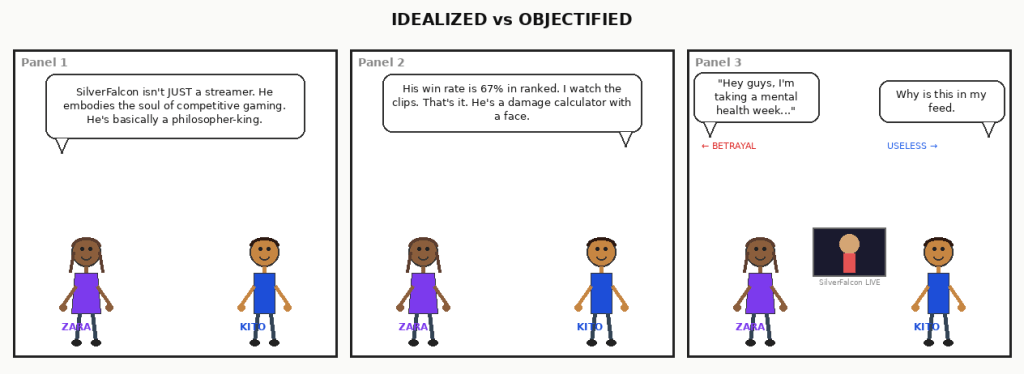
Let’s start from the most familiar version and build outward.
The word “objectification” entered common use mostly through feminist theory, specifically through the work of Martha Nussbaum, who in a 1995 paper tried to list all the things that could be meant by it: instrumentality (treating someone as a tool), inertness (treating them as if they had no agency), fungibility (treating them as interchangeable with others), violability (treating their boundaries as irrelevant), and so on. Seven properties in total. You don’t need all seven for it to count.
Nussbaum’s framework is useful, but it has a gap that I want to poke at. All seven of her properties point in the direction of positive use. They describe someone being exploited, consumed, enjoyed, instrumentalized. What they don’t describe is the obstacle.
Think about a different thought experiment. You have a coworker who reliably blocks your initiatives. Every meeting they raise objections. Every email chain they slow down. You’ve stopped thinking of them as a person with their own pressures and their own perspective and their own reasons for doing what they’re doing. They’ve become, in your mental model, an obstacle-shaped thing that occupies a desk near yours. You talk to your friends about them the way you’d talk about a malfunctioning piece of software. You have moved them, without exactly deciding to, from the category of “people” into the category of “problems in the environment.”
This is object-treatment. Not because you’re using them. Because their interiority has become structurally irrelevant to your engagement with them.
The obstacle and the tool are the same perceptual operation. Both involve a person whose inner life you have edited out. The tool is a surface you interact with to extract value. The obstacle is a surface you interact with to navigate around. Neither of these surfaces has reasons. Neither of them has a history that the current situation is connected to. They’re just features of the terrain.
You can extend this further. Nussbaum’s violability property — treating someone’s limits as ignorable — applies to obstacles just as well as tools. You don’t wonder whether your difficult coworker would prefer you stop going around them to their manager. You don’t wonder whether the slow driver has somewhere they’re trying to be. The question doesn’t arise, because the question requires a subject to address, and you’ve moved past that.
Now let’s do the same thing on the idealization side.
The positive version is easy to illustrate. A fan projects everything they value about skill and courage onto an athlete. A student turns a teacher into the embodiment of intellectual life. Someone falls in love and decides the person they’ve met represents everything they want to be or everything they want to have. The idealized person becomes a symbol, a container for meaning the idealizer already cared about.
The negative version is structurally identical and much less discussed.
Imagine you’ve had a series of very bad experiences with a particular type of person. A certain communication style. A certain set of markers — maybe class markers, maybe professional ones, maybe something more personal. You’ve been hurt by people who share these features enough times that the features have become predictive, in your experience. Now someone new comes along who has those features, and before they’ve done anything, you’re in a relationship with your prior experiences rather than with them. Whatever they say lands on that accumulated meaning. If they’re kind, it registers as manipulation. If they’re apologetic, it registers as performance. The evidence reorganizes itself around what you already know.
This is negative idealization. The person has become a symbol for something bad. Not because of who they are, but because of what they remind you of, or what you’ve decided they represent. You’ve replaced them with an abstraction the same way the fan replaces the athlete. The fan’s abstraction is “greatness.” Yours is “people who hurt me” or “this particular political category” or “how my father acted.”
The test is the same in both directions: can new information change your mind? Not update it incrementally — change it. If the athlete you love has a scandal, do you reevaluate the projection? If the person you’d written off as a type does something that doesn’t fit the type, does it register? Symbols don’t update easily. Real people force you to.
Here is where it gets structurally strange. Object-treatment and negative-ideal-treatment can produce almost identical outcomes while feeling completely different from the inside. If you dismiss your coworker’s reasons as irrelevant because they’re just an obstacle, and someone else dismisses them because they’ve decided the coworker represents everything wrong with corporate culture — the coworker’s experience of both interactions is probably similar. Neither person is actually engaging with them. But the first person feels cold and pragmatic about it. The second person feels morally engaged, even righteous. They’re not just ignoring the coworker, they’re holding them accountable to something.
This is one of the weirder features of negative idealization: it can feel like the opposite of dismissiveness while being functionally indistinguishable from it.
One way to think about the full structure: it’s a triangle with three points, not a spectrum with two ends. At one point is Object (person as tool or obstacle). At another point is Ideal (person as symbol, positive or negative). At the third is Subject (person as a person, with their own interiority that precedes and survives your relationship to them). Object and Ideal are not opposites. They are two different ways of arriving at the same failure: the replacement of the real person with a construction you can engage with more efficiently.
Efficiency is the key word. Both object-treatment and ideal-treatment are cognitively cheaper than subject-treatment. Objects and ideals are stable. You know how to interact with them. They don’t surprise you in ways that require recalibration. Subjects are expensive. They change. They have context that keeps mattering. They require you to hold open the possibility that you’re wrong about them, indefinitely, which is one of the more demanding things you can ask a mind to do.
Now a deep cut. In the Masnavi, the 13th-century Sufi poem by Rumi that most people only know via inspirational posters, there is a story about a man who falls in love with a portrait. Not a person. A painting. He finds the portrait and devotes himself to it completely. The poem is not interested in this as tragedy. It’s interested in it as epistemology. Rumi keeps returning to the question of what it would mean for the painting to “respond” — and whether the man’s love would survive the response. The painting doesn’t demand anything of you. It cannot contradict what you see in it. It is the perfect object of devotion because it remains exactly as you need it to be.
What Rumi is pointing at is that idealization is, at its root, a desire for a love object that doesn’t push back. Not because you’re cruel. But because being pushed back on is hard, and the mind is very good at offering you something that won’t. The painting is the purest form of this. The athlete-as-symbol is a mild form. The villain-as-political-category is the same structure in the negative direction. In all cases: the surface doesn’t push back. It only reflects.
There’s a particular version of this in internet culture that has gotten its own vocabulary. “Parasocial relationships” are relationships where one party is a content creator and the other party develops an emotional relationship with them while the creator has no corresponding relationship in return. These are almost always analyzed through the idealization frame: the fan projects, the creator becomes a symbol. What gets less attention is that parasocial relationships can also run in the object direction. Some viewers engage with creators the way they engage with a streaming service: it provides something, and if it stops providing that thing, it gets cancelled. No projection involved. Pure function. When the creator has a difficult public moment and the functionalist viewer unsubscribes, nobody writes think-pieces about it. But the object-treatment was running the whole time.
There’s another thing worth naming. Both modes get reinforced by the social context around them.
Object-treatment tends to get reinforced in hierarchical, high-throughput environments. When an institution processes many people quickly and rewards efficiency, it is selecting for the cognitive habits that support object-treatment. You don’t have time to engage with the subject. You have a queue. The institutional logic doesn’t make you evil. It makes you tired, and then it makes object-treatment feel like just how things work.
Ideal-treatment (positive and negative) tends to get reinforced in high-stakes identity contexts. When your group has been through something, when the symbols matter, when the categories carry weight — the pressure to maintain the idealization is social, not just personal. To see the symbol as a person is to seem like you’re not taking the stakes seriously. To notice that the villain is more complicated than the category is to seem like you’re letting the villain off the hook. The social cost of subject-treatment goes up, and the mind is responsive to social costs.
None of this is destiny. Both modes are things you can notice yourself doing if you’re paying attention. Subject-treatment isn’t a secret, and it isn’t a discovery. Everyone knows what it is and finds it genuinely difficult in roughly the same way everyone knows they should be patient when they’re hungry. The knowledge doesn’t solve the hunger.
What helps, maybe, is recognizing the specific tell for each mode.
The tell for object-treatment is context-blindness. You’re not asking why the person is doing what they’re doing. You’re only asking what they’re doing and how it affects you. Their reasons have become irrelevant in a way you haven’t explicitly decided on.
The tell for ideal-treatment is update-resistance. New information is being absorbed by the projection rather than changing it. Positive ideal: the evidence for their flaw gets explained away. Negative ideal: the evidence against the category gets filed as an exception. Either way, the symbol stays intact and the person disappears behind it.
The tell for subject-treatment is inconvenience. Subjects are inconvenient. They do things you didn’t expect. They need things you didn’t plan for. They have their own logic that you have to factor in rather than route around. If engaging with someone is never inconvenient, in a long relationship, something is probably wrong.
- The sports scapegoat. A player who underperforms in a key game becomes the crystallized symbol of a team’s failure. Every previous good performance gets recontextualized. Every subsequent performance is interpreted through the lens of the mistake. They have been idealized in the negative — made to carry meaning far larger than what they actually did.
- The HR “resource.” The word “human resources” encodes object-treatment into institutional vocabulary. The employee is a resource to be allocated, which works fine for scheduling and works terribly for anything involving morale, burnout, or the actual human reasons work does or doesn’t happen.
- The Designated Relatable Character. In certain kinds of media criticism, a character from a marginalized group gets elevated into a symbol of representation rather than engaged with as a character who might be badly written, morally complicated, or just not very good. The idealization protects the symbol from the criticism. Any negative assessment becomes an attack on what they represent rather than an assessment of the work.
- The ex-coded stranger. You meet someone who shares a set of traits with a person who hurt you. Before they’ve done anything, your emotional response is calibrated to the prior person. You’re in a relationship with a symbol of your ex rather than with the new person. This is negative idealization running so automatically it doesn’t feel like a choice.
- The “brilliant jerk” tolerance pattern. In high-output environments, a person who delivers excellent work but is actively harmful to colleagues gets treated as a useful object by the institution. Their interiority — whatever has made them harmful, whatever they might need — is irrelevant. The function is there. The object stays. This is often framed as “pragmatism” and produces exactly the kind of institutional damage that eventually looks, from the outside, like shocking negligence.
We have been making each other into things since before we had words for it, and I suspect the word was not a great help.
There is a much older vocabulary, laid down in the sediment beneath the one we use now. In the Rig Veda the self is distinguished by the word atman, which means breath, which means the thing-that-breathes-itself, the interior weather that makes the body a body rather than a shape of meat. To have an atman is to be a subject. To be perceived without atman, to have the breath edited out of the picture, is something for which the Vedic vocabulary had no clean word because the error seemed too obvious to require one. The error is very old. The vocabulary is catching up slowly.
The Romans, who thought about these things institutionally, built their entire social architecture around the concept of persona, which originally meant a theatrical mask, a role, the face one presented in the public-legal world. Your persona was not you. It was what you were in the eyes of the state, the contractual self, the version that could own property and be held accountable. The person beneath the persona was, in some legal sense, irrelevant. The slave had labor-value. The woman had symbolic-value in the context of the family’s honor. The free Roman citizen had persona. The distinction between the mask and the face was a distinction between being visible as a subject and being processed as an object or a symbol, and the Romans built an entire civilization on the decision about who got which treatment.
Nothing changed.
What I mean is that the problem is not a failure of civilization, not a symptom of modernity, not something the right political vocabulary will eventually correct. It is older than politics and will survive it. You, right now, reading this — and I mean you specifically, not “people in general” which is how we speak when we do not want to be embarrassed — you are in a relationship with at least one person whose inner life you have reduced to a function or inflated into a symbol, and you are not currently aware of it as a distortion. This is not an accusation. It is just arithmetic. The cognitive habits that produce it are adaptive. They have been solving problems for longer than language has existed to name them.
What the naming gives you is at most the sudden awareness that the picture has a frame. Not the ability to remove the frame. The awareness that the frame is there, that the painting continues beyond it, that the person you are engaging with has edges and a back and an interior you cannot fully see from where you’re standing.
The Gnostics — who were not, whatever your high school survey class told you, simply early Christians with weird opinions about matter — believed that the created world was an error, a projection emanating from a divine mind that had mistaken its own image for reality. The demiurge, the lesser god who made the material world, was not evil in most versions of the myth. Just confused. Relating to its own construction as if the construction were the thing. Loving the image so completely that the original got lost behind it.
I am not endorsing Gnosticism. (I am not not endorsing it either. The cosmological metaphor is too good to refuse.)
What I am saying is that the failure has always been framed as a cosmic one, not merely a social one, because it felt that large from the inside. To be reduced to a function by someone who should have seen you as a person: this is not a minor slight. It is an erasure. To be inflated into a symbol by someone who was supposed to love you as a person: this is also an erasure, lit from a different angle, and the person doing it feels, the whole time, that they are doing something magnificent.
Both feel like recognition when you are on the giving end.
Neither is.
The image of the other person that you hold in your mind is not them. It is a picture of them shaped by your needs and your history and your categories, and it is always, by a margin you cannot measure, incomplete. This is not a reason to despair and it is not a reason to congratulate yourself once you have noticed it. It is a condition. The condition is: other people exist, fully, outside your perception of them, and they will keep doing that whether or not you find it convenient.
This has been true since before the Vedas. It will be true after us. It is an enormous and entirely ordinary fact.
We keep forgetting it every morning.
The Rescheduled Session
A dialogue on Idealized vs Objectified — featuring Bartuk, Galit, and Kerry
Setting: A kitchen table. Three people, one unfinished card game, one empty chair. Fen canceled twenty minutes ago. The text said “can’t make it, sorry.” This is the third time.
BARTUK: Third time. We’re done with Fen.
GALIT: We are absolutely not done with Fen, and if you write him off over three cancellations I will lose my mind.
BARTUK: I’m not writing him off. I’m adjusting expectations. He’s unreliable. I’m noting that.
GALIT: He’s not unreliable. He’s going through something.
BARTUK: Those aren’t mutually exclusive.
GALIT: Fen has shown up for me more times than I can count. When I was dealing with the whole Tower mess, when everyone else had their own agenda — Fen just showed up. No conditions. No “what’s in it for me.” He just showed up. So no. I will not sit here and let you reduce him to a no-show statistic.
BARTUK: I’m not reducing him to anything. He reduced himself to a text message. I’m just reading the text message.
KERRY: I want to flag that Galit’s defense of Fen has so far been entirely about what Fen has done for Galit.
GALIT: That’s — that’s not what I’m doing. I’m saying he’s a good person.
KERRY: You’re saying he’s proven himself to you. Specifically. Which is a slightly different thing.
GALIT: Fine, yes. He proved himself. He earned it. Which means he gets the benefit of the doubt.
BARTUK: Benefit of the doubt on what? He didn’t accuse me of anything. He canceled a card game.
GALIT: The benefit of the doubt that he has a reason. That he’s not just blowing us off. That he’s not — that he hasn’t just decided we don’t matter anymore.
KERRY: There it is.
GALIT: What.
KERRY: You’re not worried about Fen. You’re worried about what it means if Fen is capable of blowing you off. Because Fen is the one person in your life you have filed under “will not do that.”
GALIT: That is an extremely uncharitable reading of —
KERRY: The whole speech was about what he did for you. The whole speech. When everyone else had their own agenda, Fen was different. Fen showed up. Fen is the proof that at least one person can be counted on, which means if Fen turns out to be normal and flawed and sometimes cancels on people — something you believe about the world has to change, and that’s much more threatening than a missing fourth player.
GALIT: (long pause) I hate when you do that.
KERRY: I know.
GALIT: It’s not wrong, it’s just — I’m allowed to have one person I trust completely.
BARTUK: Sure. But the person you trust completely is a specific Fen who showed up during the Tower mess three years ago. Tonight’s Fen is a different situation and possibly a different mood and almost certainly has no idea he is currently carrying your entire theory of human loyalty.
GALIT: Now you’re doing it.
BARTUK: I’ve been doing it for twenty years. I just don’t dress it up.
GALIT: So what’s your version? He’s a slot on a roster. He’s filled the slot unreliably. Remove him from the roster.
BARTUK: Not remove. Reclassify. “Person who sometimes plays cards with us” instead of “person you can always count on for cards on Fridays.” Still a friend. Less logistical weight.
GALIT: You’ve reclassified half the people I know.
BARTUK: And I have not been surprised by any of them since.
GALIT: That sounds deeply sad.
BARTUK: It is efficient.
KERRY: You’re both wrong about Fen in the same direction. You’ve both replaced him with a version that’s easier to have feelings about. Bartuk’s Fen is a data point. Galit’s Fen is a flag she planted in the ground that says “loyalty is real.” Neither of those is a person who maybe just had a hard week and couldn’t say so in a text.
GALIT: Then what are we supposed to do, Kerry? Just — hold everyone loosely? Have no sense of who people are?
KERRY: I don’t know. I think you’re supposed to check on him without it being about your cosmology.
GALIT: I was going to check on him anyway.
KERRY: I know. I’m saying do it for him.
A silence. Galit picks up her phone, puts it down, picks it up again. Bartuk deals a three-player hand without asking.
GALIT: What if he is going through something though. What if it’s serious.
BARTUK: Then we’ll find out and we’ll help.
GALIT: You’d help.
BARTUK: He’s a friend. Of course I’d help. I just don’t need him to be a symbol of the entire social contract in order to do it.
GALIT: (quietly) It was a really good speech though. About him showing up.
KERRY: It was a great speech. You should tell him that. When you check on him. Tomorrow. For him.
GALIT: I hate this table so much.
BARTUK: Pick up your cards.
 Alt Binaries
Leave a comment