*[Human admin here. It’s objectification week! Hrm, that sounded better before I said it. Well, today and Thursday – because we’re moving to the two-a-week schedule – will be about forms of objectification. Also I won’t be at my computer, so if you rely on my tumblr posts to tell you when there’s a new post here, well that may not happen. Just check back here.]*
***
Quick grammar refresher, because I promise this is going somewhere. In the sentence “The boy kicked the ball,” the boy is the subject and the ball is the object. The subject does things. The object has things done to it. You learned this in like fourth grade and never thought about it again.
But your brain never stopped sorting the world this way.
When something goes wrong (a crime, a breakup, a botched group project), your first instinct is to sort the people involved into *who did this* and *who did this happen to*. The subject and the object. And mostly, you think you’re sorting based on the facts of the situation. You think you’re looking at what actually happened, and that the categories just fall out naturally. They don’t. The categories were already there before you looked.
Our culture has strong priors about which kinds of people are subjects and which are objects, and those priors do a *tremendous* amount of work before the facts even show up. Men are subjects. Women are objects. This isn’t a controversial feminist claim; it’s just a description of how the verb “objectification” got coined in the first place. When we say someone is “objectified,” we mean they’re being treated as the thing-acted-upon rather than the thing-acting. We already have the vocabulary. We just haven’t taken it seriously enough.
Because it’s not only bad to be the object.
Yes, obviously, nobody takes you seriously. Nobody gives you real power. Your successes get attributed to luck or someone else’s generosity and your ambitions get treated as cute. Protection becomes a cage. All that is true and well-documented and if you haven’t read it elsewhere I envy you because it means you have a lot of very good, very angry books ahead of you.
But nobody talks about how being the *subject* also has a downside, because it sounds too much like complaining that it’s hard to be a white guy, and no one wants to be that person at the party. (I don’t want to be that person at the party. But I do think the dynamic is real, and ignoring it makes the whole picture incoherent, so.)
If you are perceived as a subject (someone who acts, who chooses, who is responsible), then when things go badly, *it’s all your fault*. Context doesn’t exist. Structural problems are just excuses. You chose this, and now you pay for it. If a subject commits a crime, we throw the book at them. If a subject fails at their job, it’s because they weren’t good enough. If a subject is lonely, well, they should have tried harder to be likeable.
God is usually depicted as male. So is the Devil.
Men occupy the extremes. The highest positions of power and the worst punishment and living conditions our society can assign. This sounds like a paradox (how can the “privileged” group also be the most imprisoned?) until you realize that *both outcomes are subject-coded*. The CEO earned his empire. The prisoner earned his cell. In neither case do we much care about the external forces involved.
Meanwhile, the object gets neither the heights nor the depths. The object gets a kind of mediocre safety, punctuated by occasional horror when someone decides to treat them as *really* not having agency. The glass ceiling is an object-class phenomenon. So is the glass floor.
And if you’re reading this and already mentally filing it as “men’s rights adjacent,” I want you to notice that impulse and sit with it for a second. Because what I am describing is not a claim about who has it worse. It’s a claim about how our brains sort people into grammatical roles, and how those roles carry consequences that don’t show up in a simple oppressor/oppressed binary.
Some minorities get the object treatment (infantilized, not taken seriously, pitied). Some get the subject treatment (feared, held responsible for collective behavior, punished severely). Some get both at different moments and it’s a miserable whiplash. The sorting is older than any of our current political coalitions, and it doesn’t care about your ideology.
This post is about that sorting. Not about who’s right. Not about whose suffering counts more. Just about how, at the level of grammar, we have already decided who acts and who is acted upon, long before the first fact hits the table.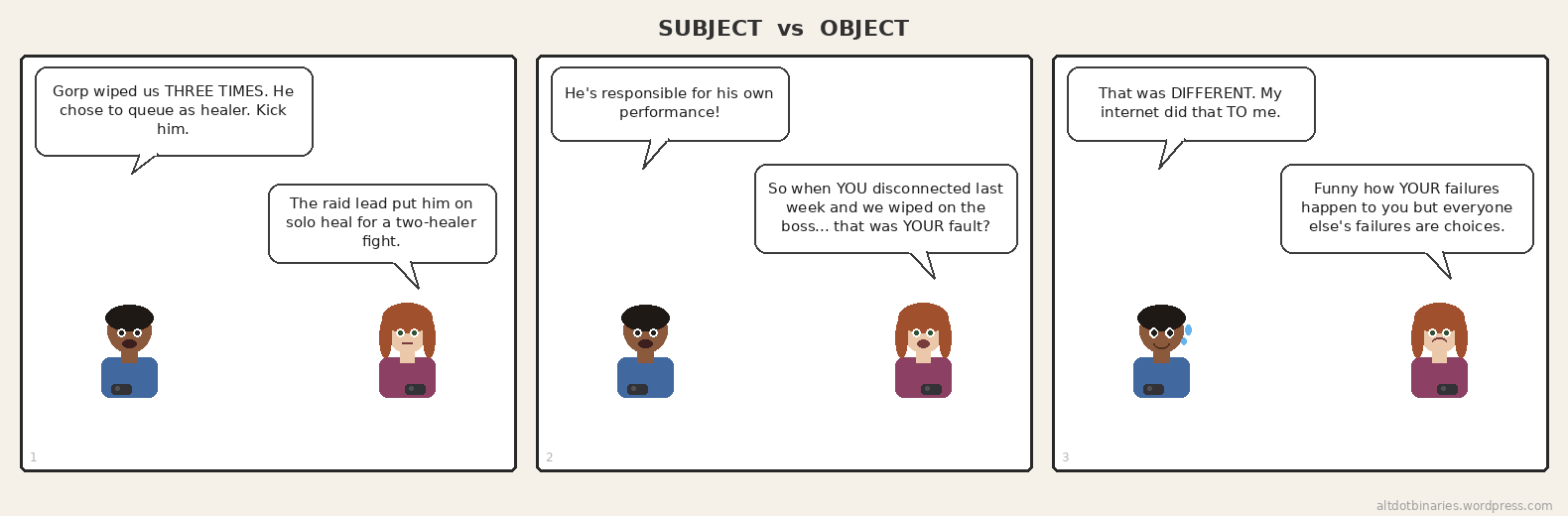
⟡ ⟡ ⟡
Imagine you’re on a jury. The defendant is a man, mid-thirties, charged with theft. He stole food from a grocery store. The defense argues he was unemployed, recently evicted, and hadn’t eaten in two days. The prosecution argues he walked in, put items in his bag, and walked out. Both accounts are factually identical.
Now notice what your brain is doing.
If you’re thinking about this man as a *subject* (an agent who makes choices and bears responsibility for them), then even the sympathetic details are just context for his decision. He chose to steal rather than go to a food bank, or ask for help, or do any number of other things. His hunger is a circumstance; his theft is an action. And actions have consequences.
If you’re thinking about him as an *object* (someone shaped and moved by forces outside his control), then the theft is practically inevitable. The system evicted him, the system denied him work, the system left him hungry, and the system’s food was right there behind inadequate security. He isn’t the subject of this story. Poverty is.
Neither of these is wrong, exactly. Both are incomplete. But the one your brain reaches for first tells you something, and the one a *culture* reaches for first tells you something much louder.
This is the binary I want to talk about: *Subject* versus *Object*. Not the grammatical terms (though those are useful), and not exactly the philosophical ones (though we’ll get there). This is about the perceptual lens through which we view different kinds of people, the one that was already running before we consciously started thinking about fairness or rights or who deserves what.
One way to think about it: a subject is someone whose *choices* are the relevant unit of analysis. An object is someone whose *circumstances* are. When we see someone as a subject, we foreground their will, their decisions, their agency. When we see someone as an object, we foreground what happened to them, what shaped them, what forces pushed them here.
Both of these are real aspects of every person. The question is which one your culture treats as the *default*.
Let’s start with the most obvious case. In our society, men are default subjects and women are default objects. This is not a controversial claim. It’s literally the etymology of the word “objectification.” When feminists say women are objectified, they’re pointing to a specific perceptual pattern: women are seen as things-acted-upon. Their role in the cultural grammar is to be the target of verbs, not the one conjugating them.
The upsides of being seen as a subject are the obvious ones. People grant you responsibility, trust you with power, believe your claims of competence, take your anger seriously. If you succeed, the success is attributed to you. If you assert yourself, the assertion lands.
The downsides are the inverse. If you fail, the failure is attributed to you. If you commit a crime, you are punished not just for the act but for the presumption that you *chose* it with full awareness. The contextual factors (your upbringing, your mental health, the structural incentives) are treated as excuses. Subjects get judged.
For objects, mirror the whole thing. The downside of being seen as an object is that nobody takes you seriously. Your accomplishments get attributed to luck, beauty, or someone else’s generosity. Your ambitions are patronized. Your anger is treated as irrational or cute. You’re protected, maybe, but protection means someone else is making the decisions about what you need protecting from.
The upside (and there is one, though people don’t like admitting it) is that when things go wrong, you get sympathy. Context matters. External forces are considered. You don’t get the full weight of blame, because everyone implicitly understands that you were being *acted upon*. Objects get compassion.
This framework helps explain a paradox that neither standard progressive nor standard conservative analysis handles well.
Men hold the vast majority of the highest positions of power in virtually every field. Congress, corporate boardrooms, film directors, heads of state. After fifty-plus years of nominally believing in gender equality, the numbers at the top have moved with infuriating slowness. This is real, and the progressive account of structural barriers and unconscious bias is largely correct.
But men also occupy the worst positions our society can assign. The prison population is overwhelmingly male. Men receive dramatically longer sentences for equivalent crimes. Men are the majority of the homeless, the majority of workplace deaths, the majority of combat casualties, the majority of suicides. If you told a sociologist about two demographic groups where one had ten times the incarceration rate of the other, their first instinct would not be “the more-jailed group is just naturally worse.” They’d look for systemic explanations. But when the divide is gendered, we mostly don’t.
This isn’t a paradox if you see it through the subject/object lens. Both outcomes (the CEO and the prisoner) are what happens when someone is perceived as a *subject*. Subjects get the extremes. They get the highest rewards for success and the harshest penalties for failure, because in both cases we’re treating their position as something they *earned* through their own choices. Objects get the middle. Not the pinnacle, not the pit. A safer, flatter distribution, bounded by the glass ceiling above and the glass floor below.
This framing doesn’t tell you who has it “worse.” It tells you that the *shape* of advantage and disadvantage is different depending on which grammatical role your culture assigned you.
There is a particularly instructive example of this dynamic in the strategy game *Crusader Kings*, which is such a deep cut that I’m going to allow myself to enjoy it.
In *Crusader Kings*, you play as a medieval dynasty. Each character in your realm has personality traits. Some traits are what the game calls “active”: Ambitious, Brave, Wrathful. These characters scheme, start wars, press claims. They act. Other traits are “passive”: Content, Craven, Temperate. These characters accept their lot, stay quiet, maintain stability. They are acted upon.
The genius of the game’s design is that active characters are both your greatest assets and your greatest threats. An ambitious vassal might conquer a duchy for your realm or might plot to murder you and take the throne. A craven vassal will never do either. The active characters (subjects) produce the extremes of outcome. The passive characters (objects) produce the safe middle.
And the game’s community has noticed something: players instinctively treat “active” NPCs as people with preferences and goals, and “passive” NPCs as furniture. A Content duke with excellent stats and decades of loyal service is just a number on a screen. An Ambitious duchess with terrible stats who once tried to assassinate you is a *character* you remember and tell stories about. Subjecthood makes you visible. Objecthood makes you useful but forgettable.
This mirrors real life in ways that the game’s designers probably didn’t intend. The people we remember, lionize, fear, and punish are the ones we perceive as subjects. The people we rely on, take for granted, and fail to credit are the ones we perceive as objects. Both categories serve essential functions. Neither is enviable from all angles.
Now let me walk through an example that makes this dynamic more concrete, because I want to show how the sorting operates underneath even our best intentions.
Imagine two vendors are competing for your business. Vendor A is a woman. Vendor B is a man. Both offer identical products at identical prices. You might, consciously or not, feel a small pull toward Vendor A. You might think: if I hire her, I’m helping correct an imbalance, supporting professional women. All else equal, she gets the nod. This feels progressive and good.
Now Vendor A tries to negotiate. She tells you that her product is essential, that you’ll fall behind without it, that she could take it elsewhere and you’ll regret it. Suddenly the goodwill evaporates. You were being *generous*. Now she’s being *greedy*. She was supposed to receive; now she’s acting like a subject, and it feels wrong.
Vendor B does the same thing: demands more, claims you need him, threatens to walk. You might find him annoying. But you also, at some level, believe him. He *sounds* like someone who has leverage, because subjects are the kind of people who *have* leverage. You might pay him more, not because you like him, but because his claim of power registers as plausible in a way that hers didn’t.
Notice what just happened. The progressive instinct (favor the woman) and the subject/object instinct (subjects have power, objects receive kindness) ended up in the same place: the man extracted more money. Not because anyone was trying to be sexist. The people in this scenario might be ardently feminist. But the subject/object lens was running underneath their good intentions, and it produced the same result that overt sexism would have.
A substantial portion of the wage gap operates through exactly this kind of mechanism. Teaching women to negotiate more aggressively helps, but only so much, because the problem isn’t that women don’t know how to negotiate. The problem is that the same negotiation tactic reads differently coming from a subject than from an object. An object claiming power triggers a kind of category violation that generates backlash rather than respect.
This brings us to the part that makes everyone uncomfortable, which is that this sorting doesn’t only follow gender lines. It follows racial ones too, in ways that don’t align neatly with a simple “privileged vs. marginalized” map.
In American culture, Black people (and Black men in particular) are often subject-coded. Research has found that Black boys are perceived as older, more responsible, and less innocent than white boys of the same age. Their behavior is read as *chosen* rather than *caused*. When a Black teenager acts out in school, the instinct is to treat it as a discipline problem (a subject who made a bad choice) rather than a developmental one (a child being shaped by circumstances). This is one of the engines of the school-to-prison pipeline.
The subject-coding of Black men produces the same bimodal distribution that gender-based subject-coding produces. On one end, a cultural comfort with Black male authority: American media portrayed Black presidents routinely long before one was elected, treating it as unremarkable in a way that female presidents never were. On the other end, the punitive catastrophe of mass incarceration, driven by the deep-rooted perception that Black men are *agents* whose failures are choices rather than circumstances.
Meanwhile, other minorities are more typically object-coded. Infantilized, pitied, not taken seriously as independent agents. This produces a different set of harms (the bamboo ceiling, the assumption of passivity, the reduction to cultural mascot) and a different set of protections (less incarceration, more benefit-of-the-doubt).
None of this is to say that one form of misperception is better than the other. It’s to say that the subject/object lens cuts differently than the simple oppressor/oppressed binary, and that some people get sorted into subject or object in ways that run counter to what you’d predict from their overall position in the social hierarchy.
So why does this persist? Why can’t we just decide to treat everyone as a full human with both agency and circumstance, and be done with it?
Partly because these perceptions are incredibly efficient mental shortcuts. When you have limited information about a person (which is most of the time), the subject/object default gives you a quick prediction about their behavior, their trustworthiness, and how to interact with them. It’s wrong a lot. All stereotypes are. But it’s *fast*, and in a world where you meet hundreds of people, your brain optimizes for speed over accuracy.
Partly because the categories are self-reinforcing. If you treat someone as a subject, they get the opportunities and pressures that produce subject-like behavior (risk-taking, self-assertion, visible ambition). If you treat someone as an object, they get the protections and limitations that produce object-like behavior (caution, compliance, invisible maintenance). The perception creates the reality, which confirms the perception.
And partly because (and this is the uncomfortable one) the subject/object frame is *useful for advocacy* in a way that makes it very hard for movements to abandon. If you’re trying to protect a group, casting them as objects (innocent, acted-upon, in need of defense) is enormously powerful. It triggers deep protective instincts. It makes your opponent look like a bully. It *works*.
But it works by reinforcing the very dynamic you’re trying to dismantle. Treating women as objects to be protected is not structurally different from treating women as objects to be consumed. The valence flips. The grammar stays the same. And fifty years later, you have an advocacy infrastructure that can generate enormous outrage and sympathy but can’t seem to close the actual gaps in power and representation, because closing those gaps would require people to see the protected class as subjects, and the whole strategy depends on them being objects.
This isn’t a critique of any particular movement. It’s a description of a trap that every movement falls into, because the trap is built into the language.
The reverse trap exists too, and it’s just as sticky. If your culture codes a group as subjects, then even well-meaning reforms struggle against the current. Criminal justice reform for men faces the constant undertow of “but they chose this.” Mental health support for subject-coded groups hits the wall of “real subjects don’t need help.” Every attempt to add context or compassion runs into the grammar that says subjects are self-caused, and self-caused things don’t deserve mitigation.
People can be punished for deviating from their assigned role, too. A woman who acts like a subject (aggressive, competitive, unapologetic) doesn’t get treated the way a male subject would. Her anger isn’t taken seriously; it’s treated as a tantrum. A man who acts like an object (vulnerable, complaint-oriented, asking for sympathy) doesn’t get the compassion an actual object would. His pain gets treated as weakness. The scripts are punishing in both directions.
It’s not that women can’t be angry or men can’t be vulnerable. It’s that the *social returns* on those behaviors are different depending on your category. A subject’s anger can be effective or dangerous; either way, it’s *real*. An object’s anger is decorative. A subject’s vulnerability is contemptible. An object’s vulnerability is natural. The same behavior, the same emotion, processed through two different grammars, yielding two different results.
There is an image from the ancient world that never quite left us, the Wheel of Fortuna, which is not (as modernity has flattened it into) a game show prop but a theological engine, a device for processing the unbearable fact that the same forces which raise a person to glory will dash them against the ground, and that the distinction between the king and the beggar is not character or merit or even luck but *position on the wheel at the moment you happened to look*. The subject rides the wheel’s ascent. The object clings to the hub. And the medieval mind, which was in many respects more honest than ours, understood that neither position was chosen, that the wheel turns of its own volition, that the grammar of who-acts and who-is-acted-upon is not a description of souls but of *angles*.
We forgot this.
We forgot it so thoroughly that we built entire civilizations on the principle that subjects *deserve* their position at the top and objects *deserve* their position in the middle, that the grammar is the ground truth rather than the lens, that the sentence diagram of a life tells you something real about the life rather than about the diagrammer. The Romans, who were better at cruelty and therefore better at honesty about cruelty, had the concept of *persona*, the mask worn by actors, through which the voice sounded (*per-sonare*, to sound through), and they understood that the mask determined whether you were the hero or the chorus, the killer or the killed, and that underneath the mask the face was just a face. We have lost even this. We think the mask *is* the face. We think the grammatical role *IS* the person.
Consider what this costs. In the Greek tragedies (which were themselves a kind of grammar lesson, a public seminar on how the city’s stories should be parsed), Agamemnon is a subject. He acts. He sacrifices his daughter, he wages war, he returns, he is murdered. Every verb is his. Cassandra is an object. She is captured, she is cursed, she is ignored, she is killed. Every verb is someone else’s. And the audience understands, in the way that theater allows you to understand things your philosophy cannot, that this is monstrous. That Cassandra *knows*. That she sees more than Agamemnon ever did. That her objecthood is not a description of her capacity but of the world’s refusal to grant her the grammatical slot that would make her knowledge *count*.
Two thousand years and we are still Cassandra’s audience, still watching, still understanding, still failing to change the grammar.
What the subject/object binary reveals, when you let it sit long enough and stop trying to extract an answer from it, is that we have built our entire social grammar on an asymmetry that is, at the deepest level, invented. Not because both sides are equally real (the comfortable hedge), but because at the final resolution, at the point where physics meets philosophy and neither blinks, there is only one side. There are only objects. Every human action is a consequence of prior causes: the neuron fires because the chemical gradient demanded it, the chemical gradient exists because of the gene and the environment and the breakfast and the childhood, and every link in that chain was itself caused by the link before it, back and back through evolutionary time to the first thermal gradient that made anything move at all. You are the weather. So is the man who robbed the grocery store. So is the judge who sentenced him. Determinism is not a position in the debate. It is the floor beneath the debate, the floor we all pretend isn’t there because standing on it makes it very hard to hold anyone responsible for anything, and we *need* to hold people responsible for things, and so we invented subjects.
We invented them because we had to. Because a social world without agency is not a social world at all but a physics simulation, and we are not built to live in physics simulations. We are built to live in stories. The subject is a fiction. It is also the most important fiction we have. Our inner lives require it (try experiencing yourself as nothing but cascading chemical reactions for an afternoon and see how that goes). Our social existence requires it (accountability, praise, love, blame, all of it collapses without the premise that someone *chose*). And pragmatically, treating people as if their choices matter produces better lives than treating them as billiard balls, even though billiard balls is what they technically are.
So we keep the fiction. And the task is not to discard it, not to arrive at some Olympian remove where we see only atoms and feel nothing, but to remember, in the moments that matter most (the sentencing, the hiring, the argument with someone you love), that the other person’s fiction of subjecthood is as real as yours, and that neither of you chose to be the one holding the story you’re holding.
*In which Drako Valentis and Nadia, judges at the Haven Annual Cookoff, disagree about how to score a contestant whose soufflé collapsed because the provided oven’s thermostat was broken.*
DRAKO: Zero. The dish failed. Next.
NADIA: Zero? The oven was broken. The *venue* gave her broken equipment.
DRAKO: And? A competent cook checks her equipment before she begins. I have watched sixty-three soufflés rise in my life, Nadia. Each one began with a hand on the oven door and an eye on the thermometer. She skipped the step. The soufflé collapsed. These are connected events.
NADIA: She’s seventeen.
DRAKO: I was holding a blade at thirteen. Age is a circumstance, not an excuse. The soufflé doesn’t care how old you are. It rises or it doesn’t.
NADIA: Right, because the soufflé is the objective measure of the universe’s moral order. Drako, listen to yourself. She was assigned a station. She trusted the station to function. That’s not incompetence. That’s a *reasonable assumption about the world she was placed in*.
DRAKO: Reasonable assumptions are how people get killed.
NADIA: In a *war*, maybe. This is a cooking competition in a park.
DRAKO: There is no environment where assuming your tools work, without verification, is a skill worth rewarding. Not in a park. Not in a war. Not in a kitchen. She was given a challenge. The challenge included the equipment. Overcoming flawed conditions is part of what distinguishes excellence from adequacy.
NADIA: So you want to give a zero to a kid who made a technically flawless batter, demonstrated proper folding technique, timed everything correctly, and lost because an institution handed her a broken machine. And you think this is *just*.
DRAKO: I think it is accurate. Which is better than just.
NADIA: See, this is what kills me about people like you. You genuinely think you’re being neutral. You think “I only judge the outcome” is an ideology-free position. But it’s not. It’s a *choice* to ignore every structural factor that produced the outcome. And that choice happens to benefit everyone who was lucky enough to get a working oven.
DRAKO: You’re saying I should give her points for being unlucky?
NADIA: I’m saying you should give her points for her *skill*, which was evident in everything she did right, and which was undermined by a factor she did not create and could not reasonably have anticipated in a supervised competition. You want to know what her soufflé would have looked like in a functional oven? Look at her mise en place. Look at her technique. The information is all there. You’re just choosing to look at the collapsed dish instead because it confirms your theory that everyone gets what they deserve.
DRAKO: And you’re choosing to look at the technique instead of the result because it confirms *your* theory that no one is responsible for anything that goes wrong in their life. She is not a passive victim of an oven, Nadia. She is a person who entered a competition and did not produce a successful dish. I am not punishing her. I am *describing* her.
NADIA: You’re not describing her. You’re describing the *oven* and calling it her name.
[Long pause.]
DRAKO: That is… a more interesting sentence than I expected from you.
NADIA: I know. I’m full of surprises. It’s what happens when you pay attention to the people the system treats as scenery.
DRAKO: I’ll give her a four. Out of ten. For technique. The soufflé is still a zero.
NADIA: I’ll take it. You monster.
DRAKO: Accurate monster.
NADIA: Sure. The accurate kind. Those are always the most dangerous.
**Further reading referenced in this post’s source material:**
[rebelhumanist.blogspot.com — “Sexism and Objectification”](https://rebelhumanist.blogspot.com/2017/02/sexism-and-objectification.html) — The original essay that coined the subject/object framework for gender dynamics, exploring how men are culturally coded as subjects (responsible agents) and women as objects (things acted upon), and how this dual lens explains both the glass ceiling and the male incarceration gap.
- Comment
- Reblog
-
Subscribe
Subscribed
Already have a WordPress.com account? Log in now.
 Alt Binaries
Leave a comment