Everyone agrees you should love people. Congratulations. The actually interesting fight is about why, and it maps onto almost nothing you’d expect.
The universalist says: all people deserve love and dignity, full stop, because they are people. You don’t need to meet them. You don’t need to hear their story. You don’t need to be emotionally moved by their particular suffering. The principle is the principle, and your personal feelings about whether someone is sympathetic are, frankly, irrelevant to it.
The humanist says: all people deserve love and dignity because each one of them is a staggeringly complex being with cities inside them, and if you actually sit with a person long enough to discover what kind of music they listen to when they’re sad, or how they felt the day their father didn’t show up, you will naturally arrive at compassion. Not as a rule. As a response.
Same conclusion. Completely different operating systems.
I’m being very reductive on purpose, to make the shape of the thing visible. But the instinct is real, and it shows up in strange places.
Like: who cries at movies? Not the relevant question. The relevant question is what makes you cry. If you cry at the specific character moment (the soldier writing a letter home, the dog waiting at the train station), you’re running humanist software. If you cry at the soaring orchestral swell that represents humanity’s capacity for goodness (the ending of Schindler’s List where it zooms out and out until the individual becomes a collective, or Gandalf’s “so do all who live to see such times”), those are universalist tears. Same salt water! Different plumbing.
This is not the same as “thinking vs. feeling.” Universalists can be incredibly emotional about their principles. Go read any argument about international human rights law; those people are furious with each other at all times. And humanists can be very analytical about empathy (narrative psychology is basically “what makes people give a shit about each other, studied rigorously”). The split is upstream of the think/feel divide.
It’s also not left vs. right, at least not cleanly. Your local church running a shelter because Jesus commanded it and your local bureaucrat running the same shelter because the data says housing-first is optimal are both universalist operations. The volunteer who knows every client’s name and the novelist writing a sympathetic villain are both humanist operations. I know people who are universalist about policy and humanist about art (and the reverse), which should tip you off that this is a tool rather than a personality.
(This is the part where I’m supposed to say “but people tend to favor one!” and they do, but I hate this rhetorical move because it always sounds like I’m loading the gun to tell you which one I prefer. I don’t think I have a settled preference. It genuinely depends on the stakes.)
The pop culture version is maybe the most fun. Compare Star Trek: TNG and Firefly. Picard loves humanity. He will speechify about what the human race is capable of, and it’s stirring, and he’ll extend dignity to alien species he met fifteen minutes ago because his principle demands it. Mal Reynolds loves his people. He knows what Kaylee’s father did for a living. He knows Zoe’s laugh. His compassion extends outward from that core only reluctantly, unevenly, and it shows.
You can already feel which one you’d rather have a beer with.
(Picard would be a better captain in a genuine crisis, though. Which is sort of the universalist’s whole argument.)
The failure mode of the universalist is that they treat everyone equally and therefore treat everyone like a stranger. The failure mode of the humanist is that they love a handful of people so vividly that everyone else becomes background radiation.
What’s uncomfortable is that both failure modes look an awful lot like what most of us actually do every day. The universalist’s “all people have dignity” quietly coexists with their inability to name ten refugees. The humanist’s deep love for their inner circle quietly coexists with a vast indifference to everyone outside it.
Which means this binary isn’t really about other people at all. It’s about how honest you are regarding the limits of your own compassion.
(Told you I’d take it somewhere uncomfortable.)
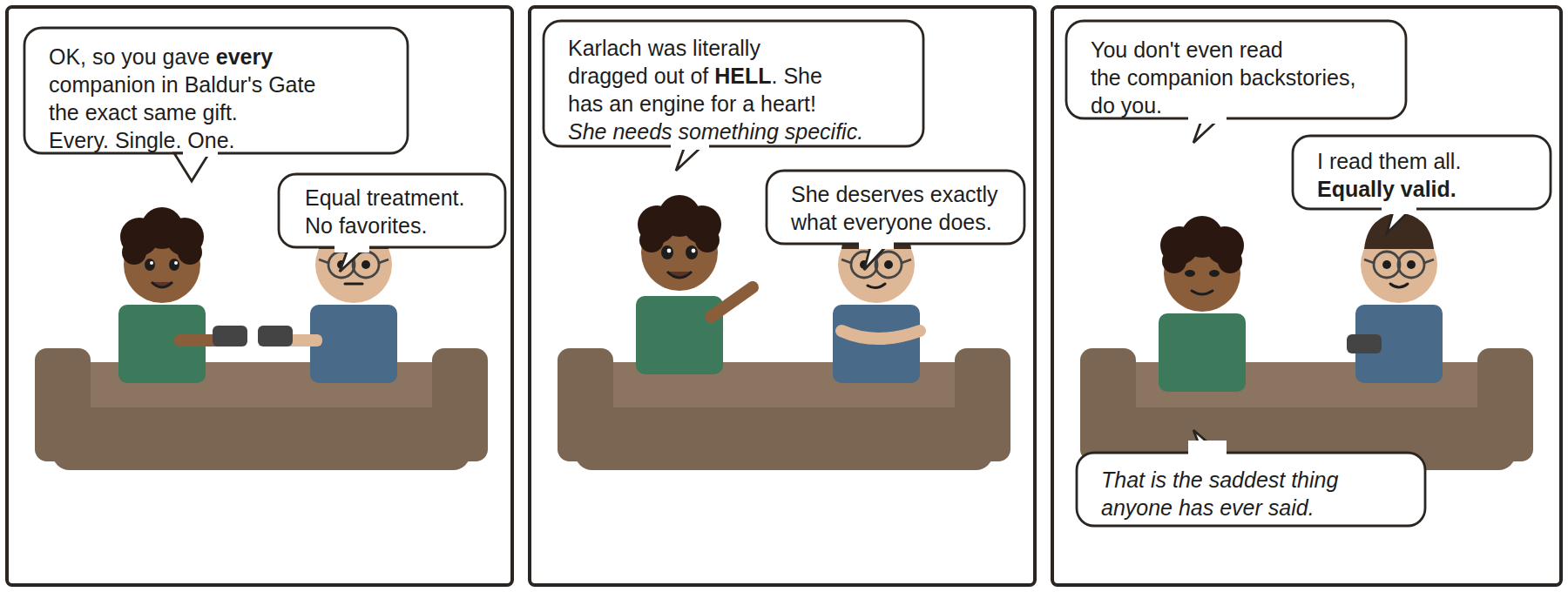
Imagine you’re hiring a home nurse for an elderly parent.
Candidate A has impeccable credentials. She treats every patient identically, follows protocol to the letter, has never been accused of favoritism. If you asked her about any specific patient, she’d tell you they all deserve the same standard of care. She has also, in fifteen years of nursing, never once been caught sitting by a patient’s bed at 2 AM reading to them.
Candidate B has slightly worse credentials but clearly knows her patients. She remembers that Mrs. Chen hates being called “sweetie.” She knows that Mr. Okafor lights up when someone asks about his grandchildren. She once got a note in her file for spending forty minutes with one patient and being late to the next.
Most people pick B. This feels obvious.
But notice what you just did. You picked the nurse who is worse at being fair because she is better at being particular. You accepted an uneven distribution of attention (some patients get more, some get less) because the quality of that attention felt more real. And if I asked you, “Would you still pick Nurse B if your parent was the one she was always late for?” you might hesitate. Because suddenly the uneven distribution matters a lot.
This is the universalist/humanist tension in miniature. It shows up everywhere once you start looking.
One way to frame it: the universalist and the humanist are each answering the question “why should I care about a stranger?” but they’re drawing from completely different wells.
The universalist answer is experiential, and it’s harder to argue with than you’d expect. Someone who has been in enough pain, or watched enough of it, arrives at a simpler place: pain is pain. Joy is joy. Hunger is hunger. Death is death. These are the same substrate in every nervous system. It does not matter whose body they are happening in. It does not matter what that person did, or what their childhood was like, or whether their story would make a good documentary. If you think any of these experiences are bad, they’re bad for everyone; if good, good for everyone. And if you want there to be less suffering or more flourishing, the biography is noise.
This version of universalism doesn’t come from a book or a lecture hall. It comes from having the particular burned out of you until only the universal is left. It’s the nurse who has seen so many patients die that she no longer needs to know their names to grieve for them. It’s the torture survivor who discovers, to their own surprise, that they cannot wish the same pain on their torturer — not out of magnanimity, but because they now know exactly what that pain is, and no abstraction about justice can make it tolerable. The principle didn’t come first. The experience did. But the conclusion is the same: every person counts equally, because the thing that matters most about them — their capacity to suffer — is already equal.
What this means is that the universalist doesn’t need to know the specific person in order to care about them. Knowing them wouldn’t change the math. Pain is pain, and more of it is worse.
The humanist answer is experiential. You should care because if you actually look at a specific person (really look at them) you will discover they are enormously complex and irreplaceable, and that discovery will generate compassion in you. The reason to care comes from the encounter. You meet the person. Then the caring follows.
Many people assume these are just two paths up the same mountain. In one sense they are. But they produce different failure modes, different blind spots, and different cultural artifacts, and those differences are large enough to matter a great deal.
The failure modes are more revealing, so let’s take those first.
There’s a famous result in psychology called the identifiable victim effect. Researchers showed subjects a charity appeal for food aid in Africa. One version described the scope of the problem: millions of people facing starvation, statistical breakdowns by region, scale of the crisis. The other version told the story of Rokia, a seven-year-old girl in Mali, and described her specific situation.
People donated roughly twice as much to Rokia.
This is deeply irrational, from a universalist perspective. One girl in Mali is not worth more than millions of people in Mali. If anything, the statistical version should trigger more compassion, because it describes more suffering. The universalist looks at this and sees a bug in human cognition. Our empathy module was designed for small groups, and it fails to scale. We need to build institutions that correct for this.
The humanist looks at the same data and sees empathy working correctly. The reason people give more to Rokia is that Rokia is real to them in a way that a statistic is not. The statistic strips away everything that makes a person a person. Of course your compassion doesn’t fire for a number. It fires for a face.
Both responses are correct. They are also in deep tension.
The universalist is right that the identifiable victim effect creates grotesque misallocations. There’s a reason the kid who falls down a well gets a million-dollar rescue operation and the ten thousand kids who die of preventable disease this week get nothing. The well-kid has a name and a face and a family waiting on the news. The ten thousand don’t. A world where resources flow to whoever has the best story is not a just world.
The humanist is right that the universalist alternative (make all suffering equally abstract, allocate by the numbers) produces a world where no one actually feels anything. You can’t guilt-trip people into caring about a spreadsheet. If you strip away the individual story, you don’t get a more rational compassion. You get no compassion at all, and then a bureaucrat decides.
Where I think this gets genuinely interesting is how each approach handles evil.
Thought experiment. A man has done something terrible. Not ambiguously terrible. Straightforwardly, uncomplicatedly terrible: he tortured someone for pleasure. How do you argue that this man still deserves moral consideration?
The universalist argues from principle. No one deserves to be tortured; therefore the torturer cannot be tortured. This is the strongest form of the argument, because it depends on zero contingent facts about the man’s life. It doesn’t matter if he had a rough childhood or a brain lesion or a sad backstory. The principle precedes the case. You could know nothing about this man and still know he has rights.
The humanist argues from encounter. Even this man, if you sat across from him long enough, would reveal himself as complex. He has a favorite song. He has a memory of being kind to someone. There is a face he makes when he’s nervous that looks exactly like a child’s. He is not exhausted by the worst thing he did. If you reduce him to “torturer,” you are performing the same dehumanizing move that made his crime possible in the first place.
Now here is what I find interesting.
The universalist argument is airtight. It can’t be refuted. It also doesn’t ask you to do anything hard. You simply apply the rule. You can say “even torturers have rights” without ever looking the man in the eye, without learning a single thing about him, without having your comfortable moral categories disturbed. The principle does the work and leaves your emotions exactly where they were.
The humanist argument is fragile. It might fail. Maybe you sit across from this man and feel nothing. Maybe his story doesn’t move you. Maybe he’s boring or repulsive or too alien to connect with. The humanist approach runs on emotional fuel, and there is no guarantee the fuel will be there. But when it works, it does something the universalist approach cannot do: it actually changes you. You walk away from that encounter a slightly different person, with a slightly expanded capacity for compassion that you didn’t have before.
This asymmetry explains a lot of the real-world friction between the two camps.
Universalist systems (law, the Geneva Convention, the U.N. Declaration of Human Rights) are enormously scalable and enormously flat. They cover everyone and move no one. When you read “all persons have inherent dignity,” your heart rate doesn’t change. The sentence works as a legal instrument, not an emotional one. This is a feature. Legal instruments need to be reliable precisely in the cases where emotions would betray you. But it means that universalist morality, deployed at scale, has a disturbing hollowness to it. You can build a whole civilization on “all men are created equal” and still have slavery, because the principle, by itself, does not require you to look any particular person in the eye.
Humanist practices (the novel, the documentary, the eulogy, fan fiction about your favorite villain, the act of sitting shiva) are enormously vivid and enormously uneven. They change people’s hearts, and they do it retail, one story at a time. When you read a good novel about a character unlike yourself, your measurable neural capacity for empathy expands (this is an actual finding, from a 2013 study in Science). But humanist empathy doesn’t scale. You can’t read a novel about every refugee. You can’t learn the name of every person in the shelter. The humanist approach is bounded by cognitive limits that no amount of goodwill can overcome.
This leads to a pattern I think about a lot, which I’ll call the empathy coverage problem.
The total number of people you can hold in your head as fully realized, complex, irreplaceable individuals (with their own favorite songs, childhood memories, private jokes) is somewhere around 150. Dunbar’s number. This is the humanist’s hard ceiling. Beyond 150 people, your brain starts treating humans as categories. “The poor.” “Republicans.” “The Chinese.” Each category contains millions of people who are each as complex as your best friend. You do not have the neural bandwidth to treat them that way.
So what happens outside the Dunbar radius? I see three options:
1. You let the humanist approach fail gracefully and accept that you simply won’t care much about people you don’t know. This is most people’s actual behavior. It’s honest. It produces the familiar landscape of intense loyalty to friends and family alongside polite indifference to the rest of the species.
2. You patch the gap with universalist principles. “I can’t hold seven billion people in my heart, so I’ll support institutions that treat them fairly even when I personally feel nothing.” The standard liberal-institutional response. It works surprisingly well (international humanitarian law exists and does real things), though it is emotionally unsatisfying and perpetually accused of being bloodless.
3. You try to expand the humanist radius. You deliberately seek out more stories, more encounters, more faces. You read novels from unfamiliar cultures. You volunteer. You listen. You try to make the empathy engine run hotter, cover more ground. This is admirable and also exhausting, and has its own pathology: it can curdle into competitive empathy display, where the performance of caring substitutes for the thing itself.
None of these are complete. Each fails in a way the others would patch.
There’s a version of this that shows up in everyday arguments that I think is underappreciated. Notice what happens when someone is accused of wrongdoing on the internet (which is to say, constantly).
The universalist response is: “The principle applies regardless. If we believe X is wrong, it’s wrong when our guy does it too.” This is admirable. It is also curiously easy to say, because it requires you to know nothing at all about the actual situation. You’re operating from a rule. The rule is doing the emotional labor so that you don’t have to.
The humanist response is: “Wait, do you know this person? Do you know their situation? Let me tell you about the context.” This is also admirable. It also has a failure mode where “context” becomes an infinite deferral of judgment, where every accusation dissolves into biography and you never have to actually say “this was wrong” because you’re too busy understanding.
The universalist accuses the humanist of making excuses. The humanist accuses the universalist of flattening. Both accusations are accurate roughly 40% of the time, which is often enough to sustain the argument forever.
And then there is the extremely common case where the same person applies universalism to their enemies and humanism to their friends. Your guy screwed up? “Well, you have to understand his background, he was under enormous pressure, the situation was more nuanced than…” Their guy screwed up? “The principle is clear, and it applies to everyone equally, no exceptions.” I would estimate this describes approximately 95% of political commentary, including mine, including yours, and the remaining 5% is people who are aware they’re doing it and trying to stop, with mixed results.
This asymmetric deployment is, I think, the actual scandal. Not that people are universalists or humanists, but that almost everyone is a universalist about strangers and a humanist about their friends, and very few people are honest about this.
The rare person who is a consistent universalist (same rules for everyone, including people they love) comes across as cold, even robotic. The rare person who is a consistent humanist (genuinely curious about the interior life of their enemies, not just their allies) comes across as naive, even dangerous. Consistency in either direction is socially expensive, which is why almost nobody pays for it.
I want to bring in a weird example from game design that illuminates this better than any philosophical argument I know. In 1985, Richard Garriott released Ultima IV: Quest of the Avatar, a game unlike any RPG before it. Instead of killing a villain, the player had to embody eight virtues: Compassion, Honesty, Valor, Justice, Honor, Sacrifice, Spirituality, Humility. The game tracked your behavior and graded whether you were being virtuous.
The moral framework was explicitly universalist. Compassion meant compassion toward everyone (beggars, enemies, annoying NPCs). The system deducted points if you refused to give gold to beggars, and it didn’t care which beggar. Equal application. No favorites.
But here is the thing Garriott couldn’t solve. The game could measure whether you gave gold to the beggar. It could not measure whether you cared about the beggar. The universalist system could track compliance but not connection. Players figured out immediately that they could farm Compassion points by mechanically donating gold every time they saw a beggar, without once clicking through the NPC’s dialogue or thinking about their situation for a single second.
Garriott had built a game about virtue that could only detect obedience.
I don’t think this is a quirk of game design. I think it’s a deep structural truth about the universalist approach in general. Any system that applies equally to all people can only measure what’s legible from the outside: did you follow the rule, did you allocate the resource, did you comply with the protocol. It cannot measure the interior event (did you see the person, did you let them change you) because interior events aren’t legible. They can’t be audited. They don’t scale. They exist only in the specific encounter between two people, and they vanish when you try to put them in a spreadsheet.
Which means the universalist is always, at some level, building a system that can function without love. That’s the point. The system has to work even when the love isn’t there, because sometimes the love isn’t there. Human rights law does not depend on the judge personally caring about the defendant. That is what makes it reliable.
And the humanist is always, at some level, insisting that a system without love isn’t worth building. That the entire point of moral life is the interior event, the moment when you look at another person and something shifts, and that any system which bypasses this moment in the name of efficiency has lost the plot entirely.
I keep noticing how these two positions circle each other. Each one looks at the other’s failure mode and says see? The universalist points at the identifiable victim effect, at GoFundMe campaigns that raise half a million for one photogenic family while a million equally desperate families get nothing, and says: this is what happens when you trust the humanist engine. It plays favorites. It rewards charisma. It’s a popularity contest wearing the mask of moral feeling.
The humanist points at the U.N. Declaration, at the Geneva Convention, at every grand universal principle that has coexisted comfortably with atrocity, and says: this is what happens when you trust the universalist framework. Beautiful sentences that change nothing. You get to feel moral without ever being changed. It’s a way to care about everyone in theory while caring about no one in practice.
Both critiques land.
A few more examples of this binary in the wild, because the breadth of the thing is part of the point:
- Teaching. A universalist teacher uses the same rubric for every student: clear criteria, applied identically, no exceptions. A humanist teacher notices that Marcus writes brilliantly when he can pace around the room and that Priya needs to outline in silence for twenty minutes before she can start. The universalist produces fairness. The humanist produces the occasional student who says “that class changed my life,” alongside others who barely got noticed.
- Grief. The universalist grief counselor says: loss is loss, and there are well-documented stages that apply to every bereaved person. The humanist says: you are not mourning “a father,” you are mourning the specific man who burned the pancakes every Saturday and called you “bug” until you were thirty-four. The universalist framework lets you build a bereavement support group for strangers. The humanist one is why the support group never works as well as one conversation with someone who actually knew him.
- Medicine. Universalist medicine is evidence-based protocols: if you present with condition X, you receive treatment Y, because randomized controlled trials say it works for the largest number of people. Humanist medicine is the doctor who remembers that Mrs. Okafor won’t take pills that look like the ones her late husband choked on, and adjusts the prescription accordingly. The protocol saves more lives in aggregate. The adjustment saves this one.
- Tipping. The universalist tips 20% at every restaurant, every time, regardless of how the meal went, because service workers deserve consistent compensation and your personal experience of the risotto shouldn’t determine someone else’s rent. The humanist tips the server who noticed their kid was getting restless and brought crayons without being asked an extra ten dollars, and the one who was visibly annoyed by the kid nothing extra. Both believe they’re being fair. Neither is wrong.
- Memorials. A universalist memorial lists every name in the same font, same size, alphabetical order: no hierarchy, no favoritism, the democracy of the dead. The AIDS Memorial Quilt asked each person’s loved ones to sew a unique panel — this one covered in sequins, that one with a faded concert T-shirt stitched to the center, another with a handwritten joke only two people on earth would understand. The wall of names is more complete. The quilt is more true.
There’s a moment in Disco Elysium (the 2019 RPG, and the deepest cut I’m going to attempt without losing everyone) that captures this better than anything I’ve read in actual philosophy. The game lets you adopt political ideologies: communist, fascist, liberal moralist, ultraliberal. Each is a universalist framework with a grand theory of human organization. The game mocks all of them, relentlessly, because its actual engine runs on humanist encounters. You talk to a specific woman about her specific dead husband. You sit with a specific old man’s specific theory about the pale. You grieve in a specific church. Every ideology you adopt is, in the game’s framing, a way of retreating from the terrifying specificity of other people into the comfortable generality of a system.
But (and this is what makes the game great rather than merely clever) it also knows you need the systems. The main character has been destroyed by specificity. He loved one particular woman too much. He felt one particular grief too keenly. His humanist engine burned so hot it consumed him entirely. The ideologies, absurd as they are, give him a way to care about something larger than his own broken heart. They give him a way to get out of bed.
The universalist framework lets you function. The humanist encounter gives you a reason to.
Which is, I think, only to restate in the argot of a medium that has still not decided whether it is art or product what the Cappadocian Fathers already understood in the fourth century, when they argued against the Eunomians and their brittle logical monotheism that the Godhead itself must be understood as a relation between persons and not as a property of substance, that the Trinity is not a committee of three deities splitting the cosmic portfolio but an eternal movement of kenosis, of self-emptying, in which each person of God pours itself out into the other in a motion that has no origin and no conclusion and no moment of rest, and that this pouring-out is not a deficiency in God but is God, the whole of what divinity means, so that when Gregory of Nyssa writes that the Father is Father only insofar as he is oriented toward the Son, and the Son is Son only insofar as he receives and returns, he is saying in language that will sound alien to anyone raised on the thin gruel of Enlightenment individualism that personhood is not a possession but an event, something that happens between, and that the universalist error is to imagine love can be a law, written once on a tablet and applied forever to anyone without variation, without the terrible risk of looking another creature in the face and finding yourself altered by what you see there, and that the humanist error is to imagine love can be a feeling, housed in one body, generated by one encounter, sustained by the private electricity of one nervous system, when love in its oldest and most unmanageable form is neither of these things, is rather the name we give to the structure of a situation in which two beings who cannot fully comprehend each other nonetheless refuse to stop trying.
There were cults in the ancient Mediterranean (before Christ, and alongside him) in which the initiate was required to look into the face of a stranger and say I know you. Not “I know your name” or “I know your story” or even “I know your suffering.” Just: I know you. The stranger said it back. That was the whole rite. No animal was harmed. No wine was consecrated. Two people stood in a room and lied to each other in a way that was also, somehow, the deepest truth available to them, because of course you do not know this person, you cannot, the entire width of another consciousness is permanently closed to you and will remain so until you or they are dead, but in the act of claiming it you commit to the impossibility of the project, you sign up for the permanent unfinishedness of it, and this commitment to a task you will never complete is, in the grammar of the ancient world, what distinguished the sacred from the merely ethical.
The merely ethical says: do not harm this person. Fine. The sacred says: this person is inexhaustible. And so are you. And the space between you will never be fully mapped. And you will spend your life on the mapping anyway. And you will die with most of it incomplete. And this is not a tragedy.
We have, predictably, lost all of this. We have replaced it on the one hand with declarations (all men are created equal, with certain unalienable rights, which are violated roughly six thousand times before anyone finishes breakfast) and on the other with performances of individual feeling (I cried at the movie, I shared the GoFundMe, I changed my profile picture to a flag), and each substitute is more comfortable than the original because each lets you stop. The declaration is finished once spoken. The performance is finished once witnessed. But the old rite had no endpoint. You stood in the room with the stranger, you said I know you, and then you had to keep standing there, because the knowing was not a state you arrived at. It was a direction you faced.
The universalist faces everyone. The humanist faces someone. What the old cults understood, what we have been trying very hard to forget, is that the gesture of facing is the thing itself, prior to both principle and feeling, prior to law and prior to story, the first and stupidest and most radical act available to a creature with eyes.
You turn toward another person.
Everything else is commentary.
The Gift Exchange
ALEKSANDER: Okay, I’ve been thinking about the Tower gift exchange.
ABBAS: There are rules for the gift exchange.
ALEKSANDER: I know there are rules, Abbas—
ABBAS: Twenty-crown limit. Random draw. No swaps. The rules exist so that everyone is treated equally and no one is made to feel lesser because they received a worse gift or were passed over by the person they wanted.
ALEKSANDER: Yes. And every year, thanks to the rules, Hadria ends up with a scented candle.
ABBAS: Scented candles are perfectly—
ALEKSANDER: She is allergic to most scents, Abbas. She has told people this. Multiple times. At volume.
ABBAS: Then the giver should have been more thoughtful within the parameters of the system.
ALEKSANDER: The giver was Drako. Drako’s idea of thoughtfulness is not actively wishing you harm. He bought fourteen identical candles. One for whoever he drew. The other thirteen because they were on sale and he thought they might be “useful.”
ABBAS: That is… a failure of execution, not of principle.
ALEKSANDER: It is a failure of knowing who you’re giving something to. Which is the whole point of giving a gift! You wouldn’t hand someone medicine without checking if they’re sick. You wouldn’t give a poem to someone who can’t read. Gifts are supposed to be acts of seeing another person—
ABBAS: Gifts in a formal exchange are acts of community. The point is that everyone participates on equal footing. The moment you start tailoring gifts to individuals based on your personal knowledge of them, you’ve created a hierarchy. The people you know well get beautiful, thoughtful presents. The people you don’t know get… what? The candle.
ALEKSANDER: That’s already happening! That’s what I’m trying to fix!
ABBAS: You’re trying to fix it by replacing a fair system with your personal judgment about who deserves what kind of attention. Forgive me if that sounds worse.
ALEKSANDER: It’s not my personal judgment, it’s—okay. Okay. Do you know what Laszlo collects?
ABBAS: I don’t see how—
ALEKSANDER: Pressed flowers. From every place he’s studied. He has a whole book of them. He showed it to me once, very quietly, like he was embarrassed, which he was. Do you know that about him?
ABBAS: …No.
ALEKSANDER: Do you know that Kamella can’t sleep without something heavy on her chest? She told me it’s because of the nightmares. She wraps herself in the thickest blanket she can find and it still isn’t enough. Do you know what I got her last year? A weighted lap throw I had made from scraps. She cried, Abbas. She stood there holding this ugly, lopsided blanket and she cried. But I wasn’t her assigned giver. I just gave it to her. Which you’re telling me is against the rules.
ABBAS: It is against the rules. Because if you give Kamella a weighted blanket and her assigned giver gives her a twenty-crown trinket, what have you done? You’ve made the assigned giver look callous. You’ve made Kamella feel that the official system failed her. You’ve created a two-tier exchange: the real gifts from people who know you, and the hollow gestures from people who drew your name out of a hat. Congratulations: you’ve just built a popularity contest.
ALEKSANDER: You say “popularity contest” like I’m ranking people. I’m not ranking anyone. I love everyone—
ABBAS: You love everyone differently. That’s the problem.
ALEKSANDER: That’s not a problem, that’s what love is—
ABBAS: Love that varies by recipient is preference. Preference scaled across a community is inequality. I have watched you, Aleksander, at every gathering, every feast, every occasion where people are together. You are magnificent with individuals. You remember their names, their stories, the specific way they take their tea. But the people whose stories you haven’t collected? The quiet ones, the new ones, the ones who didn’t open up to you within the first ten minutes? They get the generic version. The warm smile that doesn’t quite reach the eyes.
ALEKSANDER: That’s not—
ABBAS: It is. I’ve seen it. You’re warmer than anyone I know to the people you know, and you are merely polite to the people you don’t. And politeness, in the shadow of your warmth, feels like being shut out.
ALEKSANDER: …
ABBAS: The rules exist to protect those people. The ones whose stories you haven’t heard yet. The twenty-crown limit means Kamella’s gift and the new girl’s gift cost the same. The random draw means no one gets to choose who they care about. It’s crude, yes. It’s imperfect, yes. Hadria gets a candle she can’t smell. But she gets it on equal footing with every other person in the room, and there is a dignity in that. A small, stupid, imperfect dignity, but it’s real.
ALEKSANDER: You know what else is real? Hadria throwing the candle at Drako’s head last year.
ABBAS: She has a strong arm.
ALEKSANDER: She does. Good follow-through. Listen. I hear you. I do. But what you’re describing—the equal-footing thing—it sounds beautiful in theory and in practice it means nobody gets seen. Everyone gets the same tepid gesture. Nobody is hurt, sure, but nobody is reached either. You’re so afraid of someone getting less that you’ve made sure nobody gets enough.
ABBAS: And you’re so eager for someone to get enough that you can’t see the six people standing behind them getting nothing.
ALEKSANDER: That’s why I’m proposing we change the system—
ABBAS: To what?
ALEKSANDER: To—I don’t know—a thing where you answer questions about yourself. Anonymously. And your assigned giver gets the answers. What’s a smell you like. What’s a memory that makes you happy. What’s something you need. And then you get them something based on that, based on who they actually are, not just—
ABBAS: You want to build a system for making strangers legible to each other.
ALEKSANDER: …Yes?
ABBAS: You want to take the humanist impulse—the specific knowledge of a person that you acquire by loving them over time—and bureaucratize it. Put it in a questionnaire. Reduce “I know what makes Kamella cry” to a fill-in-the-blank form.
ALEKSANDER: Well when you say it like that—
ABBAS: I’m saying it like that because it’s what you’re proposing. You want the warmth of the personal encounter without the encounter. You want every gift to feel like it came from someone who knows you, delivered by someone who read your answers on a piece of paper. That’s not humanism. That’s a simulation of humanism. It’s the scented candle of emotional connection.
ALEKSANDER: Okay, that one actually hurt.
ABBAS: I’m sorry.
ALEKSANDER: No, it’s—you might be right. I don’t know. I just… I keep thinking about Kamella holding that blanket. And I think: the system didn’t do that. I did that. I did that because I sat with her one night when she couldn’t sleep and she told me things she doesn’t tell people, and I listened, and then months later I remembered. No questionnaire would have gotten there. But also… no fair system would have gotten there either.
ABBAS: No.
ALEKSANDER: So what do we do?
ABBAS: We run the gift exchange. Twenty crowns. Random draw. No swaps.
ALEKSANDER: And Hadria gets another candle.
ABBAS: And you, separately, privately, outside the system, give Kamella a blanket. And Laszlo a pressed flower. And Hadria something that doesn’t make her sneeze. You do it because you love them. Not because the system asked you to. Not because a questionnaire told you to. Because you know them.
ALEKSANDER: …That’s two systems running at the same time. The fair one and the real one.
ABBAS: Yes.
ALEKSANDER: Isn’t that sort of an admission that neither one works?
ABBAS: It is an admission that people need both to be treated equally and to be known individually, and that these are fundamentally incompatible projects that we are condemned to pursue simultaneously for the rest of our lives.
ALEKSANDER: That’s the most depressing thing you’ve ever said to me.
ABBAS: I also got you something. Outside the system.
ALEKSANDER: …What?
ABBAS: A notebook. For the stories you collect. Your old one was full.
ALEKSANDER: How did you—
ABBAS: I notice things. Don’t make it into a whole narrative.
ALEKSANDER: Abbas.
ABBAS: What.
ALEKSANDER: You are a humanist.
ABBAS: I am a universalist who is occasionally, grudgingly, also a person. Now help me sort these names for the draw. And tell Drako if he buys fourteen candles again I will make it a disciplinary matter.
[Human author’s notes:
1. Yes, the AI came up with the entirety of that sentence. You know the one.
2. If today’s dichotomy interests you, you can buy my two player LARP about it.
3. I accidentally posted this binary before the blog launched, before I even told anyone about it, and I took it down within a couple of hours. In that time it got more “Likes” than any of my other posts have gotten so far.]
 Alt Binaries
Leave a comment