I want to talk about a distinction that sounds like it belongs in a graduate seminar but actually explains most of the arguments you’ve had this week. No, most of the thoughts you’ve had this week.
The Real and the Symbolic.
The Real is what’s actually there. The body. The weather. The truck that runs a red light. The tumor on the scan. It doesn’t care what you call it, what frame you put around it, or how you feel about it. It is the thing itself that remains when you stop talking.
The Symbolic is the entire apparatus of language, meaning, status, and interpretation we layer on top of everything. It’s the word “tumor.” It’s the red light itself (just a colored bulb, if you think about it, that we’ve collectively agreed means “stop”). It’s your job title, your diploma, the wedding ring, the flag.
Most people, when they hear this, immediately think: “Okay so the Real is what matters and the Symbolic is fake.” And I get that impulse. But sit with it for five minutes and it falls apart.
You are currently reading symbols. These words are doing something to your brain that grunting and pointing could never accomplish. The entire cooperative infrastructure of civilization (money, law, traffic lights, medicine) is Symbolic. When someone gets a diagnosis, the name of the disease doesn’t change the biology, but it changes everything about how they and everyone around them respond. The Symbolic isn’t a veil over the Real. It’s the scaffold we build so we can do anything about the Real at all.
Meanwhile, the Real has this inconvenient habit of not reading the memo. You can have the most beautiful symbolic framework in the world (a peace treaty, a business plan, a five-year relationship built on the narrative that “we’re soulmates”) and then something real happens and the whole thing cracks. Lacan, who coined these terms in roughly this usage, called it a “traumatic encounter with the Real.” You’re sitting at a green light, you go, and a semi blows through the intersection, and suddenly you understand in your body that traffic law is a collective fiction held together by social trust and colored bulbs. Nothing actually stops the truck.
The people who orient toward the Real tend to say things like: “I don’t care what you call it, I care what it does.” They distrust credentials, titles, euphemisms. They want the raw data. They’re the person at the meeting who says “but what are the actual numbers.” They think most of society is a machine for producing comforting stories that obscure a harsher, more interesting truth. They have a point.
The people who orient toward the Symbolic tend to say things like: “How you frame something is what it does.” They understand that a doctor saying “you have a condition” versus “you’re dying” produces completely different outcomes even when describing the same scan. They know that confidence is a performance and the performance is the thing. They know that calling a group of fighters “freedom fighters” versus “terrorists” isn’t just spin; it actually changes who joins, who funds them, who shoots at them. They also have a point.
Both of these are, and I hate doing this but I’m going to do it here, basically correct. Which means the interesting question isn’t “which one is real” (pun intended) but when each lens is more useful. If your house is on fire, you are briefly and terrifyingly in the domain of the Real, and the person who says “well, ‘fire’ is a culturally constructed category” is not helping. If you’re trying to build a political coalition or write a resume or comfort a grieving friend, you are deep in the Symbolic, and the person who says “none of these words actually correspond to the underlying physical reality” is (while technically correct) an absolute nightmare at parties.
The gap between these two is where most of the comedy and tragedy of human life takes place. It’s the space where your dating profile can’t capture who you actually are. Where a nation’s GDP doesn’t tell you whether anyone in it is happy. Where your mother is dead and no obituary will ever be adequate.
Ideally you’d want to be the kind of person who can operate in both registers, who knows when to pay attention to the symbol and when to look past it at the thing itself. In practice most of us have a home base. This post is about figuring out which one is yours, and getting curious about the other.
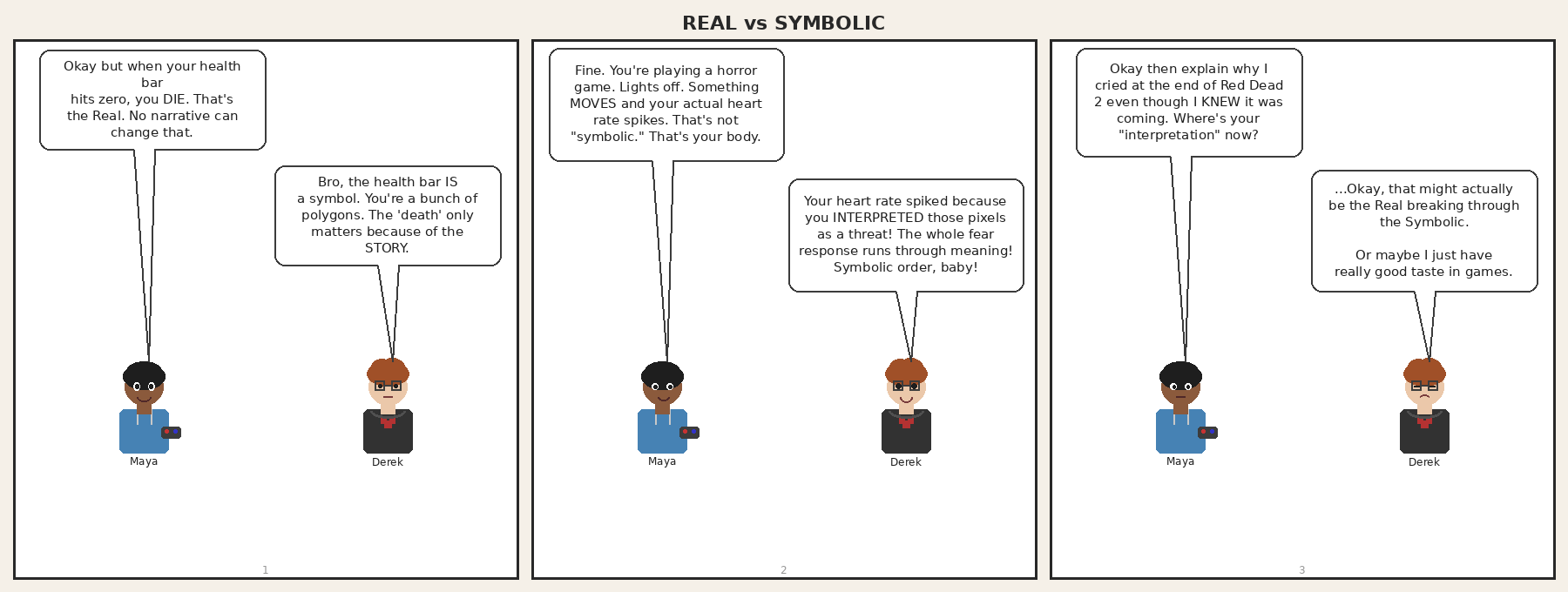
Copy
One way to think about the Real and the Symbolic is through something embarrassingly mundane: a job interview.
You walk in. You’re wearing a suit (or at least a nice shirt). You’ve rehearsed answers. You have a resume, which is a document that translates the messy, complex, often contradictory experience of your working life into a series of bullet points designed to trigger specific interpretive responses in a stranger. Everything in this room is Symbolic. The handshake, the eye contact, the question “tell me about yourself” (which does not actually want you to tell them about yourself). The entire interaction is a ritual of symbol-exchange, and both parties know it.
Now imagine the interviewer asks you a technical question and you don’t know the answer.
There is a very brief, very electric moment where the Real intrudes. You don’t know. That’s a fact about the world. No amount of confident body language or clever reframing can make you know something you don’t know. You can perform knowledge (Symbolic), or you can admit ignorance (closer to the Real), and the choice you make in that half-second tells you which register you default to under pressure.
This isn’t just about interviews, obviously. It’s about everything.
But let’s stay with the interview for one more moment, because something subtler is happening. The interviewer is also operating in layers of the Symbolic. They have the explicit Symbolic framework (the job description, the rubric, the “culture fit” checklist) and they have a vaguer, less articulated Symbolic impression (a “vibe,” a sense of whether you “fit,” a half-formed narrative about who you are based on your handshake and your first sentence). That second layer feels like instinct, but it’s still Symbolic. It’s still interpretation, pattern-matching, narrative. It’s just Symbolic that hasn’t been formalized yet. Study after study shows that hiring decisions are made in the first thirty seconds and then rationalized afterward. The inchoate Symbolic impression comes first. The explicit Symbolic justification is built to house it. Both the interviewer and the candidate know this, and neither can say it out loud, because saying it out loud would break the Symbolic frame that makes the interaction function. This is one of the quieter ways the Symbolic operates: in layers, some polished and presentable, others murky and half-conscious, all of them interpretation rather than raw encounter.
Consider medicine. A patient goes to a doctor with chronic pain. The doctor runs tests and finds nothing. “There’s nothing wrong with you,” the doctor says. Now, in the Symbolic register, this is true. The tests (which are themselves symbolic representations of biological processes) returned no recognized pattern. In the register of the Real, the patient is still in pain. The pain doesn’t care about the test results. The pain is a brute fact of bodily experience that exists whether or not the medical establishment has a name for it.
Huge amounts of medical suffering happen in exactly this gap. Patients with conditions that don’t yet have names, or whose symptoms don’t match recognized patterns, live in a strange limbo where the Real (their body) and the Symbolic (the diagnostic framework) refuse to line up. And because we’ve built a civilization that runs primarily on Symbolic infrastructure (insurance codes, diagnostic manuals, referral systems), the patient without a code is, in a very practical sense, a patient without a disease. Even though they’re in pain.
Lacan, the French psychoanalyst who formalized this distinction (in his own peculiar and frequently infuriating way), was obsessed with exactly this kind of gap. He thought most of human anxiety comes from the space between what we experience and what we can say about what we experience. You know the feeling of trying to describe a dream and watching it evaporate as you put it into words? That’s the Symbolic failing to capture the Real. You know the uncanny feeling of reading your own medical chart, or hearing someone describe you at a party, and thinking “that’s technically accurate but it’s not me”? Same gap.
He had a thought experiment (well, more of an observation) about traffic intersections that I find genuinely useful. You’re sitting at a red light. You have Symbolic knowledge of how intersections work: red means stop, green means go. This is clean, simple, and it works. Then one day you go on green and a truck nearly kills you because the driver wasn’t paying attention. And for a moment you understand, with your whole nervous system, that the intersection is not actually governed by the colors of the lights. It’s governed by the mass and velocity of objects moving through space, and the lights are just a suggestion that works if everyone cooperates. The Real (physics, metal, momentum) was always there underneath the Symbolic (traffic law, colored lights, social trust). You just forgot.
This is not to say the Symbolic is trivial. The Symbolic is what lets you forget. And forgetting is incredibly useful. If you drove through every intersection in a state of vivid awareness that two tons of metal could obliterate you at any moment, you’d never go anywhere. The entire function of the Symbolic is to make the overwhelming, chaotic, often terrifying Real manageable enough to navigate. Language, categories, laws, institutions, names, diagnoses, maps, money: all of it is a compression algorithm that turns the incomprehensible Real into something you can work with.
The question is what happens when the compression loses too much data.
Think about maps. A map of a city is Symbolic. It represents streets and buildings and parks with lines and shapes and colors. Extremely useful. But the map doesn’t include the smell of the bakery on 5th Street, the fact that the sidewalk on Oak Avenue is buckled and will trip you, or the unspoken social reality that one block is safe at night and the next one isn’t. A tourist with only a map has Symbolic knowledge. A resident who’s walked those streets for twenty years has something closer to Real knowledge (embodied, sensory, unspeakable). The tourist can navigate. The resident can live.
James C. Scott’s Seeing Like a State is essentially a book-length study of this exact failure mode. Scott shows how modern states, in their drive to make populations and landscapes legible, imposed Symbolic grids (standardized surnames, cadastral maps, planned cities, monoculture forests) on the messy Real of how people actually lived and worked. The results were often catastrophic: forests died, cities became uninhabitable, agricultural schemes starved the people they were supposed to feed. The state could see its maps. It could not see the territory.
There’s something important to flag here that makes this binary different from a clean toggle. You can never be fully in one register. There is no such thing as a purely Real experience or a purely Symbolic one. The moment you notice the smell of that bakery on 5th Street, you’re already categorizing it (“bakery,” “good,” “reminds me of my grandmother’s kitchen”). The Real has been caught by the Symbolic before you even finish the breath. And conversely, even the most abstract Symbolic system (pure mathematics, formal logic) is being processed by a physical brain, in a body, with blood sugar and fatigue and a creaky chair, and all of that Real substrate shapes the thought in ways the symbols can’t represent. Everything is a mixture. The question is never “which one is this” but “which one is doing more of the work right now.” It’s a dial, not a switch, and the dial never hits either endpoint.
Neither perspective is sufficient alone or even possible. But most of the time, we’re running on one or the other, and the interesting moments are when we switch (or are forced to switch).
Here’s where this gets personal and political, because of course it does.
People who orient heavily toward the Symbolic tend to be very good at navigating institutions, building consensus, managing perceptions, and constructing narratives. They understand that how something is framed often matters more than what it is. They’re right. A company that’s losing money but has a compelling growth narrative will attract more investment than a profitable company with a boring story. A political candidate who tells a resonant story wins over the one who recites accurate statistics. The Symbolic is not a distortion of reality. It is a force in reality, one that moves money and armies and hearts.
People who orient heavily toward the Real tend to be frustrated by this. They see the narrative layer as an obstruction. They want to strip it away and look at what’s underneath. They’re the empiricists, the debunkers, the people who say “but what actually happened.” They have a certain iconoclastic energy that is extremely useful when the Symbolic has calcified into dogma (when everyone agrees the emperor has clothes because the Symbolic says he does) and extremely annoying when the Symbolic is doing important work (when a comforting fiction is holding a family or a nation together, and the person who insists on “the truth” is actually just detonating the load-bearing walls).
Nobody has mapped this tension more obsessively than David Lynch. His entire filmography is a sustained meditation on what happens when the Symbolic surface cracks and the Real bleeds through.
Blue Velvet opens with what might be the most Symbolic sequence in American cinema. White picket fences. Red roses. A fireman waves from a passing truck. Bobby Vinton croons on the soundtrack. It’s not a suburb; it’s the idea of a suburb, every image so saturated and slow that it already feels like an advertisement for itself. And then the camera pushes down through the manicured lawn into the soil, and you hear the sound of beetles devouring each other in the dark. That’s it. That’s the whole binary in forty-five seconds. The Symbolic surface is pristine. The Real underneath is writhing.
The movie’s plot follows the same trajectory: Jeffrey finds a severed human ear in a field (about as blunt an eruption of the Real as you can get), and the entire story is him descending through layers of the Symbolic (the nice neighborhood, the friendly detective, the wholesome girlfriend) into the Real underneath (Frank Booth, who is essentially the Real made flesh, a creature of pure appetite and violence who doesn’t perform anything, who says exactly what he wants and takes it). What makes Frank terrifying isn’t that he’s hidden. It’s that he’s right there, one layer down, and the Symbolic surface of Lumberton was always a thin membrane stretched over him.
Twin Peaks does the same thing at the scale of an entire town. The Symbolic layer is almost parodically thick: cherry pie, damn fine coffee, the Miss Twin Peaks pageant, the soap-opera love triangles. Every resident is performing “small-town America” with the dedication of a community theater cast. And then Laura Palmer is found wrapped in plastic, and the whole performance starts to crack. The deeper Agent Cooper digs, the more the Real asserts itself: abuse, addiction, prostitution, and eventually something that isn’t even human. BOB. The Black Lodge. Forces that don’t operate by narrative logic at all, that simply are, in the way that a disease or a natural disaster simply is.
Lynch’s insight – and what makes “Lynchian” mean something more than “weird and dreamy” – is that the Symbolic isn’t just a cover-up. The people of Twin Peaks aren’t faking their warmth and their pie and their community. Those things are real too, in the way that the Symbolic is always real: it structures how people live, it gives them roles and rituals and reasons to get up in the morning. The cherry pie is genuinely delicious. The problem is that the pie and the horror coexist, and the town’s Symbolic apparatus has no way to represent the horror, so it just… doesn’t. Until it has to.
This is a surprisingly honest articulation of the Symbolic position taken to its natural limit. If the surface holds, everything works. If everything is well-framed and well-performed and well-lit, then there’s a kind of liberation in that (nothing is hidden, nothing needs to be excavated), but also a kind of emptiness (nothing is deep, nothing resists interpretation, nothing can surprise you). The fully Symbolic world is a world without mystery. Lynch keeps showing us people who live in that world and are perfectly comfortable. Then he shows us the ear in the grass.
The fully Real world, conversely, is a world without meaning. If you strip away all the Symbolic infrastructure (language, categories, narrative, value), what you’re left with is the raw sensory chaos of a body in space. You’re a collection of aches and chemical reactions and electrical impulses, with no story, no name, no way to make sense of any of it. Lacan described the experience of the Real as inherently traumatic, and he wasn’t being melodramatic. Pure unmediated reality is too much. It’s why we built the Symbolic in the first place.
Neither extreme is livable, or even reachable. All of life is a negotiation between them.
Imagine two people arguing about poverty. One says: “The poverty rate has declined by X percent over the last thirty years. By the metrics, things are getting better.” The other says: “I grew up poor. I know what it feels like. The numbers don’t capture it.” They’re both right, and they’re talking past each other, because one is speaking from the Symbolic (statistics, trend lines, policy frameworks) and the other from the Real (hunger, shame, cold apartments, the particular texture of not having enough). The first person has information that can guide policy. The second person has knowledge that the first person’s information systematically excludes. A serious conversation about poverty requires both registers, and the tragedy is that they’re almost untranslatable to each other.
Or think about war. Military strategy operates in the Symbolic: maps, troop counts, supply lines, game theory. Combat operates in the Real: mud, noise, terror, the weight of a weapon, the face of the person you’re shooting at. The history of warfare is littered with brilliant strategic plans that collapsed on contact with the Real (the famous observation that “no plan survives first contact with the enemy” is basically a statement about the Real puncturing the Symbolic). And yet you can’t fight a war without plans. The Symbolic is necessary and insufficient. The Real is inescapable and unmanageable.
There’s a dilemma I once encountered in a fiction setting that captures this perfectly. Imagine you’re in charge of a civilization’s communications system. The system is breaking down. Soon you will lose all contact with the outside world, permanently. Do you tell the population the truth (that they are now alone, that the comforting promise of eventual reconnection was always fragile and is now gone)? Or do you maintain the fiction, keep reporting reassuring news from the outside, and let the Symbolic framework of “we’ll go back someday” continue to hold society together?
The Real answer is: tell them. The truth is the truth. People deserve to know. A society built on a lie is a society with a crack in its foundation.
The Symbolic answer is: the lie is load-bearing. If you remove it, the whole structure may collapse. People will despair, or worse, do something reckless. The fiction is keeping millions of people functional and hopeful. And who are you to decide that truth is more important than their wellbeing?
There is no clean resolution to this. And that’s the point. The Real and the Symbolic don’t resolve. They coexist in permanent tension, like two tectonic plates grinding against each other, and the earthquakes at the boundary are where most of the interesting (and terrible) things happen.
Consider: you’re at a funeral. The Symbolic is doing enormous work. The rituals, the clothing, the eulogy, the receiving line, the casseroles brought by neighbors. All of it is a Symbolic apparatus designed to make an encounter with the Real (death, the permanent absence of a person, the biological fact of a body ceasing to function) bearable. And it mostly works. People get through funerals because the Symbolic gives them a script.
But sometimes, in the middle of the eulogy, someone laughs at the wrong moment, or a child says something artlessly honest, or you catch a smell that was the dead person’s smell, and the Symbolic cracks. The Real floods in. And for a moment you are not performing grief according to a script; you are in grief, formless and enormous. Then you collect yourself, return to the script, and the Symbolic patches over the crack.
Both of those moments are necessary. A funeral that is only Symbolic (pure ritual, no genuine feeling) is hollow. A funeral that is only Real (raw unprocessed anguish with no structure) is unbearable. The art of being human is in the movement between them.
You can see this in how we handle compliments and insults. Someone at work says “great job on that presentation.” Symbolically, this is straightforward: positive feedback, professional affirmation. But the Real is murkier. Was it genuine? Was it performative? Was it a setup for asking a favor? You can’t know from the words alone. The Symbolic content (the sentence) and the Real content (the intention, the body language, the context, the relationship history) may or may not align. When they do align, we call it “sincerity,” and it feels surprisingly rare and valuable. When they don’t, we call it “politics.”
An insult works similarly but in reverse. Someone calls you something cruel. Symbolically, you can dismiss it: “they’re just words, they don’t reflect reality.” And that’s true. But the Real of the insult (the adrenaline spike, the flush of shame, the fact that your body responded before your mind could intervene) doesn’t care about your rational Symbolic dismissal. Your body heard a threat. Your nervous system responded. The Symbolic “it’s just words” arrives second, and it arrives as damage control, not as prevention.
Lacan thought most of therapy was about exactly this: people come in with Symbolic explanations of their problems (“I have anxiety because of my childhood”) that are technically accurate and completely useless, because the Real (the body, the nervous system, the pre-verbal patterns laid down before language existed) doesn’t update just because you’ve constructed a good narrative. The insight is real. The change requires something else.
Here are five more places this binary shows up, which I haven’t touched on yet:
- Cooking. A recipe is Symbolic: “1 tsp salt, medium heat, 12 minutes.” An experienced cook works in the Real: the sound of the sizzle, the smell of the browning, the give of the dough under the hand. Beginners need the recipe. Experts have internalized it into bodily knowledge. But even experts write recipes when they want to transmit what they know, because the Symbolic is how knowledge travels between bodies.
- Sports statistics vs. watching the game. You can know that a baseball player has a .312 batting average and a 142 OPS+ (Symbolic) without having any sense of what it looks like when he swings, how the ball sounds coming off his bat, the way the outfielders shift when he walks to the plate (Real). Sabermetrics revolutionized baseball by taking the Symbolic seriously. But scouts who watch a player move still catch things the numbers miss, which is why both still exist.
- Therapy. A patient can know (Symbolically) that their anxiety comes from childhood attachment patterns. They can describe it, name it, trace the causal chain. And still be anxious. Because the Real (the nervous system, the body’s learned responses) doesn’t update just because you’ve narrated it correctly. The gap between insight and change is the gap between the Symbolic and the Real. (This, incidentally, was one of Lacan’s central obsessions.)
- Music notation vs. performance. A score is Symbolic. It tells you which notes to play, how loud, how fast. But every musician knows the score is not the music. Two pianists can play the same Chopin nocturne from the same score and produce completely different experiences, because the Real of music (timbre, micro-timing, the weight of a finger on a key, the resonance of a specific piano in a specific room) exceeds what notation can capture. Glenn Gould’s recordings of the Goldberg Variations sound nothing like anyone else’s, and you can’t find the difference in the score.
- The Dwarf Fortress problem. In the video game Dwarf Fortress, the simulation is so complex that emergent behaviors arise that no one designed. A dwarf might go insane because their favorite mug was destroyed, spiral into depression, and murder another dwarf, triggering a fortress-wide cascade of trauma. This is “Real” (within the simulation): it emerged from the interaction of systems, not from a narrative script. The player, watching, constructs a story about what happened (Symbolic). The game is compelling because neither layer is dispensable. Without the simulation, there’s no surprise. Without the story, there’s no meaning. Dwarf Fortress is a machine for generating encounters between the Real and the Symbolic, which is arguably what all good games are.
The long post flows into the nature of the thing itself, and it is here that I ask you to stay with me, because the registers must change and the air must get thinner.
Consider what the medievals knew about naming. In the old theology (not the cleaned-up catechism version but the strange, feverish, half-heretical theology that actually animated the people who built the cathedrals) there was a dispute that lasted centuries about whether the names of things participated in the essence of things or merely designated them. The nominalists said: a word is a label. A sound. Arbitrary. The realists (and I am aware of the irony of this term) said: no, the name of a thing touches the thing. To name God is to invoke God. To know the true name of a demon is to hold power over it. Language is not a map laid over a territory; language is a force, and the territory knows it is being spoken.
We smile at this. We are moderns. We know that words are conventional signs, that the relationship between signifier and signified is arbitrary (Saussure told us so, and Saussure is our saint). And yet. And yet you flinch when someone says your name in anger. And yet entire nations have gone to war over a word, a flag, a cartoon. And yet the patient who receives a diagnosis feels something shift in their body at the moment the doctor speaks the word, as though the name itself had rearranged the cells. The nominalists won the argument. The realists won the world.
Lacan knew this. For all his vanity and his interminable sentences and his parlor-trick topology, he knew that the Symbolic is not a layer over the Real but a force that acts upon it, and that the Real is not a foundation beneath the Symbolic but a rupture that tears through it, and that the two are knotted together in a way that cannot be undone without unraveling the human subject entirely. He drew diagrams of this knot. They are beautiful and useless. The knot is not in the diagram. The knot is in the body of every person who has ever tried to say what they mean and failed, who has ever been struck dumb by grief or joy, who has ever known something they could not prove and proved something they did not know.
There is a moment in the Pellegrin story where the young mathematician, reeling from the death of his mother, descends into the catacombs beneath the tower where his people have lived for centuries, and sits beside her remains, and writes equations by firelight, and asks himself whether logic is the ultimate lie: the most refined Symbolic apparatus ever built, or the closest approach to the Real that a finite mind can make. He does not answer. Instead something older answers him. Something that has been contemplating the asymptote between symbol and substance for a million years, and has traveled so far along it that the distinction has ceased to matter, or rather has become the only thing that matters, which is the same thing.
Would you give up the whole world to have your mother back? No. But you would give it all up just to know if something was really true.
That is the prayer of the Real. And it is spoken in symbols, because there is no other way to speak. And the symbols fail, because there is no other way for symbols to behave in the presence of what exceeds them. And the failure is the point. Adorno said that after Auschwitz, to write poetry is barbaric. He also kept writing. Because the barbarism of the symbol in the face of the Real is not an argument against the symbol. It is the condition under which all symbols operate. Every word is a failed attempt to touch what is. Every touch is an experience that no word can hold. And we go on, shuttling between them, building our Symbolic cities on the slopes of a Real volcano, knowing it will erupt, knowing the city is worth building, knowing that the eruption and the city are two names for the same unnameable thing, which is the fact that we are here, briefly, and it matters, and we cannot say why.
The saw and the hammer. The name and the thing. Use both. Forgive both for what they cannot do.
Sources and Further Reading
- A Salon on Jacques Lacan: A conversational walkthrough of Lacan’s key concepts, including the mirror stage, the Imaginary/Real/Symbolic triad, the Other, and Lacan’s unorthodox therapeutic methods.
- Pellegrin Foiskola: A fictional character study of a mathematician who progressively merges with an ancient entity representing the Real, exploring what it means to pursue truth at the expense of all social bonds.
- Pellegrin and Tierri: A scenario exploring the Real vs Symbolic dilemma directly, asking whether to tell a population a devastating truth or maintain a stabilizing fiction.
- Ghosts in the Void (Nuriel the Gorgon): The character whose philosophy is “appearance is reality,” and what a world ruled by pure Symbolic would look like.
- Seeing Like a State by James C. Scott (1998): How modernist states impose Symbolic legibility on the chaotic Real of human life and ecology — and how those simplifications fail.
Dialogue: The Menu
(A restaurant. Not a good one. Pellegrin Foiskola and Tierri Sangbelles are seated across from each other. Pellegrin has not opened the menu. Tierri has opened the menu, closed it, opened it again, and is now holding it at an angle as though it were a Renaissance painting he’s trying to see in the right light.)
TIERRI: What are you thinking?
PELLEGRIN: I’m thinking that the structural integrity of this chair is suspect and that the ambient temperature is three degrees too warm for the ventilation system they’ve installed, which means they bought the cheaper unit. I’m thinking that the couple two tables over are performing a relationship for each other rather than having one. I’m also hungry. That one is simple.
TIERRI: I meant for dinner.
PELLEGRIN: Protein. Cooked.
TIERRI: You can’t just say “protein, cooked” to the waiter.
PELLEGRIN: Why not? It’s what I want. The menu is a list of symbolic categories designed to obscure the fact that everything in that kitchen is roughly the same twelve ingredients recombined in slightly different ratios and sold at wildly different prices based on the French or Italian word attached to them.
TIERRI: It’s also how you communicate what you’d like to eat.
PELLEGRIN: I just did. Protein. Cooked. If pressed: not too much sauce. I have communicated the totality of my preference. Everything beyond that is theater.
TIERRI: (gently) Pellegrin, do you want to have a nice dinner, or do you want to be right?
PELLEGRIN: These are not mutually exclusive. In fact, in most of my experience, being right is the only reliable source of satisfaction available.
TIERRI: Okay. I’m going to get the branzino.
PELLEGRIN: You’re going to get a fish.
TIERRI: I’m going to get the branzino.
PELLEGRIN: The word “branzino” doesn’t change the fish.
TIERRI: It does, though. It changes what I expect, which changes how I experience eating it. If the menu said “white fish, pan-fried,” I would taste a different thing. Not because the atoms rearranged, but because I rearranged. The frame is part of the meal.
PELLEGRIN: The frame is a lie you tell yourself to justify paying twenty-eight dollars for a fish.
TIERRI: You’re not wrong. But the lie works. That’s what makes it interesting.
PELLEGRIN: I find very few lies interesting.
TIERRI: You find all lies interesting. You just don’t find them forgivable. There’s a difference.
(The waiter arrives. Tierri’s posture shifts. Not dramatically — nothing about Tierri is ever dramatic in an observable way — but his shoulders open, his smile warms, and he becomes, for the duration of the interaction, exactly the kind of person a waiter enjoys serving.)
TIERRI: Hi! We’re going to start with the burrata for the table — my friend doesn’t know he wants it yet but he does — and then I’ll have the branzino, and he’ll have… (glances at Pellegrin)
PELLEGRIN: The steak. Medium rare.
TIERRI: (to the waiter, with a conspiratorial half-smile) He’s decisive.
WAITER: (charmed, exits)
PELLEGRIN: You just performed three different social identities in eleven seconds.
TIERRI: I made the waiter feel good about serving us. Now our food will arrive faster and probably be slightly better because the kitchen won’t resent our table. That’s not performance. That’s cause and effect.
PELLEGRIN: No, it’s performance that produces cause and effect. Which is precisely my objection. You are so skilled at manipulating the Symbolic that you’ve convinced yourself it’s the same as engaging with the Real.
TIERRI: And you’re so committed to engaging with the Real that you’ve forgotten the Real includes other people’s feelings.
(Pause.)
PELLEGRIN: The burrata was unnecessary.
TIERRI: You love burrata.
PELLEGRIN: I have no particular feelings about burrata.
TIERRI: You ate an entire ball of it at Hadria’s dinner last month and then sat in silence for thirty seconds, which, for you, is the equivalent of weeping with joy.
PELLEGRIN: I was thinking about a proof.
TIERRI: You were thinking about the burrata and you know it.
PELLEGRIN: (very slight pause) The proof concerned spherical topology. The shape of the burrata was coincidental.
TIERRI: (smiling) Coincidental.
PELLEGRIN: Entirely.
TIERRI: You know what I think is funny about you? You think you’re the one who sees through things. You think everyone else is lost in symbols and you’re the one standing on solid ground. But you’re standing on one solid thing. Mathematics. And everything else, you just… refuse to look at.
PELLEGRIN: I look at everything. That’s the problem. Most of it doesn’t hold up.
TIERRI: Most of it isn’t supposed to hold up. A handshake doesn’t hold up. A birthday card doesn’t hold up. That little thing the waiter does where he says “excellent choice” even though you ordered the most boring item on the menu doesn’t hold up. None of it is true in your sense. But all of it is load-bearing. Take it away and the building falls down.
PELLEGRIN: Then the building was never sound.
TIERRI: Every building requires maintenance. You just don’t like the kind that involves smiling at people.
(The burrata arrives. It is, objectively, a very good burrata. Pellegrin looks at it. Tierri watches Pellegrin look at it.)
PELLEGRIN: This proves nothing.
TIERRI: Eat your cheese.
PELLEGRIN: (eating the cheese) The menu called this “burrata pugliese with heirloom tomato and basil oil.” It’s mozzarella with a tomato and some oil.
TIERRI: And yet your eyes closed when you took the first bite.
PELLEGRIN: That was a reflexive response to fat and salt content. Entirely biological. The Real, as it happens.
TIERRI: Right. The Real. And when you opened your eyes, you looked at me. Not at the plate. At me. As if to check whether I’d noticed.
PELLEGRIN: I was not—
TIERRI: That’s the thing you don’t account for. The moment you looked at me to see if I’d seen you enjoy it? That’s Symbolic. That’s the part of you that lives in a world with other people and wants — despite your entire philosophical framework — to be witnessed.
(Long pause. Pellegrin takes another bite of burrata. He does not close his eyes this time, but the pause before he chews is a fraction of a second longer than it needs to be.)
PELLEGRIN: The steak had better be good.
TIERRI: It will be. I was very nice to our waiter.
PELLEGRIN: Symbolic nonsense.
TIERRI: Symbolic nonsense that results in a Real steak arriving at an above-average temperature. You’re welcome.
PELLEGRIN: (after a moment) Thank you for ordering the burrata.
TIERRI: See? That’s a purely Symbolic utterance. The words “thank you” don’t change the cheese. They don’t alter the atoms. They’re theater.
PELLEGRIN: (quietly) Don’t.
TIERRI: (gently) I know. They’re not theater. That’s what I keep trying to tell you.
(The steak arrives. It is, as predicted, excellent. Pellegrin eats it without comment, which is his version of a standing ovation. Tierri eats his branzino slowly, savoring the name as much as the fish, because for Tierri the name is part of the fish, and the evening is part of the meal, and the company is part of the evening, and none of it can be reduced to its ingredients without losing the thing that makes it matter. Pellegrin would say this is sentimental. But he keeps coming to dinner.)
 Alt Binaries
Leave a comment