Darth Vader is one of the greatest villains in cinema. The mask, the breathing, the cape. He is Hades, he is the Sheriff of Nottingham, he is every fairy tale wolf dressed in technological armor. He’s the Dark Father (it’s literally his name). You felt the chill when he walked on screen because your nervous system has been responding to that silhouette for ten thousand years.
And then the prequels came along and tried to explain where Vader came from. A scared kid. A forbidden romance. A slow seduction by a patient fascist. On paper, this is a great tragic backstory. In practice, it’s famously awkward, and not (just) because of the dialogue about sand. The awkwardness runs deeper than craft. There’s something about Darth Vader that actively resists being a specific person with a specific childhood. The character was built to be mythic. Giving him a psychology is like giving the Grim Reaper a therapy session. George Lucas wasn’t failing to make a humanist story. He was making one on purpose, and the material kept bucking him, because the material is archetypal at its foundation.
What’s funny is that someone did pull off a humanist Darth Vader, and it wasn’t a film studio with $300 million. It was a blogger.
In 2005, a writer published The Darth Side: Memoirs of a Monster, narrating the events of the original trilogy as Vader’s personal diary. And it’s astonishingly good. Vader has middle-management frustrations. He writes passive-aggressive condolence letters to the families of officers he’s strangled. He ruminates on the Force with a philosopher’s weariness. He has specific, petty, recognizably human reactions to the comedy of errors unfolding around him. The blog works because it doesn’t try to replace the archetype with a person. It layers a person on top of the archetype, so you get both: the mythic silhouette, and the guy inside it who is tired and angry and a little funny about it.
That difference (the archetype vs. the person inside it) is much bigger than Star Wars.
It’s the disagreement between the fairy tale and the novel. Between theater and film. Between Greek tragedy and prestige TV. Between the stories that survive 3,000 years and the stories that make you cry on the couch at 2 AM because you recognize your ex in a fictional barista. Both of these are real forms of power, both of them work, and almost no one has a vocabulary for talking about the difference (which is ironic, given how much of the internet is devoted to arguing about fiction).
An archetype is a pattern that recurs across cultures and centuries. The Trickster. The Mentor. The Threshold. Archetypal storytelling treats characters as roles in a cosmic drama, and the power of the story comes from how perfectly those roles are executed. A great fairy tale doesn’t need you to know the woodcutter’s childhood traumas. The woodcutter is the role of the woodcutter, fully and completely, and the story would be worse if you gave him an inner monologue about his marriage.
Humanist storytelling is nearly the opposite. It’s grounded, particular, psychological. The power comes from specificity: this person’s specific memories, this person’s specific way of being awkward at parties, this person’s specific terrible decision that you would also have made. A great humanist character feels like someone you’ve met (or someone you’ve been). The pleasure is recognition, not resonance.
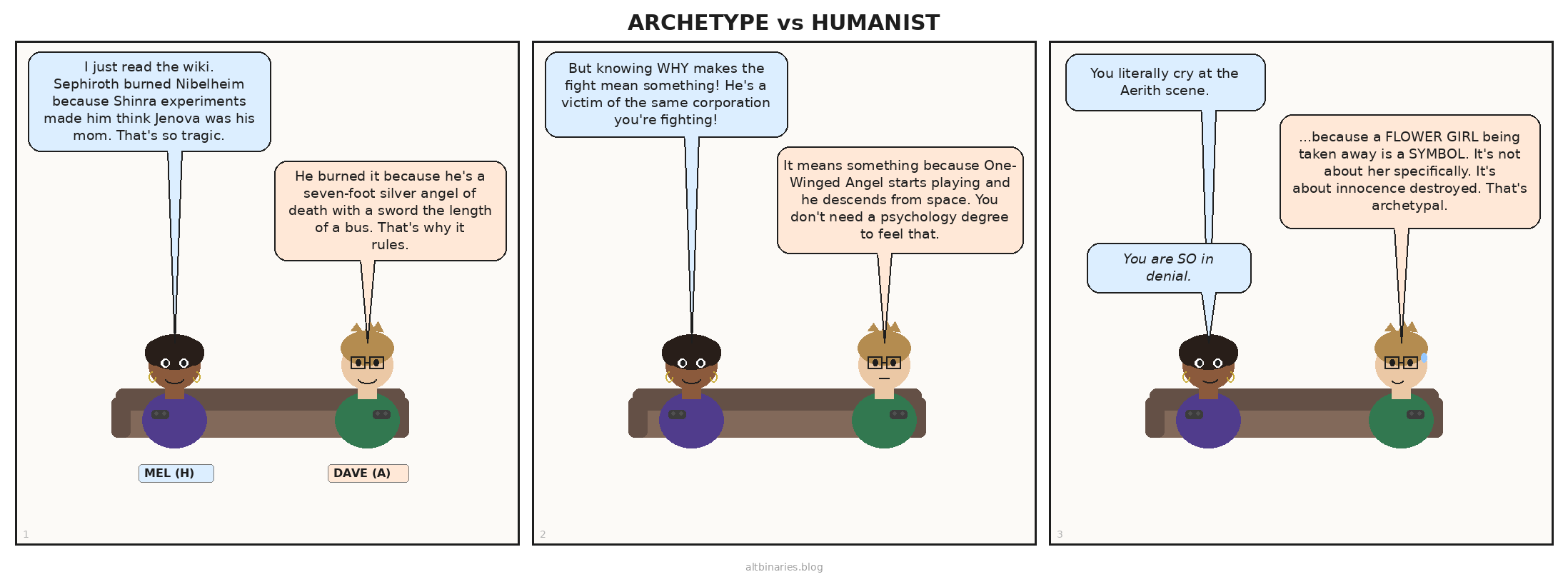
And people who love one of these approaches are often baffled, even offended, by the other. The archetype lover watches a three-hour character study and thinks nothing happened. The humanist reads a myth retelling and thinks these aren’t people, they’re action figures. They’re both right from their own frame. They’re both missing something huge from the other’s.
Like every binary in this blog: two tools. Not two tribes.
Imagine two productions of Hamlet.
In the first, the director has cast someone tall and gaunt in all black, standing under a single spotlight. He speaks the soliloquies like incantations. The Ghost of Hamlet’s father isn’t an actor in makeup; it’s a towering shadow projected on the back wall, a voice that seems to come from the architecture itself. The set is bare. The costumes are symbolic. When Hamlet holds Yorick’s skull, the audience doesn’t think about a dead jester, they think about Death. The play feels ancient, inevitable, like a ritual being performed.
In the second, the director has set the play in a modern university. Hamlet is a graduate student in a hoodie. Claudius is the new department chair who married his dead colleague’s wife uncomfortably fast. Ophelia texts her friends about how weird Hamlet’s been acting lately. The “To be or not to be” speech happens in a dorm room, and the actor delivers it quietly, like he’s actually thinking about whether to kill himself. It’s devastating. You recognize every single social dynamic.
Which is the better Hamlet?
Wrong question. They’re doing completely different things with the same text, and the fact that Shakespeare supports both is one of the reasons his plays have lasted four centuries (which is itself telling, and we’ll come back to that).
The first production is working in the Archetypal mode. It wants to connect you to something transpersonal: the universal experience of grief, betrayal, indecision. Characters are vessels for forces larger than themselves. The staging says this is not about one specific Danish prince, this is about the human condition. And that registers as profundity, as seriousness, as the kind of experience you might walk out of feeling like you’ve been to church.
The second production is working in the Humanist mode. It wants to make you feel that Hamlet is a real person whose specific situation you can inhabit. The staging says this is about THIS guy, with THIS set of problems, and you probably know someone like him. And that registers as emotional truth, as intimacy, as the kind of experience you might walk out of feeling like you understand your own life a little better.
The Archetypal mode is what Joseph Campbell was trying to describe when he wrote about the monomyth. Stories that survive across cultures, he argued, share deep structural features because they’re plugging into something hardwired (or at least very deeply installed) in human cognition. The Hero’s Journey, the Descent to the Underworld, the Return with the Elixir. Campbell was sometimes sloppy about this, mashing together genuinely different traditions to make them fit his schema. But the core observation is sound: people across wildly different cultures independently produce stories with remarkably similar bones, and those stories tend to be the ones that last.
A fairy tale doesn’t need character development. Cinderella doesn’t grow. She endures, and is rewarded, and the power of the story is in the pattern of endurance-and-reward, not in Cinderella’s specific personality. You could give Cinderella a complex inner life and a tragic backstory and a nuanced relationship with her stepmother. Some adaptations do exactly this. But you’ve now made a different kind of story, one that works by different rules, and some of the fairy tale’s original power (which is considerable, given that versions of it exist on every inhabited continent) has been traded away for something else.
What has it been traded for?
Specificity. The humanist revolution in Western storytelling (which really gets going in the 18th and 19th centuries, with the rise of the novel) is essentially the discovery that audiences will invest enormous emotional energy in characters who feel like real, particular people. Not types. Not symbols. People with embarrassing habits and contradictory beliefs and opinions about cheese.
This was genuinely new. Or at least new in emphasis. Ancient Greek theater used masks for a reason: the character was a role, a position in the cosmic order, and the audience’s job was not to identify with Oedipus as a specific dude but to be awed and terrified by the pattern his life enacted. When Aristotle talked about catharsis, he meant the emotional release that comes from watching a mythic pattern complete itself, not the emotional release that comes from really relating to someone’s divorce.
The novel changed this. Suddenly you had hundreds of pages to spend inside one person’s head, watching them notice things and remember things and get annoyed by things and slowly change. And it turned out that this was, for many readers, more compelling than myth. Not because myth was bad but because something in the novelistic mode scratched an itch that myth never could: the itch to feel known. When you read a great novel, or watch a great humanist film, the feeling is someone sees me. When you experience a great archetypal story, the feeling is I am part of something vast. These are different feelings. Both are real. Both are needed.
One way to think about the difference is through what happens when a story fails in each mode.
A failed archetype is a cliché. If you write a Wise Mentor character without sufficient gravitas or mythic weight, you get a boring old man spouting fortune cookies. The pattern is visible but the power is missing. The audience thinks: I’ve seen this before and it was better the first time.
A failed humanist character is an overshare. If you write a Deeply Complex Person without sufficient craft, you get someone whose specific neuroses and relationship history and dietary preferences clog up the narrative without producing insight. The audience thinks: I don’t care about this person’s problems.
These failure modes are almost opposite. The archetype fails by being too familiar, the humanist fails by being too particular. This is a clue about what each mode is actually doing.
Archetypal storytelling is a kind of compression algorithm. It takes the vast mess of human experience and reduces it to a small number of legible patterns, the way a JPEG reduces millions of pixels to a manageable file. What you lose in detail, you gain in transmissibility. This is why fairy tales spread across continents and centuries: they’re small enough to carry, and the essential signal survives even radical cultural translation. Cinderella works in 9th-century China and 17th-century France because the pattern (innocence endures, wickedness is punished, transformation is possible) is almost infinitely portable.
Humanist storytelling is high-fidelity recording. It captures the grain and texture of one specific situation with as much resolution as possible. What you lose in portability, you gain in emotional precision. This is why your favorite novel probably doesn’t travel as well across cultures as your favorite fairy tale, but hits you, personally, harder. Anna Karenina is a more devastating experience than any myth about doomed lovers, if you happen to be the kind of person who can receive what Tolstoy is transmitting. If you’re not, it’s just a very long book about Russian dinner parties.
One thought experiment that might help: imagine a friend tells you about the worst breakup of their life. Imagine two versions.
Version one: “She left, and it felt like dying. Like the ground opened up and swallowed everything. I didn’t know who I was without her.” This is archetypal. It communicates through universal metaphors that anyone can feel.
Version two: “She left her reading glasses on my nightstand, and every morning I’d see them and think about how she always fell asleep with her book on her chest, and I’d just move it to the nightstand and turn off her lamp, and now I turn off the lamp and there’s no book.” This is humanist. It communicates through an irreplaceable specific detail that you either feel in your gut or you don’t.
Neither is more honest. Neither is more true. They are different instruments for accessing different registers of emotion.
And the split shows up everywhere once you have the vocabulary for it.
Consider the entire history of superhero comics. When Superman first appeared in 1938, he was pure archetype. He was strong and good and he fought bad people. That’s it. He didn’t have complex feelings about being an alien. He didn’t have relationship problems with Lois Lane beyond the basic love triangle structure. He was a champion, a mythic protector, and for decades that was enough.
Then the humanist impulse arrived. Stan Lee and Marvel Comics in the 1960s made superheroes who worried about rent and had strained relationships with their aunts and felt insecure at parties. Spider-Man was the flagship: a teenager with powers who was still, fundamentally, a specific awkward kid from Queens. This was experienced as a revolution. It felt more real. It felt more honest. For millions of readers, it was what they’d been waiting for without knowing it.
But notice what happened next. Over six decades, the humanist impulse kept compounding. Characters accumulated backstories and traumas and relationship histories and retcons and psychological complexity until many of them were nearly impossible for new readers to access. The archetypal clarity (Spider-Man is the kid who got power and learned responsibility) got buried under layers of humanist specificity (Spider-Man is the guy who was married then had his marriage erased by a demon deal then was a teacher then ran a corporation then…). Every few years, a publisher does a hard reboot, stripping a character back to their archetypal core. And it always works, for a while, until the humanist accretion starts again.
This isn’t a failure. It’s the natural oscillation between two modes that both have real power and real limitations.
Opera vs. indie film. Liturgical prayer vs. therapy. National anthem vs. love letter.
The archetype compresses experience into a transmissible pattern. It travels across time, across cultures, across the gap between people who share nothing but their humanity. Its cost is that it can feel empty, formulaic, or like a ritual whose meaning has drained away. (How many Christmas pageants have you sat through where the Nativity was just going through the motions?)
The humanist expands experience into granular detail. It bridges the gap between this specific person and this other specific person through the miracle of recognition. Its cost is that it can feel solipsistic, or overindulgent, or like therapy homework dressed up as art. (How many prestige TV dramas have you abandoned because the protagonist’s spiral stopped feeling revealing and started feeling repetitive?)
Both of these failure modes are, in the broadest sense, failures of calibration. Too much compression and you get a dead symbol. Too much resolution and you get noise.
There’s an obscure but fascinating example from the world of tabletop RPGs. In Dungeons & Dragons, player characters have historically been defined almost entirely by archetype: you’re a Dwarf Fighter or an Elf Wizard, and your “personality” is largely the personality associated with those types. But the 5th edition of the game introduced detailed backstory mechanics (bonds, flaws, ideals) that encouraged players to think of their characters as specific people with humanist-style interiority. Some tables loved this. Others found that the more specific a character’s backstory became, the harder it was to slot them into the archetypal adventure structures that the game was built around. A character with an elaborate personal history about their estranged father doesn’t mesh easily with “you meet in a tavern and a stranger offers you gold to clear out a goblin cave.” The archetype wants a hero. The humanist wants a person. And the game, awkwardly, tries to be both.
Theater has been navigating this split for millennia. The ancient tradition (Greek tragedy, Noh theater, commedia dell’arte, Kabuki) is overwhelmingly archetypal: masked performers embodying types within formal structures. The modern tradition (starting roughly with Ibsen and Chekhov, accelerating through the 20th century) is overwhelmingly humanist: actors inhabiting specific people in specific rooms, trying to make the audience forget they’re watching a performance. Both traditions produce extraordinary work. When a Kabuki actor performs a mie (a dramatic freeze-pose), the power is entirely archetypal: this is a hero in the moment of resolve, and your body responds to the pattern. When an actor in a Chekhov play pauses and says nothing and you can see in their face that they’re remembering something they’ll never tell anyone, the power is entirely humanist: this is a person, and you are watching them be private.
What stories last the test of time? This is worth asking directly, because the answer is complicated. Fairy tales last. Myths last. The Odyssey has lasted nearly three millennia. These are archetypal works, and their longevity is evidence for the power of compression: strip a story to its bones and it can survive anything.
But Shakespeare has lasted too, and Shakespeare (particularly the late Shakespeare, the Shakespeare of the great tragedies and romances) is profoundly humanist. Hamlet is not just the Indecisive Prince archetype. He is a guy who makes jokes and then hates himself for making jokes, who loves his dead father and is terrified of becoming him, who is cruel to someone he loves and can’t fully explain why. The humanist detail is what makes Shakespeare Shakespeare and not just another Elizabethan revenge tragedy.
So both modes can survive. What seems to be true is that the works which last the longest tend to have a strong archetypal skeleton and humanist flesh. But the skeleton has to come first. You can add humanist detail to a mythic structure and it enriches. Strip the myth from a humanist work and you often have nothing left that travels.
This is probably why the best “coffeeshop AU” fanfiction (and yes, there is a best, fight me) tends to be written about characters who were originally introduced in archetypal frameworks. You take a character whose mythic role you already feel in your bones, and then you humanize them. You imagine what the Dark Lord eats for breakfast. Or, in the case of darthside.blogspot.com, you imagine Darth Vader writing passive-aggressive memos about fleet logistics. The archetype provides the emotional investment; the humanist detail provides the intimacy. It’s powerful. It’s also parasitic on the archetype in a way that humanist purists sometimes don’t want to acknowledge.
That observation cuts both ways. The archetype purist doesn’t want to acknowledge that many archetypal stories, experienced cold by someone without cultural context, feel hollow. The Norse myths are extraordinary if you already care about them. If you don’t, they can read like a list of names and grudges. Something has to make you care, and often that something is a humanist entry point: a specific character whose situation you recognize.
Both modes are spells you can cast. The archetype conjures the feeling of deep time, of participating in something that has always been and always will be. The humanist conjures the feeling of true sight, of being seen and understood in your weird, particular, unrepeatable selfhood.
| # | Archetype | Humanist |
|---|---|---|
| 1 | Star Wars (original trilogy) — Vader is pure mythic presence, no psychology needed | Star Wars (prequel trilogy) — Anakin’s childhood, romance, political grievances; intentionally awkward because Vader doesn’t humanize well |
| 2 | The Odyssey — Odysseus as the Clever Man, every episode a fable | Ulysses (Joyce) — one ordinary Dublin man’s day, doing the same journey in his head amid kidney breakfasts and bodily functions |
| 3 | Grimm’s Fairy Tales — the woodcutter, the witch, the maiden; no one has an inner life | Into the Woods (Sondheim) — what happens after happily ever after, when the archetypes have to keep living |
| 4 | The Wizard of Oz (1939) — each companion is one trait (brainless, heartless, cowardly), Dorothy is pure goodness | Wicked — the Wicked Witch has a name, a college roommate, political opinions, and a complicated relationship with her father |
| 5 | Neon Genesis Evangelion (episodes 1–16) — robot fights angels, mysterious father, chosen pilot | Neon Genesis Evangelion (episodes 17–26) — actually it’s about Shinji’s depression and everyone’s inability to connect |
| 6 | Mad Max: Fury Road — Max is barely a person, he’s a survival instinct with a car; Furiosa is Redemption Driving a Truck | Children of Men — similar apocalyptic road journey, but Clive Owen is a specific burnt-out bureaucrat with an ex-wife and alcoholism |
| 7 | No Country for Old Men — Anton Chigurh as Death itself, coin flips as fate | Fargo (film) — Jerry Lundegaard is a very specific kind of desperate, sweaty, small-time car salesman |
| 8 | Legend of Zelda (series) — Link is the Hero, Zelda is the Princess, Ganon is Evil; this is the whole story every time | Disco Elysium — you’re a detective, but mostly you’re a specific alcoholic wreck trying to figure out what kind of person you even are |
| 9 | Macbeth — Ambition, Murder, Guilt, Madness; each character IS their fatal quality | Death of a Salesman — Willy Loman is not Ambition, he’s a particular exhausted man with particular wrong ideas about success |
| 10 | Kino’s Journey — a traveler visits allegorical countries that each embody one idea | Mushishi — Ginko travels too, but each episode is about specific, eccentric people with particular problems involving spirits |
| 11 | 2001: A Space Odyssey — astronauts are almost interchangeable; the monolith, HAL, the Star Child are mythic symbols | Moon (2009) — Sam Rockwell is a very specific lonely guy on a lunar base discovering something awful about his employment contract |
| 12 | Superman (1938-era) — he’s strong and good and fights bad people, that’s it | Spider-Man (early Stan Lee) — a teenager who worries about rent, has a strained relationship with his aunt, and feels insecure at parties |
| 13 | Oedipus Rex — a king enacting fate; the tragedy is a mechanism | Hamlet — a prince who can’t stop thinking, delaying, performing, doubting; the tragedy is a person |
| 14 | The Passion of Joan of Arc (Dreyer) — Joan’s face IS faith, suffering, transcendence; almost no context | Lady Bird — a Catholic school girl in Sacramento who is not a saint, just a teenager who lies about her address |
| 15 | The Little Prince — a rose, a fox, a series of allegorical planets; a child’s pure fable about the absurdity of adults | The Catcher in the Rye — the most specific teenager in American literature, with his red hunting hat and his dead brother Allie and his opinion about the ducks in Central Park |
| 16 | Apocalypse Now – In this interpretation of Joseph Conrad’s Heart of Darkness, everyone – Kurtz, the colonel playing Ride of the Valkyries, the photographer is an absurd symbol | The Deer Hunter – The local boys who go off to war are specific people, who suffer specific tortures and degradations, and leave the war with specific mental illnesses. |
| 17 | Kill Bill — The Bride is Vengeance in a yellow jumpsuit; the Deadly Viper Assassination Squad are archetypes with code names | Blue Ruin — same premise (revenge for a murdered family member), but the guy is a specific frightened homeless drifter who is terrible at violence and keeps making mistakes |
| 18 | Dracula (Stoker) — the Count is Evil, ancient, aristocratic, a force of darkness repelled by faith and purity | Interview with the Vampire — Louis is a specific depressed plantation owner who hates being a vampire and can’t stop talking about it |
| 19 | Dark Souls — you are the Chosen Undead; NPCs speak in riddles; the world is myth and ruin | Baldur’s Gate 3 — your companions have romantic histories, petty jealousies, and opinions about your camping cooking |
| 20 | Mulholland Drive — characters dissolve into dream-logic and symbolic identities; Hollywood as archetype factory | Barton Fink — also about Hollywood eating artists alive, but Barton is a very specific pretentious New York playwright with writer’s block in a very specific peeling hotel |
There is a building in Ravenna, unremarkable from outside, sixth-century brick, the sort of thing you’d walk past looking for lunch. Inside, the walls and ceiling are covered entirely in mosaic: glass tesserae in blue and gold, depicting Christ and the apostles and the saints and the Emperor Justinian and his wife Theodora, staring out at you from across fifteen centuries with enormous dark eyes. The figures are flat, frontal, identical in posture. Christ raises his hand in the same gesture in a hundred churches. Theodora’s face is a mask of power, not a portrait of a woman. These are archetypes, deliberately: the mosaicist was not interested in what Theodora looked like when she was tired, or how Christ held a cup, or the specific drape of a specific garment on a specific afternoon. The gold background abolishes space and time. Everything happens in eternity. And the effect of standing in that building is not the effect of recognizing another human being. It is the effect of being addressed by something so much older than you, so much more permanent, that your own specificity feels briefly irrelevant, and that irrelevance feels like relief.
Down the road in Florence, three centuries later (though in art-historical terms it may as well be a geological epoch), Giotto paints the Lamentation of Christ. And suddenly grief has a specific face. The angels above are screaming, mouths open, bodies twisted at individual angles of anguish. Mary holds her dead son and her expression is not the expression of The Mother. It is the expression of this mother. Someone, looking at this painting in 1305, was seeing for perhaps the first time in Western art a sacred figure depicted as though they were a person you might know. The shock of that must have been extraordinary. It is a humanist shock: the recognition that even God can be a specific, suffering individual, not only a golden pattern on a wall.
Both of these buildings still stand. Both of them still work. The Ravenna mosaics reduce you to silence through the sheer weight of the archetypal: you are a creature standing before the Eternal, and the Eternal does not care about your particulars. The Giotto fresco breaks your heart through the humanist: grief is grief is grief, and this woman’s grief is every grief, but it achieves that universality precisely by being hers, hers alone, rendered with such specificity that you cannot look away.
The tension between these two powers is not a problem to be solved. It is the engine that has driven every interesting development in storytelling, liturgy, architecture, theater, and the visual arts for at least three thousand years and probably longer, probably since the first time someone telling a story around a fire decided to give the Monster a name, or the first time someone carving a mask decided not to, decided to leave the face blank and terrible and universal, a face that was no one’s and therefore everyone’s, a face that would outlast the carver and the village and the language and the century, traveling forward through time like a signal with no source, still legible, still powerful, still reaching into the chests of strangers and finding there the same fear it was built to summon, unchanged, because some things do not need to be specific to be true, and some things cannot be true unless they are.
Citations
https://prequelsredeemed.blogspot.com/2014/12/why-darth-vader-is-cool.html — An argument for why Darth Vader’s power is archetypal rather than psychological, and why the character fundamentally resists humanist treatment.
http://darthside.blogspot.com — “The Darth Side: Memoirs of a Monster.” A 2005 blog narrating the original trilogy as Vader’s personal diary. Widely praised as one of the best pieces of Star Wars fan writing, and a masterful example of layering humanist interiority onto an archetypal character.
https://balioc.wordpress.com/2017/02/20/the-story-of-the-self/ — Balioc’s essay on identity as narrative: how casting yourself as a character in a story transforms the way you experience your own life, and why “coffeeshop AU” fanfiction and literary novels are doing the same humanist work.
The Toast
Aurora Valentis and Aleksander ne Codex Breaker have been asked to co-write the wedding toast for their mutual friend Hadria. They are sitting across from each other at a table with one (1) piece of paper between them. It has been forty minutes. The paper is blank.
ALEKSANDER: Okay. I think we start with the time Hadria got her head stuck in the banister at the Breaker commons trying to eavesdrop on Vyacheslav’s meditation group.
AURORA: We absolutely do not.
ALEKSANDER: It’s endearing. It shows who she is. She’s so desperate to be part of things that she’ll wedge her entire skull through wrought iron to listen to a man hum.
AURORA: It shows that she has poor spatial reasoning and no dignity. A wedding toast is not an autopsy of someone’s embarrassments, Aleksander. It is an invocation. You are standing before the gathered witnesses of two lives becoming one, and your task is to speak something worthy of that transformation. Something that will ring in the memory long after the glasses are empty.
ALEKSANDER: Right, so, “Dear friends, we gather today to honor a sacred union—”
AURORA: Better.
ALEKSANDER: “—between a woman who once arm-wrestled a man unconscious at a tavern because he said her soup was ‘fine.’”
AURORA: No.
ALEKSANDER: That happened, Aurora. I was there. He was out for a full minute. The soup was excellent, by the way.
AURORA: Whether it happened is not the question. Everything happens. Millions of things happen to every person every day and most of them are not fit for ceremony. A wedding is not a catalog of incidents. It is an elevation. You take the scattered, clumsy mess of a life and you find the shape it was always trying to become. Hadria loves fiercely. Hadria protects what she cares about. Hadria found someone who matches that fire. That is the toast.
ALEKSANDER: That is a toast for anyone. You could swap in literally any bride’s name and it works the same.
AURORA: Good. That means it touches something universal.
ALEKSANDER: It means it touches something generic. Do you know what Hadria would say if she heard that toast? She’d say “that was beautiful, Aurora” and then twenty minutes later at the bar she’d say “I don’t think Aurora actually knows me at all.” And she’d be a little hurt about it. And she’d never mention it again because that’s who she is.
AURORA: …
ALEKSANDER: See, that’s who she is. Someone who would be hurt and never say so. That’s what I want in the toast. Not the archetype of a bride. Hadria. The specific, actual, banister-head-stuck-in, soup-defending, never-complains-about-being-hurt Hadria. The one who’s in the room.
AURORA: You want to make her cry at her own wedding.
ALEKSANDER: I want to make her feel seen at her own wedding. There’s a difference.
AURORA: There is a difference between being seen and being exposed. You think intimacy means cataloging someone’s specificities. But a great toast doesn’t say “remember when you did that funny thing.” A great toast says “this is what love looks like, and you are proof of it.” The listener doesn’t need your anecdote. They need to feel the weight of the moment.
ALEKSANDER: When has Hadria ever, in her entire life, wanted weight? She wants warmth. She wants someone to say her name like they mean her and not the idea of her. You keep reaching for the icon and she’s standing right there as a person.
AURORA: Icons endure.
ALEKSANDER: People need to be loved before they endure.
(Pause.)
AURORA: That’s not bad, actually.
ALEKSANDER: Thank you. Write it down.
AURORA: I will not write down your argument bait as though it were literature.
ALEKSANDER: Fine, I’ll write it. (writes) Okay. “Hadria doesn’t know how to do things halfway. I once watched her learn to ride a horse in a single afternoon because someone bet her she couldn’t. The horse was furious. Hadria was delighted. And that’s the version of her I want you to hold in your minds tonight, because that is the woman who decided to love—” what’s the spouse’s name again?
AURORA: You’ve forgotten the spouse’s name?
ALEKSANDER: I’ve met a lot of people, Aurora! I remember all of them! Eventually! It’s a volume issue!
AURORA: The spouse’s name is Senvar. Which you would know if you spent less time memorizing horse anecdotes and more time attending to the structure of the occasion.
ALEKSANDER: Great. “—decided to love Senvar. And if I know Hadria, she will love Senvar the way she rode that horse: completely, recklessly, and with no regard for whether Senvar was ready for it.”
AURORA: …that’s actually rather good.
ALEKSANDER: I know.
AURORA: But it needs a landing. Something that lifts it out of anecdote and into permanence. You’ve built the specific. Now you need the eternal. Something like… (takes the paper, writes for a moment) “There is an old blessing that says: may your love be a fire that outlasts the wood. Tonight, looking at these two, I believe it.”
ALEKSANDER: …
AURORA: What.
ALEKSANDER: That’s annoyingly perfect.
AURORA: Shall I be the one to deliver it, then? Since I have the—
ALEKSANDER: Absolutely not, you’ll do it in your speech competition voice and Hadria will think she’s being eulogized. I’ll read the whole thing. Including your line.
AURORA: You will pause before the blessing. You will not rush it.
ALEKSANDER: I will pause.
AURORA: And you will not ad-lib additional horse content.
ALEKSANDER: …
AURORA: Aleksander.
ALEKSANDER: The horse bit where it bit her is really good, Aurora.
AURORA: One horse. Final offer.
ALEKSANDER: Done.
The toast was, by all accounts, perfect. Hadria cried. Aleksander cried. Aurora did not cry, but was seen to blink more than usual. The horse was a big hit. At the bar afterward, Hadria said “I think that’s the first time anyone actually talked about me at one of these things.” Aurora heard this and experienced a brief, unfamiliar emotion she later classified as “being incorrect, but only partially.”
 Alt Binaries
Leave a comment