Why every scary movie is secretly a parenting style, and what your favorite horror says about your theory of danger.
Every horror movie scares you. But not every horror movie agrees on why you should be scared.
There’s a type of horror that works like this: someone does the thing they were told not to do. They read the book, they opened the box, they went into the basement, they had sex at the cabin, they moved into the house with the obviously cursed history. And then something terrible happens to them, and the audience thinks (on some level, maybe not consciously), “well, yeah.” The rules existed for a reason. You broke them. This is what happens.
I’m going to call this Traditional Horror.
Then there’s a different type, and it works almost exactly backwards. Something has been held down. Sometimes it’s personal: a grief, a memory, a family secret, a part of yourself you perform away every morning. Sometimes it’s much bigger than that. A town was built on a burial ground. A suburb was poured over the site of a massacre. An institution has been feeding people to something in the basement for generations, and the protagonist gets hired as the new night watchman before anyone mentions what’s in the basement. The horror isn’t that someone broke a rule. The horror is that the thing they buried is still alive down there, and it is getting bigger, and it is absolutely going to come up whether they like it or not, and the longer they wait the worse it’s going to be when it does.
That’s Liberation Horror.
In the societal version, the protagonist often starts out doing what authority tells them: investigate the disturbance, protect the property, fight the monsters. Then they realize that authority is who made the monsters. The call was coming from inside the institution.
Traditional Horror says: the world has walls for a reason, and the monster is what lives on the other side of those walls. Liberation Horror says: the monster is what happens inside the walls when you refuse to open the door, or when the people who built the walls buried something terrible in the foundation and told everyone it was solid ground. Same genre. Same jump scares. Completely opposite diagnosis of what went wrong.
You have definitely watched both kinds, probably without noticing the split. Friday the 13th is Traditional Horror so pure it’s almost a PSA: teens have sex, teens die. The Babadook is Liberation Horror so pure it’s almost therapy: a widow represses her grief, and the grief becomes a literal monster. Both movies will make you sleep with the lights on. They just disagree completely about what the lights are protecting you from.
Now, these are not the only two types of horror. There are plenty of horror movies that don’t fit either mold (existentialist horror, body horror, cosmic indifference, pure survival). But what makes this particular split worth writing about is that Traditional and Liberation line up almost perfectly with two deep political philosophies, even when the surface politics of the movie point the other way. Traditional Horror has the structure of conservatism: boundaries exist for a reason, the old rules encode hard-won wisdom, and tearing them down invites disaster. Liberation Horror has the structure of progressivism: the status quo is hiding something rotten, the institution is protecting itself at someone else’s expense, and the only way forward is to drag the buried thing into the light.
The surface politics can be completely reversed and the deep structure holds. Get Out is a progressive movie with a Traditional Horror engine. The Purge is a conservative anxiety wearing a liberal dystopia costume. Midsommar’s Liberation Horror runs through a feminist lens but also through a story about getting seduced by a murder cult. The structure doesn’t care about your voter registration. It cares about where you think danger lives.
Once you have the framework, you start seeing it outside of movie theaters. Every argument about whether to “leave well enough alone” or “finally deal with this” is, at some level, an argument about which type of horror movie you think you’re living in. The parent who says “we don’t talk about that in this family” is directing a Traditional Horror. The therapist who says “tell me about your childhood” is directing a Liberation Horror.
Both of these are tools. Like antibiotics and surgery. Sometimes the problem is an infection from outside, and sometimes the problem is something that grew wrong on the inside, and the worst possible move is to use the wrong treatment. The ideal is a person who can feel both kinds of dread and knows which one they’re experiencing.
Which, now that I think about it, is a pretty horrifying skill to have.
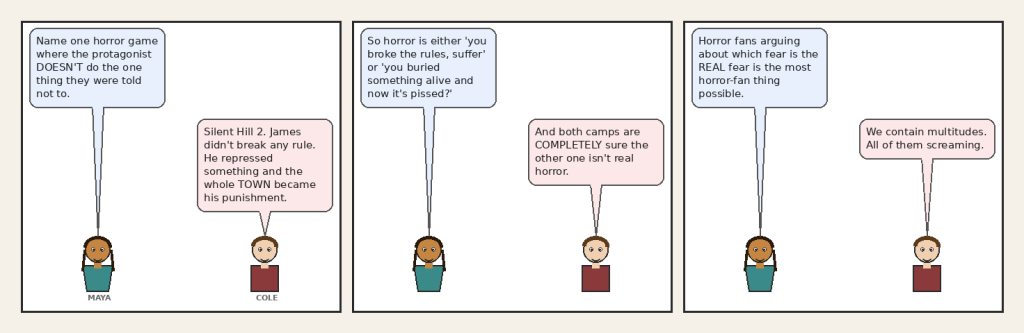
* * *
Imagine two people watching a horror movie together. Something terrible is about to happen. A character is standing in front of a closed door. Behind the door, something is making a sound that no thing in nature should make. The character reaches for the handle.
Person A grabs the couch cushion and hisses: “Don’t open it. Don’t open it.”
Person B grabs the couch cushion and hisses: “Open it. You have to open it.”
They are both terrified. And they are operating from completely different theories of where danger lives.
Person A is a Traditional Horror thinker. In their model, the world is divided into safe zones and dangerous zones, and the boundaries between them (the door, the warning sign, the ancient prohibition, the thing your grandmother told you never to do) exist for excellent reasons that you ignore at your peril. The monster is on the other side. The door is doing its job. You leave it closed.
Person B is a Liberation Horror thinker. In their model, the thing behind the door isn’t a foreign invader. It’s something that was already inside the house. It’s been growing in that sealed room for years precisely because someone sealed it in there instead of dealing with it. Keeping the door closed isn’t safety. It’s procrastination. The longer you wait, the worse it gets.
This is not just a disagreement about fictional monsters. It is a disagreement about the fundamental nature of danger, and it runs through every horror story ever told, and (more interestingly) through a huge number of non-horror arguments about how to live.
Let me walk through the Traditional side first, because it’s older.
Traditional Horror is, at its core, a cautionary tale. The structure is ancient: there is a boundary, someone crosses it, and something awful happens as a consequence. This is the logic of fairy tales (don’t stray from the path, don’t eat the apple, don’t look back). It’s the logic of myth (Prometheus stole fire and got his liver eaten daily; Pandora opened the box; Orpheus looked back). And it’s the logic of an enormous percentage of modern horror films, from the 1930s Universal monster movies all the way through to present day, where characters wander into forbidden spaces, tamper with forces they don’t understand, or violate social norms, and get punished for it.
The slasher film is maybe the purest distillation. In the classic slasher, the killer picks off characters who have transgressed in some way (had premarital sex, used drugs, wandered away from the group) while the “final girl” survives specifically because she was cautious, sober, and rule-following. You don’t have to be a film theorist to notice the pattern. The movie is saying, with the subtlety of a machete: stay in line.
But Traditional Horror is more interesting than just “obey the rules.” What it’s really saying is that the world contains forces that are too powerful and too alien for human beings to safely engage with, and that the traditions, taboos, and social structures we’ve built are load-bearing walls. They might look arbitrary. They might look like superstition. But they were put there by people who learned the hard way what happens when they’re removed, and knocking them down because they seem old-fashioned is a species of arrogance that the universe is happy to correct.
H.P. Lovecraft’s entire body of work is Traditional Horror taken to its logical extreme. His protagonists aren’t punished for being immoral. They’re punished for knowing too much. They open books they shouldn’t read, investigate ruins they shouldn’t enter, calculate geometries that human minds aren’t built to process. The horror isn’t moral failure. It’s epistemological hubris. The boundaries of human knowledge exist because what’s beyond them will destroy you, not as punishment, but as a simple mechanical consequence. You don’t scold the moth for flying into the flame. The flame doesn’t care.
Get Out, which is politically progressive in every way, is structurally Traditional Horror. The protagonist enters a space (the white girlfriend’s family home) that every survival instinct and every piece of cultural knowledge tells him is dangerous, and the horror unfolds because he overrode those warnings. The movie’s racial politics are liberal. Its narrative engine is deeply conservative: the rules existed for a reason, and breaking them nearly gets you killed.
This is important to notice. Traditional Horror is not the same as politically conservative horror. It’s a narrative structure, and that structure can carry any political content. Texas Chainsaw Massacre is Traditional Horror where the transgression is wandering off the highway into rural America. That’s not a right-wing message. But the shape of the story (you crossed a line, now suffer) is the same shape it’s been since the Greeks.
Now consider the other side.
Liberation Horror starts from a completely different premise. In this model, the problem isn’t that someone crossed a boundary. The problem is that a boundary was drawn around something that needed to be free (or at least acknowledged), and the longer that thing stays locked up, the more monstrous it becomes. The horror isn’t transgression. It’s repression.
This comes in two flavors, and both are important.
The first is personal. The Babadook (2014) is the textbook example. A widow is raising her young son while refusing to process her husband’s death. She has literally sealed his belongings in the basement. She doesn’t talk about him. She doesn’t grieve. She performs coping. And then a monster appears, one that grows stronger every time she tries to deny it, that feeds on her refusal to feel what she actually feels. The movie’s climax isn’t killing the monster. The climax is acknowledging it. She goes to the basement, faces what she’s buried, and the monster becomes manageable (not gone, but manageable) because it’s no longer growing in the dark.
The second flavor is societal, and it’s arguably the bigger and more politically explosive one. In this version, the protagonist isn’t the one who repressed anything. They show up to a situation that seems normal (a new neighborhood, a new job, an unfamiliar town) and only gradually discover that something monstrous was buried in the foundation, usually by people in power who decided that certain lives were an acceptable cost of maintaining their order.
Poltergeist (1982) is the template. A nice suburban family in a nice suburban house starts experiencing hauntings. It turns out the housing development was built on top of a cemetery. The developers moved the headstones but left the bodies. The horror comes from underneath the slab of normalcy that someone poured over the dead. The family didn’t do anything wrong. The developers did. And the dead don’t care who’s living in the house now. They care that they were paved over.
The metaphor generalizes instantly to any community built on top of something its founders chose to bury rather than reckon with. American horror is full of this for the obvious historical reasons. The Shining puts its haunted hotel on a Native American burial ground. Candyman (1992) roots its monster in the specific, documented history of racial violence in Chicago public housing. The horror isn’t random. It has an address. It has a receipts file. And the protagonist, who initially approaches the situation as an outsider trying to understand or contain it, eventually realizes that the institution they trusted (the university, the housing authority, the suburban development company) is not merely failing to fix the problem. The institution is the problem. It created the horror and then papered over it and then sent someone else to deal with the symptoms.
Cabin in the Woods (2012) makes this so explicit it’s practically a thesis statement. The entire slasher-movie setup (teens in a cabin, monsters coming for them) turns out to be an engineered ritual run by a vast bureaucratic institution that sacrifices young people annually to keep ancient gods sleeping. The protagonists start by doing what they’re supposed to (fight the monsters, survive the night) and end by realizing the whole system was designed to kill them, and that authority has been complicit the entire time. When they finally refuse to play their assigned role, the ancient gods wake up and the world ends. The movie asks: was the suppression worth it? Was the sacrifice ever justified? And it doesn’t answer, because the question is the point.
Us (2019) runs both flavors simultaneously. The Tethered are an entire population that was created, used, and then abandoned underground by the government when the experiment didn’t work out. They are literally a repressed underclass, living in tunnels beneath the nice world, mimicking the movements of the people above. The horror is what happens when the buried population comes up. And Adelaide’s personal journey (which I won’t spoil) layers the private-repression version on top of the societal one. Jordan Peele, like the best Liberation Horror directors, understands that the personal and the political aren’t separate stories. They’re the same story at different scales.
If you described this whole subgenre to a Traditional Horror thinker, they might struggle to see why it’s frightening in the same way. Where’s the transgression? Where’s the boundary that shouldn’t have been crossed? The answer is that the boundary itself was the problem. The act of sealing the basement, whether it’s a widow sealing away grief or a developer sealing bodies under a subdivision, is what created the monster. The monster is a symptom, not an invader.
Midsommar (2019) is the personal version pushed to an extreme. The protagonist is in a dying relationship, swallowing her grief while her boyfriend checks out. The horror-cult she falls into is murderous, but the film keeps showing us that the cult sees her pain in a way her boyfriend never did. Her screams of anguish are met not with discomfort but with communal wailing. The suppressed emotional truth erupts, and yes, the eruption involves flower crowns and burning buildings, but the structure is pure Liberation Horror. The repressed thing returns. It’s terrifying. It was always going to happen.
Carrie (1976) might be the original template for the personal version. A girl raised in suffocating religious repression develops telekinetic powers she can’t express, explore, or acknowledge. The prom scene is Liberation Horror in its purest form: every force that was held down explodes upward at once, and the destruction is proportional to the repression. If Carrie had been allowed to be a person, the prom would have been fine. The horror was built by the people who thought they were preventing it.
One way to see the difference clearly: ask what the characters should have done.
In Traditional Horror, they should have obeyed the warning. Don’t read the book. Don’t open the box. Don’t go in the water. The correct action is restraint, respect for boundaries, and a healthy fear of the unknown.
In Liberation Horror, it depends on the scale. In the personal version, they should have opened the door sooner. Gone to therapy. Had the conversation. Processed the grief. In the societal version, they should have asked who built the house and what’s underneath it. They should have questioned the institution that sent them to fight the symptoms. The correct action is confrontation, honesty, and a willingness to face what has been deliberately hidden.
These prescriptions are directly contradictory.
This is where it gets interesting outside of movie theaters, because the same split runs through how people think about social and psychological problems generally. Think about how different people react to, say, a family member who is behaving erratically. One instinct (Traditional) says: draw firm boundaries, maintain structure, don’t engage with the chaos, because engaging will make it worse and possibly pull you into it. The other instinct (Liberation) says: something is wrong underneath the behavior, the erratic actions are symptoms of something buried, and the only way through is to make space for whatever is trying to surface.
These map onto real therapeutic positions. Boundary-setting is foundational to treating personality disorders. Processing repressed trauma is foundational to treating PTSD. The question is which one fits the situation, and the cost of guessing wrong is high in either direction. Set boundaries against someone who needs to be heard, and you create a pressure cooker. Try to “process” someone who needs containment, and you give the chaos room to expand.
Horror knows this intuitively, even when it can’t articulate it.
There’s a deep-cut example from video games that illustrates the split with almost surgical precision. In Silent Hill 2 (2001), the protagonist, James Sunderland, receives a letter from his dead wife asking him to come to the town of Silent Hill. He goes. The town is full of monsters. And over the course of the game, you slowly discover that the monsters aren’t random. They are manifestations of James’s own psychology (his guilt, his repressed desires, his shame). The iconic monster Pyramid Head isn’t a demon from another dimension. It’s James’s need to punish himself for something he did and can’t face. The entire game is Liberation Horror: the town is a therapeutic space (a nightmarish, flesh-walled therapeutic space, but still) that forces James to confront what he buried. The horror gets worse the longer he resists, and the “good” ending requires him to finally accept the truth about himself.
Compare this with Amnesia: The Dark Descent (2010), where the protagonist has deliberately erased his own memory to forget the terrible things he’s done. You can read it as Traditional Horror (he transgressed and is fleeing consequences) or Liberation Horror (his amnesia is itself repression, and the game forces him to remember). The game works because both readings coexist. The transgression and the repression are the same event viewed from two directions.
This double-reading is actually common in the best horror. The Shining works as Traditional Horror (Jack goes to the isolated hotel against all good sense and is consumed by what’s there) and as Liberation Horror (Jack’s alcoholism, rage, and failed ambitions have been repressed under family-man performance, and the hotel gives those buried things room to grow). And the Overlook Hotel was built on a Native American burial ground, which layers the societal version underneath the personal one. The movie doesn’t resolve the tension. It doesn’t have to. Real dread lives in the space where both readings are true at the same time.
Hereditary (2018) does the same thing. Is the horror that the family disturbed an occult force they should have left alone? Or that generations of family trauma have been papered over with normalcy, and the demon is just the shape suppressed dysfunction takes when it finally surfaces? Ari Aster is smart enough to leave both doors open.
As I said up top, the deep structure of these stories aligns with political philosophies even when the surface doesn’t. But the structure is bigger than any politics. It belongs to the fear itself.
And fear, it turns out, is surprisingly honest about what a culture is anxious about. The golden age of slasher films coincided almost exactly with the conservative backlash against the sexual revolution. Meanwhile, Liberation Horror tends to surge during periods where something feels wrong underneath functional-looking surfaces. The Babadook, Us, Hereditary, and Midsommar all emerged in the 2010s. The culture was ready for stories about what happens when you finally look at the thing everyone agreed not to talk about.
A few more examples, because this binary shows up in places you might not expect:
- Addiction recovery. The Traditional Horror model of addiction is “don’t start.” The walls (sobriety, abstinence, rules about what you put in your body) exist because what’s on the other side will consume you. AA meetings are partly about reinforcing those walls with community and ritual. The Liberation Horror model of addiction says that substance use is often a response to unprocessed pain, and the recovery requires surfacing and integrating whatever the person was medicating away. Each model has saved lives, and each has failed spectacularly when applied to the wrong patient.
- Whistleblowing. From a Traditional perspective, the whistleblower is the person who opens the forbidden door: they break the rules of institutional loyalty, and what comes out destabilizes everything. From a Liberation perspective, the whistleblower is the only person honest enough to unseal the basement before the rot spreads further. Whether Edward Snowden is a hero or a traitor depends almost entirely on which horror movie you think you’re living in.
- Relationship fights. One partner says “can we just not do this right now?” (Traditional: the boundary protects us, don’t open that door tonight). The other partner says “we HAVE to do this right now, because every time we don’t, it gets worse” (Liberation: the repressed conflict is the actual monster). Both of them are vindicated often enough to feel completely justified every single time.
- Religious schisms. The Catholic Church’s position on doctrine is essentially Traditional Horror applied to theology: the dogma is a wall built by people wiser than you, and if you start tearing it down because parts of it seem outdated, you will release forces you cannot control. Every Protestant reformation is Liberation Horror: the institution has buried something true under layers of political calculus and institutional self-protection, and the buried truth is now poisoning the whole structure. Martin Luther literally nailed his repressed complaints to the door.
- Content moderation. Platform trust-and-safety teams face a version of this constantly. Do you suppress controversial speech to maintain boundaries (Traditional: the walls protect the community)? Or does suppression create a pressure cooker where the banned ideas mutate into something more extreme in the dark (Liberation: the repressed always returns, worse than before)? Every deplatforming debate is, structurally, two people arguing about whether to open the basement door.
What makes this binary particularly tricky is the empirical evidence. Traditions and taboos really do encode survival-relevant information that individuals would be foolish to ignore. Chesterton’s fence (the idea that you shouldn’t tear down a fence until you understand why it was built) is a real and useful heuristic, and ignoring it has produced genuine catastrophes. And repression really does produce monsters. The psychological evidence for this is massive: trauma that isn’t processed doesn’t disappear, it expresses itself sideways, as anxiety, as addiction, as explosive rage, as physical illness. The wall is a real defense. The thing growing behind the wall is a real threat. And you are standing in the hallway between them.
The skill isn’t choosing one framework. The skill is developing enough sensitivity to feel which kind of danger you’re actually facing, in the moment, without defaulting to whichever answer makes you more comfortable. Which is hard. Because the Traditional thinker’s comfort zone (keep things sealed, maintain order) feels exactly like safety until the basement explodes. And the Liberation thinker’s comfort zone (open everything up, process everything, let it all out) feels exactly like courage until they realize they’ve unleashed something they cannot put back.
There is an image that recurs in the mythologies of peoples who never spoke to one another, who built their temples on opposite sides of the planet, in languages that share no root and no alphabet: the sealed chamber. The room that must not be entered. The box that must not be opened. The name that must not be spoken. Pandora. Bluebeard. The Ark of the Covenant. The thirteenth room in the castle. The forbidden floor of the pagoda. Something in the architecture of human storytelling keeps constructing this room and then placing a person in front of it and asking: well? And the fact that the question has been asked ten thousand times and answered both ways, in every century, in every language, and that neither answer has ever fully satisfied, suggests that the question itself is the point, that the door and the thing behind the door and the person standing before the door are not three separate elements of the story but one indivisible image of what it means to be a creature that can imagine what it cannot see.
The Zohar describes creation itself as an act of concealment, the tzimtzum, in which the infinite withdrew inward to make a space for the finite to exist, and what rushed in to fill the void was not merely matter but the possibility of being wrong, the possibility of breaking, the divine shards scattered among husks of darkness that the tradition calls the qlippoth. These husks are not evil in the cartoonish sense. They are containers. They are the walls of the sealed room. And the light trapped inside them is not tame. It is the original fire, the fire that existed before anything existed to burn, and the entire project of human existence (according to this tradition) is to open the containers carefully enough to release the light without being consumed by it. Too cautious and the light stays trapped. Too reckless and everything burns. The mystics did not consider this a solvable problem. They considered it the permanent condition of being alive.
And this is perhaps closer to the truth than either horror tradition can reach on its own, because Traditional Horror assumes the door should stay closed, and Liberation Horror assumes the door should be opened, and the sealed chamber at the center of ten thousand myths assumes neither, assumes only that the door exists and that you exist and that the relationship between these two facts is the whole of the human predicament. The ancient world did not argue about whether Pandora should have opened the box. They told the story. They told it again. They placed it next to the story of Prometheus, who stole what was behind another kind of door, and they noticed that both stories ended in suffering and both stories ended in something necessary being released into the world (all the evils, yes, but also hope; fire, yes, but also the liver eaten daily) and they did not try to extract a lesson because the lesson was the shape of the thing itself, the door and the hand and the hinge.
Consider what fear actually is, physiologically: the body’s preparation for an encounter with the unknown. The heart rate increases. The pupils dilate. Blood flow shifts to the muscles. Every cell says: something is coming and I do not yet know what it is. Fear does not distinguish between the fear of what might enter and the fear of what might emerge. The body trembles the same way before both. The adrenaline does not ask whether the threat is an invasion or an eruption. And perhaps this is why horror, alone among genres, can hold both truths simultaneously without resolving them into a thesis, why the best horror films leave you unable to say whether the monster came from outside or from within, because at the level of the nervous system, at the level of the animal that you are underneath your theories, the distinction does not exist.
Aeschylus, who fought at Marathon, wrote in the Agamemnon that wisdom comes through suffering, that it drips in sleep upon the heart, against our will, as a kind of awful grace. He did not say which suffering. He did not specify whether the pain came from crossing a line or from holding one too rigidly. He said only that the knowledge hurts, and that it comes whether you want it or not, and that the gods have made it so.
The door. The hand. The hinge between what is kept and what is freed. We have always been standing here.
Source Material
- bambamramfan: Three Types of Horror Movies — The Tumblr post that originally articulated the split between conservative/traditionalist horror, liberal/therapeutic horror, and existentialist horror as three distinct narrative engines.
THE STORAGE ROOM
A Traditional vs. Liberation Horror Dialogue
SENECA: There is a smell coming from the old storage room on the third floor.
SIDONEI: Oh, I know. It’s been getting worse for weeks.
SENECA: Then why haven’t you reported it?
SIDONEI: Because reporting it means someone opens the door. And I happen to believe that whatever is making that smell deserves to be met, not managed through a chain of command.
SENECA: It deserves to be met. The smell. You want to meet the smell.
SIDONEI: I want to meet what’s causing the smell. Something died in there, or something grew, or something that was stored improperly has been transforming in the dark for who knows how long, and the smell is just the part that’s leaking through the cracks. The actual problem is behind the door.
SENECA: The actual problem is contained behind the door. Which is exactly where I would like it to remain. We seal the edges. We add ventilation. We move on.
SIDONEI: You want to put weatherstripping on a nightmare.
SENECA: I want to manage the situation without inviting catastrophe into the hallway, yes. The door was closed for a reason. Someone, at some point, looked at whatever is in that room and decided the correct response was to shut it away. I trust that judgment.
SIDONEI: You trust the judgment of whoever shoved a problem into a closet instead of dealing with it? That’s not wisdom, that’s avoidance with a padlock.
SENECA: And you assume every closed door is a crime against the contents. Has it occurred to you that some things are put away because they are actually dangerous? That the door isn’t repression, it’s engineering?
SIDONEI: Engineering fails, Seneca. That’s the whole story. You can engineer a perfect seal, a perfect protocol, a perfect chain of command, and eventually the pipe leaks or the wood rots or the person standing guard gets tired, and then everything you sealed away comes out at once instead of a little at a time. I’d rather face it on my own terms.
SENECA: Your terms. Your terms involve opening a door in the middle of the night with no equipment, no backup, and no authorization, because it feels more honest to you.
SIDONEI: It is more honest. The door is already failing. You can smell the failure from the landing. My proposal acknowledges what’s happening. Yours pretends it isn’t.
SENECA: My proposal buys time for a proper response. Yours buys you a confrontation you’re romanticizing in advance. I’ve seen what happens when people open doors they weren’t prepared for, Sidonei. I’ve stood behind people who decided they were brave enough. Bravery without preparation is just a faster way to make the problem worse.
SIDONEI: And preparation without action is just a very disciplined way of standing next to a growing catastrophe. You’ve been smelling this for how long?
SENECA: Four days.
SIDONEI: Four days. And in four days you’ve done what? Noted it. Assessed the perimeter. Considered the chain of command. Probably sharpened something.
SENECA: I maintain my equipment regardless of circumstances. That’s not relevant.
SIDONEI: It’s completely relevant. You’re ready for everything except the actual thing. You could fight whatever’s in that room. You could probably kill it, if it were alive. But you won’t open the door because opening the door isn’t in the manual. The manual says “report” and “wait” and “maintain position.” So you’ll maintain position while the smell gets into the walls, into the floors, into the rooms below, and by the time someone with the proper authority decides to act, the problem will have eaten the building from the inside. But at least you’ll have followed procedure.
SENECA: Procedure exists because people like you have historically opened doors and made things worse. Every protocol in this building was written in response to someone’s improvisation going wrong. You think rules are constraints. They’re scar tissue. They’re what’s left after the wound heals.
SIDONEI: Scar tissue doesn’t breathe, Seneca. It’s rigid. It holds the old shape even when the body has changed. That room was sealed by someone who is probably dead, for a reason that is probably obsolete, and the contents have been changing in the dark for longer than either of us has been on this floor. Whatever the original problem was, it’s not that problem anymore. It’s whatever that problem became when no one was looking.
SENECA: Which is precisely why you don’t open it casually.
SIDONEI: I agree. I don’t propose opening it casually. I propose opening it deliberately, with intention, facing whatever is inside instead of pretending the seal will hold forever. There’s a difference between recklessness and refusal to look away.
SENECA: The difference is usually visible only in retrospect, and only to the survivors.
TAMAR: (entering with a clipboard) I’ve filed a maintenance request.
SENECA: When?
TAMAR: Thursday. A worker with the appropriate equipment will assess the room. I’ve placed a carbon filter by the door for the interim.
SENECA: Good. I’ll clear the floor for access and station myself outside the door during the assessment.
SIDONEI: Station yourself. It’s a maintenance appointment, not a siege.
SENECA: You don’t know what’s in the room. The maintenance worker doesn’t know what’s in the room. Having someone combat-ready nearby isn’t paranoia. It’s the minimum responsible presence for an unknown situation. I would do the same if we were opening a crate, a hatch, or a letter from someone I didn’t trust.
TAMAR: You don’t need to stand guard, Seneca. But I’m not going to stop you.
SENECA: I wasn’t asking permission. I was informing you of my plan.
SIDONEI: And there it is. You won’t open the door without permission, but you’ll guard it without permission. The hierarchy only applies when it’s telling you to stay still. The moment it lets you do something (as long as the something is defensive) you don’t need authorization at all.
SENECA: Defense is always authorized. That’s not a personal opinion. That’s a principle I’ve staked my life on, repeatedly, and I am still here. Are you still here because of your principles, Sidonei? Or in spite of them?
SIDONEI: Both, probably. That’s the honest answer. I’ve opened doors I shouldn’t have. Some of them were wonderful. Some of them nearly killed me. But I have never once regretted looking. I have regretted, many times, not looking soon enough.
SENECA: And I have never once regretted holding a position I was asked to hold. We are describing two different kinds of survival. Yours requires luck. Mine requires discipline. I know which one I trust over a longer timeline.
SIDONEI: Discipline over a long enough timeline is just a very organized collapse. You hold and you hold and you hold, and one day the thing you’re holding is gone, and you’re still standing there in the hallway with your saber, guarding nothing.
SENECA: That hasn’t happened yet.
SIDONEI: It’s happening right now. You’re guarding a door that smells like rot. The thing you’re protecting is already failing. You just won’t name it because naming it would require you to act outside your role, and acting outside your role is the one thing you cannot do.
SENECA: It is not the one thing I cannot do. It is the one thing I choose not to do. There is a difference, and the difference is everything. I could open that door. I have the skill, the tools, and the physical ability. I choose not to because my judgment alone is not sufficient authority. One person’s judgment is how mistakes happen. Structure is how you prevent them.
SIDONEI: Structure is how you distribute the blame for them. If the door fails on its own before Thursday, whose fault is it? Not yours. You followed procedure. Not Tamar’s. She filed the form. Not Aurora’s. She sealed it years ago. The mold eats the building and nobody is responsible because everyone did their part. That’s not a system. That’s a conspiracy of inaction.
TAMAR: It’s a maintenance schedule. I’m going downstairs. If anyone opens that door before Thursday, the remediation invoice goes to them personally.
SENECA: Understood.
SIDONEI: (after Tamar leaves) I’m opening the door tonight.
SENECA: No. You’re not. I’ll be in this hallway from sundown until Thursday morning. I brought a chair last time something like this came up and I’ll bring one again. If you approach that door, I will stop you. Calmly. Professionally. Without ambiguity.
SIDONEI: You’re going to sit in a hallway for two days because someone you respect closed a door fourteen years ago.
SENECA: I once held a corridor for seventy-one hours because Aurora asked me to hold it “for a while.” I didn’t ask for clarification. She came back. The corridor was held. That’s not a boast. That’s a description of what service looks like when you actually mean it.
SIDONEI: And if she hadn’t come back?
SENECA: She came back.
SIDONEI: But if she hadn’t.
SENECA: Then I would still have been right to hold it. The value of the act doesn’t depend on the outcome. It depends on the commitment. You’ve never understood that because you evaluate everything by what it reveals. I evaluate everything by what it costs to maintain. We are measuring different things.
SIDONEI: I’ll tell you what’s in there Wednesday morning. I’m thinking candlelight. Something about the occasion demands it.
SENECA: You are going to open a door to a potentially hazardous room. With a candle. For ambiance.
SIDONEI: Milton would approve.
SENECA: Milton is dead.
SIDONEI: And yet his advice on confronting darkness remains unimpeachable. “Long is the way and hard, that out of Hell leads up to light.” The only way out is through, Seneca.
SENECA: That’s a quote about Satan. You’re quoting Satan to justify opening a door that smells like death.
SIDONEI: Satan had a point about sealed doors. That’s all I’m saying.
SENECA: Satan’s point about sealed doors resulted in the fall of man. The name is not aspirational, Sidonei. The story is not a manual.
SIDONEI: Every story is a manual if you read it honestly.
SENECA: And every opened door is a lesson, usually for the people who have to clean up afterward. You will not enter that room. I will be in this hallway. I will be awake. I will be armed. And I will be, as I always am, exactly where I said I would be.
SIDONEI: That’s the most Seneca thing you’ve ever said.
SENECA: Good.
SIDONEI: It wasn’t a compliment.
SENECA: Compliments aren’t the point. They never have been.
Seneca did, in fact, stand watch for forty-six hours. She brought a folding chair, a canteen, and a saber she almost certainly didn’t need. Sidonei attempted the door once, at 2 AM on Wednesday, and found her awake, seated, with the blade across her knees and an expression that made further discussion unnecessary. He retreated, murmuring something about discretion and valor that Seneca did not acknowledge. The maintenance worker arrived Thursday morning and found a leaking pipe that had saturated a box of old curtains, which had developed a spectacular colony of black mold. The remediation took two hours and cost forty dollars. Seneca considered this a vindication of procedure and noted that the outcome would have been identical whether the door was opened Tuesday or Thursday, except that Tuesday would have involved no carbon filter and no professional equipment. Sidonei considered it a vindication of confrontation, on the grounds that someone eventually opened the door. Tamar considered it a vindication of filing the correct form. The mold had no opinion, though Seneca suspected it lacked discipline.
 Alt Binaries
Leave a comment