Captain Planet and why everyone you argue with is a hypocrite, and why they’d say the same about you.
There are two ways to think about whether something is worth doing, and both of them are absolutely certain the other one is either stupid or evil.
The first one, which I’m going to call Linear, goes like this: you pick a goal, you figure out the most efficient path to that goal, and you execute. Every step should demonstrably bring you closer. If it doesn’t, cut it. If something does bring you closer but makes you uncomfortable, too bad, because we’re being rational here. Linear thinking gave us the moon landing, double-entry bookkeeping, and every self-help book that tells you to write your goals on a whiteboard. It is the voice in your head that says “but does this actually work?”
I love Linear thinking. I use it all the time.
The second one, Harmony, says: actually, we’re not trying to make a single number go up. We’re trying to grow a whole organism. A civilization (or a person, or a community) has many values at once, and those values feed each other in ways you can’t capture on a spreadsheet. Art makes people more creative, which helps the engineers, whose innovations fund more art. Health, wisdom, beauty, solidarity, play: they aren’t competing line items in a budget. They’re dimensions of a shape, and the goal is volume.
I also love Harmony thinking. I also use it all the time. That’s going to be a theme here.
You’ve already encountered these two, even if nobody labeled them for you. Linear is the energy of a spreadsheet, a flight plan, a calorie-tracking app. It’s Moneyball: ignore the scouts’ gut feelings, the data says this guy gets on base, sign him. And it works. It works so well that when you watch the movie you think “why didn’t everyone do this already?” (Because they were thinking in Harmony, is why. But we’ll get there.)
Harmony is the energy of a grandmother’s kitchen. She doesn’t measure. She’s tasted it a thousand times. Everything goes in by feel, and the soup is better than anything you could produce with a recipe, because she isn’t making soup. She’s maintaining an organism called “feeding this family” that includes the soup and the table and the gossip and the kids doing homework nearby. Take the grandmother out of the kitchen and hand the recipe to a line cook and the soup will be fine. But whatever that kitchen was is gone.
Harmony isn’t always cozy, though. It’s also the logic of an ecosystem: no organism in a forest is “trying” to optimize anything, but the whole thing sustains itself through a web of mutual dependency so complex that every time we try to manage it with Linear tools (plant these trees in rows, harvest on a schedule) it eventually collapses. A forest isn’t a tree factory. A kitchen isn’t a soup factory. A civilization isn’t a GDP factory. Harmony says: stop treating living systems like machines with separable parts, because the parts aren’t separable, and you will discover this the hard way.
And I genuinely do think Linear thinking works better in a lot of cases. If you need to win a war, land a spacecraft, or ship a product by Tuesday, you want a plan where every step is justified and nothing is wasted. Harmony-brained organizations tend to produce gorgeous community centers where twelve different stakeholder groups all got their little room and none of the rooms are quite big enough to use.
But Harmony is how most people actually live most of the time, and it’s how every civilization that lasted more than a couple centuries organized itself. So maybe the people who built the Parthenon and maintained the Silk Road weren’t all just confused utilitarians who hadn’t discovered spreadsheets yet.
Both of these are tools. Like fire spells and ice spells. You cast whichever one the situation calls for. The only mistake is thinking you’re a one-school wizard.
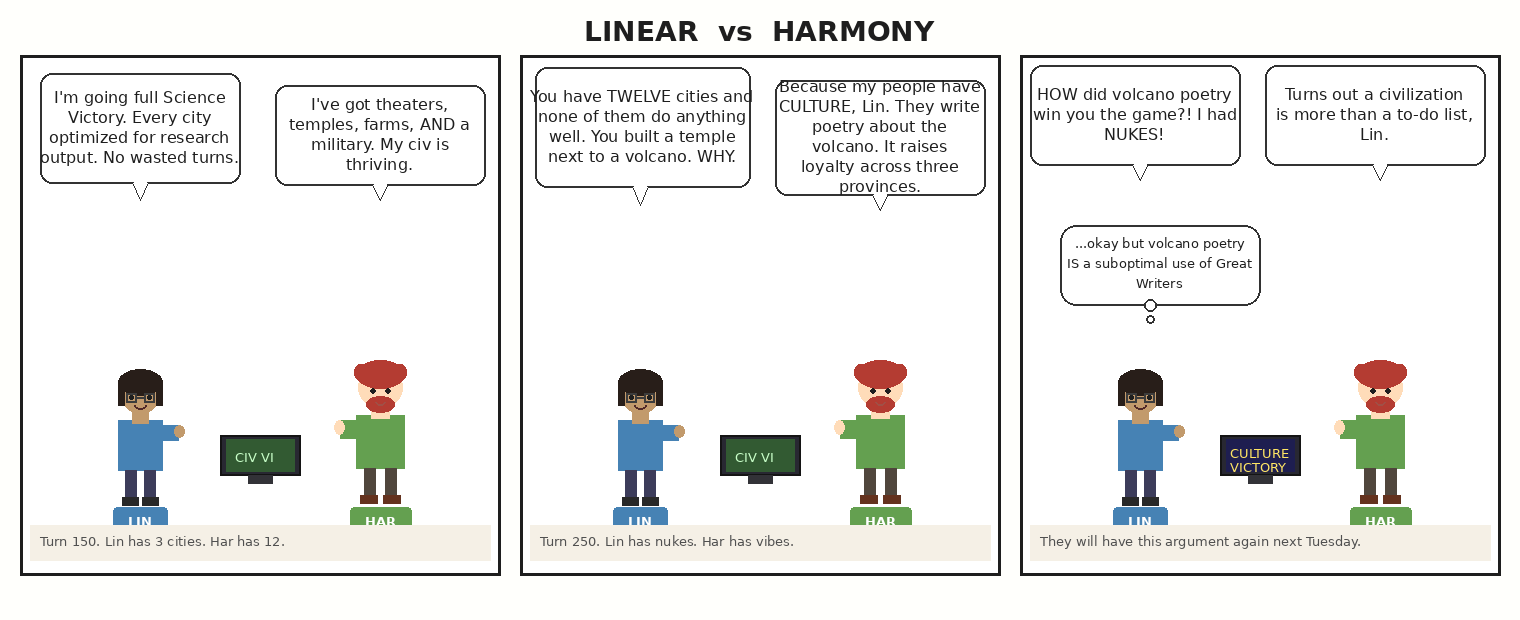
* * *
Imagine you’re running a small town. You’ve got a limited budget, and the town council is meeting tonight to decide where to spend it. Someone proposes building a public library. Someone else says no, spend it on road repair, because the potholes are destroying people’s cars and that’s costing the local economy real money. A third person wants a park.
If you’re thinking in Linear mode, the process is clean. You define your goal (“maximize economic output” or “maximize quality of life” or whatever you’ve agreed on), you estimate the return-on-investment for each option, and you pick the winner. The library might increase educational attainment by some percentage. The roads have a calculable cost savings. The park has measurable health benefits. You do the math. You pick the best one. If you’re very sophisticated, you adjust for diminishing returns and second-order effects. But the structure is always the same: one goal, ranked options, pick the top.
This is genuinely powerful. It’s how we got to the moon. It’s how businesses that survive the first five years tend to operate. It’s what every good project manager does, and every military strategist, and every person who has ever successfully lost weight by tracking calories instead of relying on vibes.
Now imagine someone at that same town council meeting says: “I don’t think we should pick one. I think the library, the roads, and the park are all part of the same thing. Educated kids grow up to be the engineers who fix the roads. People who walk in the park are healthier, so they use fewer medical resources, so there’s more money for everything else. And people who live in a town with a library and a park and good roads feel a kind of pride that makes them volunteer and invest and stick around instead of moving to the city. These aren’t competing options. They’re organs in the same body.”
That person is thinking in Harmony mode.
One way to think about the difference: Linear thinking treats values as commensurable. You can convert them to a common unit (usually dollars or “utils” or QALYs or some other metric) and compare them directly. Harmony thinking treats values as incommensurable but interdependent. You can’t really rank art against food against knowledge, but you can notice that they nourish each other, and that a society which guts any one of them starts to wither in the others.
This sounds abstract, so let me make it concrete.
Think about what it means to be a healthy person. Not healthy as in “good cardiovascular numbers,” but healthy as in flourishing. You probably want to be physically fit, intellectually stimulated, emotionally connected to people you love, doing work that matters to you, and experiencing some beauty and play and rest. Now: which of those is the real goal, and which are just instrumental steps toward it?
A strict Linear thinker has to pick one. Maybe it’s happiness (the utilitarian answer). So exercise is good because it makes you happy, relationships are good because they make you happy, meaningful work is good because it makes you happy. Everything is a means to the single end.
But most people, if they sit with this for a minute, find that framing weirdly reductive. You don’t love your children because it makes you happy. Or rather, the happiness you get from loving your children isn’t separable from the love itself. The love isn’t an instrument. It’s a dimension. A Harmony thinker would say you’re trying to grow the total volume of your life across many dimensions at once, and the dimensions feed each other. Being physically healthy makes you a better parent. Being a good parent gives you purpose that sustains you through hard workouts. None of this is circular; it’s architectural.
The rationalist community (which you may know from blogs like Slate Star Codex or LessWrong) has a word for the Linear skill: “decoupling.” Decoupling means being able to evaluate a claim on its own merits without dragging in associated concerns. Can you discuss a policy proposal without mentioning who proposed it? Can you analyze the effectiveness of a charity without letting your feelings about the cause overwhelm the numbers? Decoupling is treated in those spaces as basically synonymous with clear thinking, and its opposite (bringing in context, associations, feelings about the bigger picture) is treated as a cognitive bias to be overcome.
And decoupling is genuinely useful. Our brains are sloppy associative machines. We think “his father was a great doctor, so he’ll be a great doctor.” We judge policies by whether we like the politician. We let our anger at injustice steer us toward solutions that feel righteous but don’t work. The discipline of decoupling, of saying “show me the evidence for this specific step,” is one of humanity’s great cognitive inventions.
But notice what decoupling can’t do.
It can’t tell you why art matters.
Imagine (I’m stealing this thought experiment from the Exploring Egregores blog, which you should read) that a town must choose between funding a theater and funding a soup kitchen. A Linear thinker has two options. Option one: art is a terminal value, something good in itself, full stop. But if you say that, then anyone who doesn’t share that terminal value can just shrug and say “I don’t value art intrinsically, give me the soup kitchen.” You can’t argue someone into sharing your terminal values in a Linear framework. You just have them or you don’t. Option two: art is instrumentally valuable. Studies show it improves creativity, empathy, math scores, whatever. But if that’s your argument, then you have to actually do the math, and the math almost never favors an avant-garde theater over direct economic investment. Once you reduce art to its measurable outputs, art loses, every single time.
So why do civilizations keep building theaters?
Because they’re not doing the math. They’re growing an organism. The theater is one organ. It feeds the others. The culture it generates makes people want to live in the town, which grows the tax base, which funds the soup kitchen. The soup kitchen keeps people alive who might produce the next great playwright. The whole thing is a living system, and you can’t remove parts of it without damaging parts you didn’t expect.
This, by the way, is why killing someone feels so much worse than failing to create a new person. In a Linear framework, this is actually a puzzle. If human life has value X, then killing someone is negative X and creating someone is positive X, and they should roughly cancel out. But they obviously don’t, and everyone knows they don’t. Because a person who exists is woven into a web of relationships and dependencies and mutual nourishment. Removing them tears the web. Adding a new person doesn’t rewire the web in the same way. You’re not dealing with a ledger. You’re dealing with an ecology.
And once you have this lens, something clicks about political arguments that previously looked like pure hypocrisy.
Consider: the anti-abortion movement says abortion is murder. Okay. Murder is bad. So the obvious Linear response is to fund contraception massively, because preventing unwanted pregnancies prevents abortions, and that’s the most efficient path to fewer dead fetuses. But the anti-abortion movement does not, by and large, endorse that. A Linear thinker sees this and concludes they must be lying about their real goals. They say it’s about fetuses, but it’s really about controlling women. Case closed.
Except it makes perfect sense from a Harmony perspective. The conservative project isn’t optimizing for one variable. It’s cultivating a particular vision of a morally coherent society (chaste, charitable, self-disciplined, etc.) and opposition to abortion is one organ in that body. Flooding the world with free condoms solves the narrow problem but damages the larger organism they’re building. They’re not being hypocrites. They’re being gardeners. They’re just very bad at explaining this, because the only moral vocabulary our culture gives them is Linear.
You can run the same move on the left. Climate activists say carbon emissions will destroy the earth. Nuclear power would massively cut carbon emissions. Many climate activists oppose nuclear power. Are they lying? Or do they actually want to shrink the footprint of industrial capitalism as a whole, not just swap one energy source for another? The climate isn’t a number to them. It’s part of an ecology of values (humility, sustainability, local community) that nuclear megaprojects don’t fit into.
I am not endorsing either of those positions. I’m pointing out that once you learn to see Harmony reasoning, you’ll find it running in the background of basically everyone’s brain, including your own. Every time you catch your political opponents being “hypocritical” (they claim to want X but won’t do the most efficient thing to achieve X!) you have almost certainly found a case where their real mode of thought is Harmony, and you’re attacking them with Linear tools.
This applies to you, too. It’s not a weapon. It’s a mirror.
Now, I want to be careful here, because I’m not trying to do the thing where one side of the binary is the real answer. Linear thinking is not a mistake. It is the single most powerful planning tool our species has ever developed. When you genuinely need to accomplish a specific objective (win a battle, cure a disease, build a bridge), you want every step justified and every resource allocated efficiently. Harmony-oriented organizations have a characteristic failure mode: they try to serve every value at once, refuse to prioritize, and end up with well-intentioned mush. They build community centers with a meditation room, a co-working space, a childcare facility, a maker lab, and a performance venue, and none of these rooms are quite adequate for their purpose, and the building costs twice what it should. Everything is a half-measure that honors every constituency and accomplishes nothing.
I have been to these buildings. There is always a kombucha station.
But Linear thinking has its own pathology, and it’s arguably more dangerous because it’s harder to see. Linear pathology is: you get so good at optimizing for your chosen metric that you destroy everything the metric was supposed to be measuring. A hospital optimizes for “patient throughput” and becomes a place where nobody is actually cared for. A school optimizes for test scores and produces students who can pass tests but can’t think. A company optimizes for quarterly earnings and hollows itself out until there’s nothing left to earn from. This is the thing the rationalists call Goodhart’s Law (“when a measure becomes a target, it ceases to be a good measure”), and it’s interesting that the rationalist community, which is largely Linear in its orientation, discovered and named this failure mode of Linear thinking without quite connecting it to the broader pattern.
There’s a deep-cut example from game design that illustrates this beautifully, if you’ll forgive me going full nerd for a moment. In the original Ultima IV: Quest of the Avatar (1985), designer Richard Garriott did something that confused the entire gaming industry. After three games where the goal was to kill the bad guy, he made a game where there was no bad guy. The goal was to become a virtuous person by embodying eight virtues: honesty, compassion, valor, justice, sacrifice, honor, spirituality, and humility. You couldn’t max out one virtue and ignore the others. The game required you to develop all eight in balance. If you were incredibly brave but never showed compassion, you couldn’t win. If you were honest to the point of cruelty, the game noticed.
What Garriott had built (whether he knew it or not) was a Harmony moral system inside a medium that overwhelmingly runs on Linear logic. Games are usually pure optimization: maximize DPS, minimize time-to-kill, find the dominant strategy. Ultima IV said: no, the point is to grow into a rounded person, and the virtues are interdependent. It was the best-selling game of 1985. Players found it weirdly moving. Some of them literally changed how they behaved in real life. And no major game has successfully replicated its design since, because the gaming industry is structurally Linear: it measures engagement, retention, and monetization, and a game about becoming well-rounded doesn’t optimize for any of those.
Which is itself a pretty good illustration of the whole problem.
Let me put it a different way. You probably know people who are relentlessly optimizing some aspect of their life. Maybe they’re grinding through a brutal career path to maximize income. Maybe they’re obsessively tracking macros and gym stats. And you might notice that these people are often, paradoxically, kind of miserable, or at least one-dimensional in a way that makes you uneasy. Not because optimization is bad, but because they’ve gotten so locked into a single axis of growth that the other dimensions of their life have atrophied. Their relationships are thin. They haven’t read a book for fun in years. They can’t sit still.
And you probably also know people who are so committed to “balance” and “holistic living” that they never actually accomplish anything. They do a little yoga, a little painting, a little volunteering, a little meditation, and somehow at the end of the year nothing in their life has materially changed. They’re well-rounded in the way that a marble is well-rounded: smooth, featureless, rolling wherever gravity takes them.
These are the pathologies. The Linear person who has forgotten that life is multidimensional. The Harmony person who has forgotten that sometimes you actually need to focus.
What’s sneaky about this binary is how it operates in moral and political arguments without anyone naming it. When someone says “you claim to care about X, but you won’t do Y, which is the most efficient way to achieve X,” they are applying Linear logic. And their target almost always has a response that makes sense (they’re nurturing an organic whole, not optimizing a single variable), but that response sounds like a dodge in Linear terms, because it doesn’t point to a specific measurable outcome. So the accuser concludes their target is a hypocrite, and the target concludes the accuser is a sociopath who wants to reduce everything beautiful to a spreadsheet, and they both walk away feeling righteous.
This happens constantly. It is maybe the single most common structure of political misunderstanding in the developed world.
Most of our formal moral philosophy is Linear. Utilitarianism says: maximize well-being. Deontology says: follow the rules. In both cases, you have a clearly defined objective and the question is just how to reach it. The one major tradition that operates in Harmony mode is virtue ethics, which says: the goal is not to maximize anything or follow any rule, but to become a certain kind of person (courageous, just, temperate, wise) and all the virtues are interdependent. You can’t be truly brave without also being wise, because bravery without wisdom is recklessness. You can’t be just without also being compassionate, because justice without compassion is cruelty. Aristotle called this eudaimonia, and it’s often translated as “happiness,” but it really means something closer to “flourishing,” which is a Harmony concept if there ever was one.
It’s probably not an accident that virtue ethics was the dominant moral framework in every major civilization for thousands of years, and that utilitarianism and deontology (the Linear systems) only rose to prominence in the modern period, alongside industrialization and the scientific revolution. When you start measuring things precisely, Linear thinking becomes intoxicating. It works. It builds railroads and cures polio. The temptation to apply it to everything, including questions it can’t answer, is almost irresistible.
A few more examples, because I promised them and because they illustrate the breadth of this thing:
- Parenting. A Linear parent tracks developmental milestones, enrolls kids in the highest-rated schools, and optimizes extracurriculars for college applications. A Harmony parent tries to raise a kid who is kind, curious, healthy, and loved, and trusts that those qualities will produce good outcomes without needing to be aimed at any one of them specifically. Most actual parents do both, and the switch between these modes is so constant that it’s invisible until someone points it out.
- Urban planning. Linear cities are zoned: residential here, commercial there, industrial over there, and everyone commutes between them on highways designed to maximize traffic flow. Harmony cities are mixed-use: the bakery is below the apartment, the school is next to the park, the workshop is around the corner, and human life flows through a neighborhood that wasn’t designed to optimize any single function but somehow works better than the one that was. (Jane Jacobs was a Harmony thinker, and Robert Moses was a Linear one, and the decades-long war between their visions shaped every American city.)
- Language learning. The Linear approach is Duolingo: track your streak, hit your XP target, master grammar rules in sequence. The Harmony approach is immersion: go live in the country, stumble through conversations, absorb the culture, make embarrassing mistakes, and wake up one day thinking in the language. Both work. Immersion works better for fluency, but Duolingo works better for people who need structure to do anything at all.
- Cooking. Linear cooking is precise: measure 237ml of stock, heat to exactly 82°C, sear for 90 seconds per side. It’s how professional kitchens operate, and it produces reliable results. Harmony cooking is “a splash of this, a handful of that, taste as you go, adjust for what the ingredients are doing today.” It’s how grandmothers cook, and it produces food that is (frequently) better, but only after decades of accumulated intuition that can’t be written down.
- Ecosystem management. A Linear approach to forest management says: this forest exists to produce timber, so plant fast-growing species in rows, harvest on a 30-year cycle, replant. A Harmony approach says: a forest is an organism with fungi, insects, birds, understory plants, soil bacteria, and water cycles that all sustain each other, and if you optimize for timber you will eventually have neither timber nor forest. The German forestry service learned this the hard way in the 19th century, when their perfectly optimized monoculture plantations started dying for reasons they couldn’t explain until they realized they had destroyed the soil ecology that made the trees possible.
The German forestry example is worth dwelling on, because it’s the purest illustration of what happens when Linear thinking encounters a system that operates in Harmony. They did everything right, by their own metrics. The trees grew fast. The harvests were predictable. The spreadsheets looked great. And then the second generation of trees was weaker, and the third weaker still, and eventually the whole system collapsed, because a forest isn’t a tree farm. It’s a web of relationships between thousands of organisms, and you can extract from it for a while by pretending it’s a machine, but the machine model was always a fiction, and eventually the fiction breaks down.
The metaphor generalizes uncomfortably well.
And this is maybe the deepest thing about this binary: it’s not just a disagreement about strategy. It’s a disagreement about what kind of thing you are looking at. The Linear thinker sees a system as a machine, with parts that can be isolated, measured, and optimized independently. The Harmony thinker sees a system as an organism, where the parts are so interconnected that isolating any one of them changes what it is. Both of these are models. Neither is “the truth.” But they lead to very different actions, and very different mistakes, and the ability to switch between them consciously, rather than being trapped in whichever one feels natural, is (I think) one of the most useful cognitive skills a person can develop.
Because you already use both. Everyone does. You just probably haven’t noticed the switching.
You think Linearly when you make a grocery list, plan a project timeline, or argue that a policy won’t achieve its stated aims. You think in Harmony when you choose a neighborhood to live in (not optimizing for any single feature but trying to find a place where everything just works together), when you cook by taste rather than by recipe, or when you feel, without quite being able to articulate why, that a community that sacrificed its library to build a bigger parking lot made a terrible trade even though the cost-benefit numbers said otherwise.
The goal is not to resolve the tension. The goal is to be a person who can feel the tension and use it.
There is an old argument, older than any philosophy department, older than writing, that goes something like this: the world is a fire, and the fire consumes, and the task of a living thing is to burn in one direction long enough and hot enough to leave a mark. Prometheus stealing fire, Icarus reaching for the sun, every quest narrative, every startup pitch deck. A creature with a will selects a target and hurls itself forward, and the measure of that creature is the distance it covers before it falls. This is the argument for the line. It is very old and very compelling and it built every road you have ever walked on.
But there is another argument, equally old, that says: before the fire there was the garden.
Not a garden in the sentimental English sense (manicured, bounded, decorative) but the garden as ecology, as the original condition of entanglement, the state in which nothing exists except in relation to everything else. The mycorrhizal web beneath the forest floor that feeds trees through fungi through bacteria through root systems so interwoven that the question “where does one organism end and another begin” has no answer, because the question assumes a separateness that does not exist. This is not a metaphor. This is what soil actually is. The garden is not an idea about the world. The garden is the world, before we started drawing lines through it.
And the lines are useful. The lines are the most useful thing we have ever drawn. Aristotle’s categories, Euclid’s axioms, the walls of the first granary, the borders of the first field: all of these are acts of separation, of decoupling, of saying “this is not that” so that we can reason about each in isolation. Language itself is a line-drawing technology (every word is a boundary imposed on the continuous blur of experience) and without it we would still be clever animals nosing through the underbrush. The line gave us medicine, mathematics, law, engineering, agriculture, and every other achievement that required someone to say “I am going to focus on this one thing and ignore everything else until I understand it.” To denigrate the line is to denigrate thought itself, and anyone who tells you Linear thinking is merely reductive has never tried to build a bridge.
But.
The garden was there first, and will be there after. Every line you draw is drawn through something that was, before you drew it, whole. The act of analysis (from the Greek analusis, “a loosening, an undoing”) is always an act of cutting, and what you cut does not come back together the same way once you are done examining the pieces. The Cartesian move of separating mind from body, subject from object, fact from value, gave us modern science and also the particular modern misery of feeling like a ghost piloting a meat robot through a world drained of meaning. These are not unrelated outcomes. They are the same outcome, viewed from different angles.
Robert Burton, writing in 1621, described melancholy as a disease of people who had gotten too good at thinking about parts and had forgotten the whole. Adorno and Horkheimer, three centuries later, said much the same thing in more impenetrable prose: that the Enlightenment, which was supposed to free us from myth, had itself become a myth, the myth of the separable, the quantifiable, the controllable, and that this myth was eating the world. You can dismiss these as the complaints of people who were bad at math. Maybe they were. But the German forestry service was very good at math, and the forest died anyway.
What I am trying to say (and the trying is the point, because this is not the kind of thing that can be simply said) is that you are already both of these things, and the question is not which one is correct but whether you can hold them simultaneously without one collapsing into the other. The fire and the garden. The road and the web. The will that selects a direction and the wisdom that knows a direction is always a simplification of the territory it moves through. You need the line to act and the circle to understand what your action is doing to the world you act upon, and you need both of these at the same time, which is difficult, which is in fact the central difficulty of being a conscious creature in a world that is always more entangled than your models of it.
The saw and the hammer. The fire and the ice. The straight road and the garden underneath it, roots cracking through asphalt, always, slowly, reaching for each other in the dark.
Further Reading
- Exploring Egregores: Gaia The original essay on Gaia as the egregore of organic, multi-dimensional value; introduces Harmony as an alternative to utilitarian and deontological moral systems.
- The Gradient: Virtue Ethics and AI Alignment An argument that AI alignment might benefit from virtue ethics (a Harmony framework) rather than the Linear approaches that currently dominate the field.
Thursday we’ll have the second of our Big Three: Agency vs… something?
THE GARDEN QUESTION
A Linear vs. Harmony Dialogue
YOSELIN: I’ve drawn up the planting grid for the community garden. Forty raised beds. Tomatoes.
DINAH: All forty?
YOSELIN: All forty. Roma variety, specifically. I’ve run the soil composition analysis three times. Our pH is 6.2, our nitrogen is adequate, our sun exposure peaks at six point four hours on the south beds and drops to five point one on the north. Romas are the highest-yield cultivar for these exact conditions. We will have so many tomatoes.
DINAH: But I wanted herbs.
YOSELIN: You wanted — I’m sorry, what?
DINAH: Herbs! And maybe some squash. Oh, and Kamella mentioned sunflowers for the pollinators, and I saw this incredible thing about companion planting where you put marigolds next to the—
YOSELIN: Stop. Stop stop stop. You’re describing a garden of vibes.
DINAH: I’m describing a garden of everything! That’s what a garden is!
YOSELIN: A garden is a biological production system with quantifiable inputs and outputs. I have a spreadsheet. Would you like to see the spreadsheet?
DINAH: I would rather eat glass.
YOSELIN: The spreadsheet has color coding.
PELLEGRIN: (not looking up from his book) I couldn’t help but overhear.
YOSELIN: We didn’t ask you, Pellegrin.
PELLEGRIN: You never do. Yet here I am, the conscience of precision. Yoselin, your tomato monoculture is mathematically defensible but ecologically fragile. One blight and you’ve lost everything. Dinah, your “plant everything” approach is emotionally satisfying but spatially incoherent. You’re both wrong, which is the usual state of applied disciplines.
YOSELIN: Did you just call horticulture an “applied discipline” like it’s beneath you?
PELLEGRIN: I call everything an applied discipline. It’s beneath everything.
DINAH: Look, all I’m saying is the garden should feel like something. When you walk through it, there should be different colors, different smells — the basil near the tomatoes because they grow better together AND because it smells incredible, and the sunflowers making the whole thing look like a painting, and people want to sit there and talk to each other—
YOSELIN: None of those are measurable outcomes, Dinah.
DINAH: Measurable outcomes! We’re growing zucchini, not launching a satellite!
YOSELIN: The principles are identical.
DINAH: They are not identical!
YOSELIN: Step one: define your terminal goal. Step two: identify the optimal path. Step three: execute without distraction. Whether it’s a rocket or a radish, the method doesn’t change.
DINAH: Okay but what IS the terminal goal? You’re saying “maximum tomato yield.” I’m saying the goal is the whole experience — the beauty, the community, the food, the learning, the pollinators, the kids who come and see where vegetables actually come from—
YOSELIN: That’s not a goal, that’s a mood board.
PELLEGRIN: She’s describing an organism with multiple interdependent values, Yoselin. It’s not rigorous, but it’s not nothing.
DINAH: Thank you!
PELLEGRIN: I said it’s not nothing. That is the floor of my compliments.
YOSELIN: Fine. Fine! Let’s say we do your magical interconnected wondergarden. How do we decide what goes where? What’s the actual plan?
DINAH: We plant things that support each other! The three sisters — corn, beans, and squash — the beans fix nitrogen for the corn, the corn gives the beans something to climb, the squash leaves shade the soil so it retains moisture. It’s a whole system!
YOSELIN: And what is the caloric output per square meter compared to optimized tomato rows?
DINAH: I DON’T CARE ABOUT CALORIES PER SQUARE METER.
YOSELIN: SOMEONE HAS TO.
PELLEGRIN: (turning a page) You’re having the same argument as every civilization in history, you realize. Whether to optimize for the one thing that demonstrably works, or to cultivate the interconnected whole that makes life worth the optimization. The answer is that linear thinking wins every war and harmony thinking is why you wanted to survive the war in the first place.
DINAH: …
YOSELIN: …
DINAH: That was actually kind of beautiful, Pellegrin.
PELLEGRIN: It’s a trivial observation dressed in a metaphor. Don’t mistake ornamentation for depth.
YOSELIN: So what do YOU think we should plant?
PELLEGRIN: I think the question of what to plant is beneath me. But if forced, I would note that a garden optimized purely for tomato yield is not a garden. It’s a farm. And nobody asked for a farm.
YOSELIN: We didn’t ask for a philosophy lecture either, and yet.
DINAH: Here’s what we’re going to do. Twenty beds of tomatoes—
YOSELIN: Forty.
DINAH: TWENTY. And then ten beds of mixed herbs and companion plantings, five beds for the kids’ experimental plots, three beds of flowers for pollinators, and two beds where we just see what happens.
YOSELIN: “See what happens” is not a horticultural strategy.
DINAH: It’s EXACTLY a horticultural strategy! Half of what we know about plants we learned because someone said “huh, weird, let’s see what happens.”
YOSELIN: I want it on the record that any bed designated “see what happens” is not my responsibility when it turns into a weed apocalypse.
DINAH: Noted!
PELLEGRIN: I’ll take one of the experimental beds.
YOSELIN: You? You’ve never gardened in your life.
PELLEGRIN: I want to grow something and observe it fail. There’s a purity in watching entropy act on a system you’ve invested care into. It’s the closest thing to honest theology.
YOSELIN: You want to grow a plant… so you can watch it die… for math reasons.
PELLEGRIN: For beauty reasons. Which are math reasons. They’re the same thing.
DINAH: I am BEGGING both of you to be normal about vegetables.
The garden, when it was finally planted, produced an unreasonable quantity of tomatoes (Yoselin), a chaotic but fragrant herb spiral that became everyone’s favorite reading spot (Dinah), and a single experimental bed containing one perfectly spherical cactus that Pellegrin watered exactly once and then contemplated for the rest of the season, calling it “the most honest plant in the garden.” No one knew what he meant. He did not elaborate.
 Alt Binaries
Leave a comment